Kidy
Kidy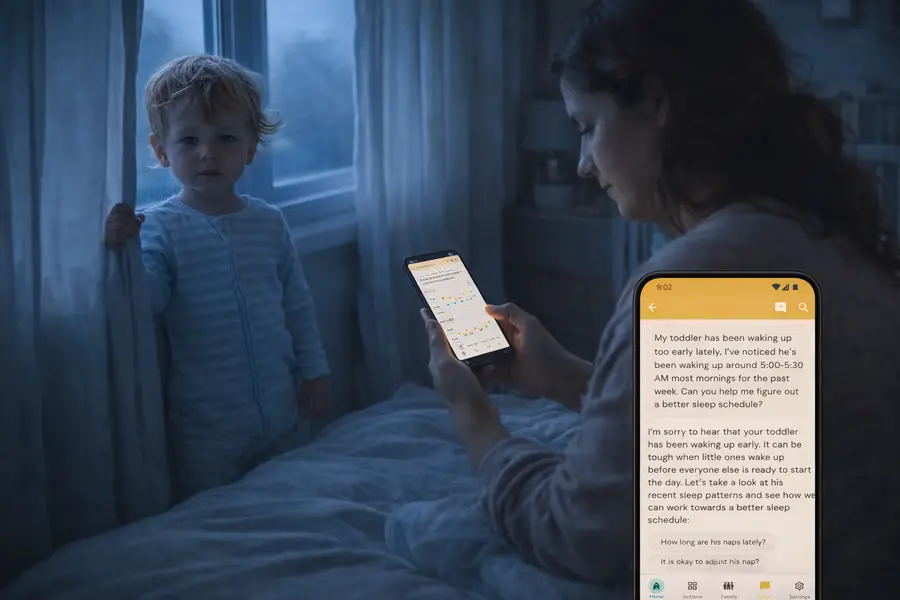
If your child wakes at 5:30 am no matter what you try, the problem usually isn't the change you picked. It's that you are testing changes blind, one bad morning at a time.
- Log nap end, bedtime, and morning wake for 5–7 days. That is enough for a first pattern.
- Read the Daily Brief for the variable most correlated with early wakes
- Change one thing for 5–7 nights and watch the trend, not single mornings
- Keep the 5:30 to 6:30 window dim, quiet, and boring. Bright plus fed equals a trained morning.
- Watch the rest of the day too, because late naps and overstimulation both leak into the morning
⏰ Check the timing first: enter your baby's age in the wake windows calculator and see how long they can comfortably stay awake between sleeps.
Early wakes resist fixing because you change three things at once after a bad morning. KidyGrow surfaces the dominant signal in the Daily Brief, so you test one lever and can actually tell what worked.
Quick Reference: typical morning wake by age
| Age | Typical wake time | Total night sleep | Common cause of early wake |
|---|---|---|---|
| 3–6 months | 06:00–07:00 | 10–12 h | Hunger, short last sleep cycle |
| 6–9 months | 06:00–07:00 | 10–12 h | Late last nap, regression |
| 9–12 months | 06:00–07:00 | 11–12 h | Wake window before bed too short |
| 12–18 months | 06:00–07:30 | 11–12 h | Nap ending past 16:00, room light |
| 18 months–3 years | 06:30–07:30 | 10–12 h | Reinforced 5:30 routine, dropped nap pressure |
Source: AAP healthy sleep ranges. KidyGrow uses your child's actual logs to land on a number inside this band, and sometimes outside it. Averages are the starting line, not the answer.
Why early waking is hard to fix alone
You try a later bedtime. Doesn't work. You try an earlier bedtime. Still 5:30. You search "5:30 wake-up" and get 47 conflicting theories, half of them contradicting the other half in the same forum thread.
The issue is that you're testing changes without the full picture across days. Maybe the real variable is nap end time, not bedtime. Maybe it's room light at 6:00. Maybe it's what happens at 5:30 that keeps reinforcing the wake. Early waking is rarely one isolated habit. It tangles with nap timing, regressions, and how the schedule shifts as your child grows, and our full guide to baby and toddler sleep walks through how those pieces fit together across the first two years.
There is a particular flavor of 5:30 despair that nobody writes about. The house is cold, the hallway light is too bright to turn on, and you stand there doing the arithmetic on how many hours you actually got. Four and a bit. You decide today is the day you fix this, which is roughly how the three-changes-at-once mistake gets made every single time.
The American Academy of Pediatrics confirms infants 4–12 months need 12–16 hours of total sleep including naps, and toddlers 1–2 years need 11–14 hours (AAP, 2016). When morning wake creeps earlier and the total drops below those ranges, the rest of the day gets harder too: a short fuse by mid-morning, a cranky witching hour, a fight at bedtime.
Morning wake is a downstream signal of the previous 24 hours, and KidyGrow is built around that. The Daily Brief reads the last nap end, the wake window before bed, the morning response, and recent room and light notes, then surfaces the one lever most worth testing.
The 4 hidden causes of early wake-ups
1. Last nap ended too late. A nap ending past 16:00 for under-2s eats into evening sleep pressure, and the catch is that it often shows up the next morning as an early wake rather than as a hard bedtime. KidyGrow flags this in your Daily Brief once the pattern repeats across three or more days. See why bedtime spirals into chaos for the same logic on the evening side.
2. Bedtime is wrong, in either direction. Too early creates a split-night wake at 5:00. Too late creates an overtired wake at 5:30 driven by cortisol. The clue is consistency. If your child wakes at the same time every morning regardless of bedtime, the cause is rarely bedtime; it is environmental or routine-trained. See signs your baby is overtired for the cortisol-spike pattern.
3. The room leaks light or sound at 5:30. Sunrise creeps earlier in spring, the heating clicks on at 5:15, a sibling's alarm goes at 5:45. These shift the trigger without you noticing. Blackout and white noise cover most of it, but you have to verify with your phone's light meter at 5:30. Don't assume.
4. The 5:30 to 6:30 window has been trained as "morning." Turn on lights, offer milk, and start the day at 5:30, and the body learns that this is morning. Within about two weeks it anticipates the routine and wakes ready for it. NHS guidance specifies a calm and drowsy handover with predictable cues (NHS, 2024), and that applies to mornings, not just bedtime.
Step-by-step: using KidyGrow's pattern detection
Day 1–5: just log. Open the app and tap-log naps, bedtime, and morning wake. No advice yet. KidyGrow needs at least 3–5 days before the Daily Brief personalizes. For this specific problem, a free-text note on room light at 5:30 ("blackout fully on", "sliver under the door") is the highest-value thing you can add.
Day 6: read your first Daily Brief. It surfaces the dominant signal, for example "last 5 days, naps ended after 16:30 and morning wake averaged 5:38." That is the variable to test first. Not bedtime, not training, not blackout.
Day 7–13: test one change. If the Brief flags late naps, cap the last nap at 16:00 for a week. If it flags light, fix the blackout. If it flags the morning routine, hold the room dark and quiet until 6:30 even when your child fusses. Run it for 5–7 nights and log how it went with one tap: better, same, or worse. One change, one week, one measurable answer.
Week 3: hold the line or pivot. If wake time shifted later, repeat the change for another week to lock it in. The brain needs roughly 5–7 nights of the same cue to register predictability. If nothing moved, the Brief points you at the next lever, usually the second-most-correlated signal.
You almost never catch this on day two. You catch it when Saturday looks exactly like Wednesday, and the only thing both days share is a nap that ran to 16:50. Bedtime was never the problem. The 16:50 nap was.
Throughout: open the wake-too-early troubleshooting guide for the underlying logic of why the morning routine is often the hardest cause to admit.
Common mistakes parents make
- Changing three things at once after one bad morning, which guarantees you never learn which one helped
- Going in at 5:30 because you can't bear the fuss. Within two weeks, this becomes the wake time.
- Cutting the nap entirely to save the morning, which usually creates an overtired 5:00 wake instead
- Reaching for an earlier bedtime as the first move, when most early wakes in over-12-month-olds are not bedtime-driven
- Ignoring the room because "we already have blackout". Verify at 5:30. See why baby wakes up crying at night for related sensory triggers.
When to seek professional help
KidyGrow handles patterns and routines, not medical evaluation. Talk to your pediatrician if any of these apply:
- Loud snoring, mouth breathing, or visible pauses while sleeping (possible sleep apnea)
- Total daily sleep is consistently below the AAP minimum for the age, meaning under 11 hours at any age 0–2
- Early wake comes with pain signals: ear pulling, crying as soon as the eyes open, fever
- The pattern hasn't moved at all after 3 weeks of one consistent routine change
- A sudden shift from a later wake to a 5:00 wake with no obvious trigger. Illness, regression, and ear infection are all worth ruling out. See baby suddenly waking more at night.
The AASM practice parameter found that consistent behavioral routines improve infant sleep without harming attachment (Mindell et al., 2006, Sleep), which is exactly the kind of routine KidyGrow's pattern detection helps you build, one variable at a time.
Frequently asked questions
How long until KidyGrow's pattern is reliable for early wakes?
5–7 days of consistent logging is the minimum for early-wake patterns specifically. That is longer than the 3–5 day minimum for evening patterns, because morning correlations are noisier and depend on what happened up to 24 hours earlier. Confidence keeps growing for about three weeks, then plateaus.
My child wakes at 5:30 only on weekends. What's that?
Almost always environment or routine. Light, sibling noise, or the fact that on weekdays you start the day at 6:30 with school prep while on weekends you stay in bed and respond at 5:30. KidyGrow's Daily Brief separates weekday from weekend patterns once you have two or more weeks of data, which makes the signal obvious.
Should I cap the last nap to fix early wakes?
Sometimes. If KidyGrow flags late nap end as the top correlated signal across five or more days, try ending the last nap by 16:00 for a week. Don't cut nap length blindly, though. For under-2s an under-slept day creates an earlier wake the next morning, not a later one. See baby wakes after 30 minutes of nap for nap-quality issues.
Will it tell me to sleep-train?
No. KidyGrow surfaces the pattern and suggests routine adjustments. It doesn't recommend a specific sleep-training method, whether cry-it-out, Ferber, or no-cry. That choice is yours. If a method fits your family, the app helps you stay consistent with it.
What if nothing helps after a month?
Then the cause is likely outside the routine: medical, developmental, or environmental in a way blackout doesn't fix, such as street noise, a neighbour's schedule, or the heating system. KidyGrow's Daily Brief flags when the pattern doesn't respond to schedule changes, which is your cue to talk to a pediatrician or sleep specialist. See nothing helps toddler sleep for the broader troubleshooting checklist.
How KidyGrow helps you fix early wake-ups
Day one, the app is guessing like everyone else: "aim for a 3-hour wake window before bed." Day eight, once you have logged a week, it sounds different: "morning wake averaged 5:38 over the last 5 days, all on days the nap ended after 16:30. Cap the last nap at 16:00 for a week and re-check."
That shift is the whole product. Nobody running on four hours of sleep can hold two weeks of nap-end times in their head and spot that the bad mornings cluster on daycare days. The app remembers instead, so when you ask why she's up at 5:30 again, it already knows her age, that yesterday's nap ended at 16:45, and that you noted the room was dim but not fully blacked out. You don't re-explain.
It also refuses to over-claim. The Daily Brief shows trends across 5–14 days, so one bad Tuesday doesn't trigger five overcorrections by Friday, and a genuine 5-day trend gets the weight it deserves. If you want the mechanics of how the correlation is actually calculated, behind the scenes: how KidyGrow's AI learns walks through it.
Sometimes there is no pattern to find. Some months are teething and a house move and an unusually bright June, and the Brief will say it has nothing rather than invent a lever for you to pull.
The Daily Brief and Tonight plan are part of the paid tier. Free accounts can log and see basic patterns, which is enough to catch the obvious link between a late nap and an early wake.
What changes is smaller than a fix and more useful than a theory. You stop guessing at 5:30 in a cold hallway, because by then the question has already been answered.
Sources
- American Academy of Pediatrics, "Healthy Sleep Habits: How Many Hours Does Your Child Need?" (2016, updated 2022). https://www.healthychildren.org/English/healthy-living/sleep/Pages/Healthy-Sleep-Habits-How-Many-Hours-Does-Your-Child-Need.aspx
- NHS, "Helping your baby to sleep" (Start for Life, 2024). https://www.nhs.uk/conditions/baby/caring-for-a-newborn/helping-your-baby-to-sleep/
- Mindell JA et al., "Behavioral treatment of bedtime problems and night wakings in infants and young children", Sleep (2006). https://pubmed.ncbi.nlm.nih.gov/17068979/
_Educational content. Not a substitute for medical advice. Talk to your pediatrician if you have concerns about your child's sleep._