 Kidy
Kidy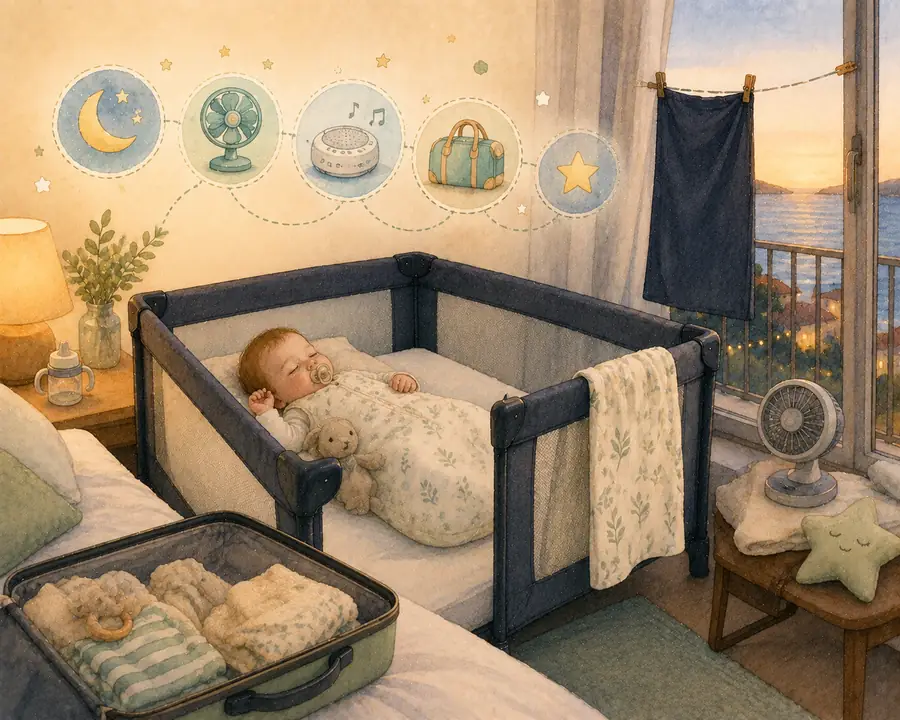
If your baby slept beautifully at home and then fell apart the first night on holiday, nothing is broken. Here is what is actually going on:
🌙 Map out the day: enter your baby's age in the sleep schedule calculator for naps and a bedtime that fit their rhythm.
- It's environmental, not developmental. A new room, heat, long summer evenings, and late nights disrupt sleep. This is not a true sleep regression and it usually settles in a few days.
- Heat is the biggest single disruptor. A hot room wakes a baby far more than an unfamiliar one. Keep the room cool, use single-layer sleepwear, and add a fan for airflow.
- Cues travel better than schedules. The same sleep sack, comforter, and white-noise sound rebuild "this is bedtime" anywhere.
- Protect one solid nap a day rather than chasing all of them, and keep roughly the usual wake windows.
Holiday sleep wobbles are one of the most common questions parents ask, right alongside teething and the dreaded 4-month stretch. The good news is that it follows rules, and once you know them you can stack the deck back in your favor.
Quick reference
| Problem on holiday | Why it happens | The fix that matters most |
|---|---|---|
| Won't settle in new room | Unfamiliar cot, light, sounds | Bring familiar cues + portable blackout |
| Wakes too early / too hot | Heat and long daylight | Cool room, fan, single layer, blackout |
| Skipping naps | Out all day, stimulation | Protect one solid nap, accept short ones |
| Late, wired bedtimes | Late dinners, long evenings | Same routine order, dim the light early |
| Rough back home | Sleep debt + reset | Return to normal room and routine at once |
Why holiday sleep falls apart
Sleep is a learned response to a familiar set of signals, and holidays scramble those signals all at once. The NHS describes how babies use consistent bedtime cues and a calm, dark environment to learn the difference between day and night. Take the baby out of that bedroom and you remove most of the cues in a single afternoon.
Then add the specifics of a summer trip. An unfamiliar cot that smells and feels different. A room that doesn't go properly dark until 9pm because the evenings are long. Heat, which the AAP and the CDC both flag as a sleep disruptor at every age. More noise, more new faces, more stimulation in a single day than a week at home. Naps skipped in the car or shifted by a late lunch. Sometimes a time-zone change on top of all of it.
None of this is a developmental regression. A regression is internal: a leap in development, a new skill, a teething wave. Holiday sleep disruption is external, and external problems have external fixes. That distinction matters, because it tells you what to do. You don't ride it out and wait for a brain to mature. You change the room.
What to pack: bring the bedtime, not just the cot
The single most useful thing you can do is make the new place feel familiar at sleep time. Pack the cues your baby already trusts.
- The same sleep sack or sleeping bag your baby uses at home, unwashed if you can manage it, so it smells right.
- The comforter or lovey if your baby has one, plus a spare in case it disappears under a hotel bed.
- White noise, the same sound, ideally an app or a small machine you already use at home. It also masks unfamiliar holiday noise: cicadas, a neighbour's terrace, the sea.
- Two or three of the usual bedtime books. The order of the routine is a cue all on its own.
- Portable blackout. A travel blackout blind that suckers onto the window is ideal. If you forget it, bin bags and tape, or kitchen foil pressed to a damp pane, do the job. It looks ridiculous. It works.
Then run the routine in the same order you do at home: bath or wash, pyjamas, books, feed, song, down. Same steps, same sequence, even if the room is wrong. The sequence is what your baby is actually reading. For a deeper look at why this works, see our guide to building a baby routine that sticks.
The room and the heat
If you fix one thing, fix the temperature. A baby who is too warm sleeps lightly, wakes often, and is harder to settle, and overheating is also a safety concern in its own right. Aim for a cool room. Open it up in the evening before bed, use a fan for both airflow and a steady hum, and dress your baby in a single light layer rather than the cosy setup that worked at home in spring.
Light is the second lever. Long summer evenings mean the sky is bright well past bedtime, and bright rooms suppress the sleepy signals a baby needs. Get the room as dark as you can with whatever blackout you brought. Darkness plus a cool room recovers most of what the unfamiliar surroundings took away.
A note on safe sleep, because a new place tempts shortcuts. Use a firm, flat travel cot. For babies under one, that means no pillows, no loose bedding, no bumpers and no soft extras, exactly as at home. Do not bed-share somewhere unfamiliar or unsafe, and a soft hotel bed or a sofa is exactly that. Keep your baby cool, not bundled. A new room is not a reason to relax the rules that keep sleep safe.
What to prioritise: protect the anchor, let the rest flex
You cannot run a perfect home schedule on holiday, so don't try. Decide what to protect and let everything else move.
- If you can protect only one thing, protect one solid nap. A real nap in the cot, blackout on, beats three broken twenty-minute catnaps in the carrier. An overtired baby sleeps worse at night, not better.
- If wake windows are drifting, nudge them back toward normal, not to the minute, but in the right ballpark, so your baby reaches bedtime tired but not wrecked. Our wake windows by age chart gives the usual ranges to aim for.
- If bedtime has to be late one night, let it be late, then protect the next morning and the next nap rather than compounding the deficit. One late beach dinner won't undo a routine. Five in a row might.
The aim isn't a flawless holiday schedule. It's a tired-enough, cool-enough, dark-enough baby with the right cues, most nights. That's enough.
Common mistakes
A few well-meant moves make holiday sleep worse, not better.
- Skipping all naps to "tire them out" for a big night. Overtired babies fight sleep harder and wake more. Tired and wrecked are different states.
- Letting the room stay hot and bright because you'll "only be here a week." Heat and light are precisely what's keeping your baby up.
- Inventing brand-new routines on the trip: a new lovey, a new song, rocking to sleep when you never did. You'll have to undo it later. Borrow from home, don't reinvent.
- Bed-sharing on a soft hotel bed or sofa out of exhaustion. Understandable, and still not safe for a baby under one.
- Panicking on night one or two. The first night in a new place is almost always the worst. Give it a few days before you conclude anything.
When it doesn't settle, and how to re-settle at home
Expect a few rough nights at the start of the trip and a few more once you're home. Most babies adjust within several days each way.
Come home and reset fast. Put your baby back in the normal room, the normal cot, the normal routine, the same evening you arrive if you can. Don't "ease back in" over a week. The fastest re-settle is an immediate return to the familiar setup, and most babies are back to baseline within several days. If your trip crossed time zones, shift toward home time straight away using daylight and meals as anchors, rather than splitting the difference. For the bigger picture on age-appropriate sleep needs, our baby sleep guide for 0 to 2 years and the age-by-age schedule both help you know what normal looks like to return to.
Most of the time this is just environment, and it passes. But call your pediatrician if sleep doesn't return to baseline after a week back home, or if the night waking comes with fever, ear-pulling, a rash, breathing changes, poor feeding, or unusual lethargy. Holiday brings new bugs as well as new rooms, and a baby who suddenly won't sleep may be telling you they are unwell rather than just unsettled.
Frequently asked questions
Is bad sleep on holiday a sleep regression?
Usually not. A true regression is driven by development, a new skill, or teething, and it follows your baby from room to room. Holiday disruption is environmental: new room, heat, light, late nights. Fix the environment and it lifts, typically within a few days.
How long does it take a baby to adjust to a new room?
Most babies take two to four nights to settle into an unfamiliar room, with the first night the hardest. Familiar sleep cues, a cool dark room, and the usual routine order all shorten the adjustment. If you've crossed time zones, allow a little longer.
How do I keep my baby cool enough to sleep on holiday?
Air the room out before bed, run a fan for airflow and gentle noise, and dress your baby in a single light layer. Skip heavy sleepwear and extra blankets. Heat is the biggest single reason babies sleep badly in summer, so a cool room solves most of it.
Should I keep naps or just go with the day?
Protect one solid nap a day if you can, ideally in the cot with blackout, and let the rest flex. An overtired baby sleeps worse at night, so chasing a fun day at the cost of all sleep usually backfires by the evening.
How do I get sleep back to normal after the trip?
Return to the normal room and routine immediately, the night you get home. Don't phase it in slowly. Most babies are back to baseline within several days once the familiar setup is fully restored.
How KidyGrow helps you
The limit first: no app gets your baby to sleep. What KidyGrow can do is hold the thread when you're too tired to.
You log naps and nights in a few taps, on the trip too. The app remembers them and shows your baby's sleep averages over the last 7 days. The Daily Brief and the Tonight plan take the last 24 hours into account, a skipped nap included, and adapt the suggestion to them.
Back home, the same logs show whether your baby has settled back to their own baseline or is still catching up. The app won't tie a bad night to a hot room. With the week in one place, you usually can.
Sources
- National Health Service (NHS). Helping your baby to sleep. https://www.nhs.uk/conditions/baby/caring-for-a-newborn/helping-your-baby-to-sleep/
- American Academy of Pediatrics (HealthyChildren.org). Healthy Sleep Habits: How Many Hours Does Your Child Need? https://www.healthychildren.org/English/healthy-living/sleep/Pages/healthy-sleep-habits-how-many-hours-does-your-child-need.aspx
- Centers for Disease Control and Prevention (CDC). About Sleep. https://www.cdc.gov/sleep/about/index.html