 Kidy
Kidy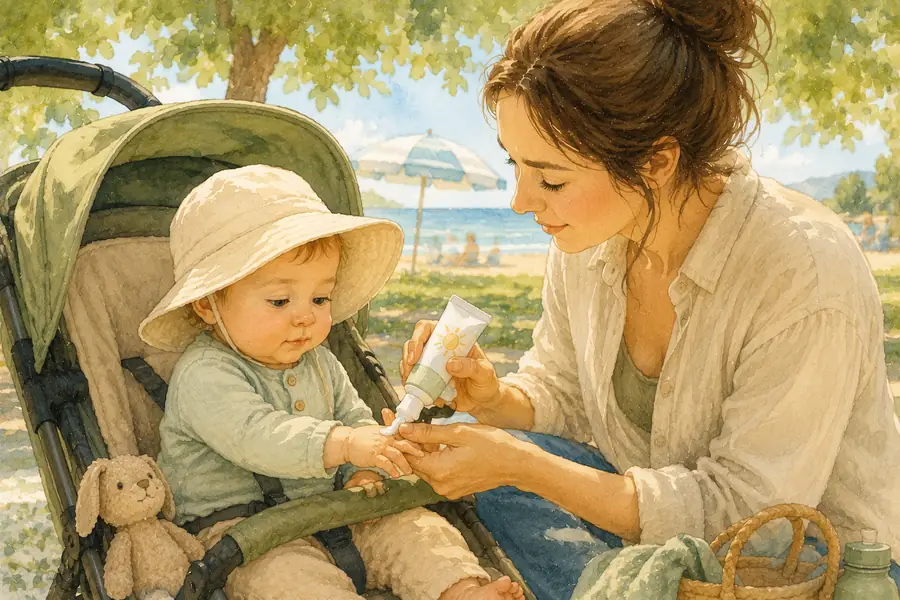
A baby's skin burns fast, and the redness often shows up hours after you're already home. Baby sunburn care and prevention comes down to a short list:
- Keep babies under 6 months in shade and covered clothing; sunscreen is a last resort, not the first line, for this age.
- For babies 6 months and older, use a broad-spectrum SPF 30+ on the small areas clothing can't cover.
- Treat a mild burn with cool compresses, fluids, and plain moisturizer; never with butter, ice, or numbing sprays.
- Call a doctor for any sunburn in a baby under 1 year, or for blistering, fever, lethargy, or signs of dehydration at any age.
The American Academy of Pediatrics (AAP) is clear that prevention beats treatment here, because there is no truly "safe" tan for a small child (HealthyChildren.org, AAP). This guide walks through both: how to stop the burn before it starts, and exactly what to do if it happens anyway.
Quick Reference: baby sunburn at a glance
| Question | Answer |
|---|---|
| Sunscreen under 6 months? | Avoid if possible; use shade + clothing. Small amounts of SPF 30+ on exposed areas only if shade isn't available (AAP) |
| Sunscreen 6 months+? | Yes, broad-spectrum SPF 30+, reapply every 2 hours |
| How long until a burn shows? | Redness peaks 6–24 hours after exposure |
| Treat a mild burn how? | Cool compress, fluids, fragrance-free moisturizer, child-dose pain relief if needed |
| Call the doctor when? | Any sunburn under 12 months; blisters, fever, lethargy, or dehydration at any age |
| When is it an emergency? | Limp, very hard to wake, no wet diapers, or sunburn plus high fever |
How do I prevent sunburn in a baby or toddler?
The strongest tool is the one parents reach for last: shade. The sun is most intense between roughly 10 a.m. and 4 p.m., so plan walks, naps in the stroller, and outdoor play around the edges of that window when you can. The Centers for Disease Control and Prevention (CDC) groups sun protection into shade, clothing, hats, sunglasses, and sunscreen, in that order of priority for the youngest kids (CDC Sun Safety).
Clothing does a lot of quiet work. A lightweight long-sleeve top, a wide-brimmed hat that covers the ears and neck, and a stroller canopy will block far more UV than a thin layer of lotion. Tightly woven fabrics protect better than loose-weave ones; if you can see daylight through it when held up, the sun gets through too.
For the parts you can't cover (the backs of hands, the tops of feet, a slice of cheek), sunscreen fills the gap.
Related: Our full guide to sun protection for babies and toddlers covers SPF choices, water-resistant formulas, and how much to actually apply.
Is sunscreen safe for babies under 6 months?
This is the question that trips up most new parents. The AAP's guidance: for babies younger than 6 months, keep them out of direct sun and rely on shade and clothing. When shade isn't available and a small area of skin (face, backs of hands) will be exposed, applying a minimal amount of broad-spectrum SPF 30+ is reasonable. So it's not a hard "never" - it's "last resort, small amount, only where you can't cover."
Why the caution? Young infants have a higher surface-area-to-body-weight ratio and thinner skin, so they absorb more of whatever goes on them. That's an argument for less product, not a sign that sunscreen is dangerous.
At 6 months and older, sunscreen moves to the front line. Choose broad-spectrum (UVA + UVB), SPF 30 or higher, and reapply every two hours and after swimming or heavy sweating. Mineral formulas with zinc oxide or titanium dioxide sit on top of the skin and tend to be gentler on sensitive baby skin than chemical filters.
One toddler at the pool can burn through a single morning even with sunscreen on, because nobody reapplied after the third trip down the slide. Reapplication is where most "but I put sunscreen on her" stories fall apart.
How do I treat a mild sunburn at home?
Most mild sunburns (pink, warm, tender, no blisters) can be managed at home in babies over a year and in toddlers. The goals are simple: cool the skin, replace fluids, and keep the area comfortable while it heals over the next few days.
- Cool it down. A cool (not ice-cold) bath or a damp cloth on the area for 10–15 minutes, several times a day, takes the heat out.
- Hydrate. Sunburned skin pulls fluid to the surface, so offer extra breast milk, formula, or water depending on age. Watch wet diapers.
- Moisturize. A plain, fragrance-free moisturizer or pure aloe vera gel soothes tight, dry skin. Apply while skin is still slightly damp.
- Comfort. For an older baby or toddler in real discomfort, ask your pediatrician about a weight-appropriate dose of acetaminophen or ibuprofen. The NHS notes paracetamol or ibuprofen can ease sunburn pain (NHS: Sunburn).
- Cover up. Keep healing skin out of the sun completely until it's no longer red and tender.
Loose cotton clothing over the burn reduces friction. Skip anything tight or synthetic against the sore area.
What should I never put on a baby's sunburn?
Old-school remedies do more harm than good on young skin:
- No butter, oils, or greasy ointments. They trap heat and can raise infection risk.
- No ice or ice packs directly on skin. Cool, yes; freezing, no. It can deepen the skin injury.
- No numbing sprays ending in "-caine" (benzocaine, lidocaine sprays) on babies and toddlers. They can irritate and, rarely, cause reactions.
- Don't pop blisters. If blisters form, leave them intact; broken blisters invite infection.
- Skip "after-sun" products with alcohol or heavy fragrance. They sting and dry already-stressed skin.
If a blister breaks on its own, keep it clean, cover loosely, and watch for spreading redness, warmth, or pus.
When should I call the doctor or go to the ER?
Here's the part to read twice. For the youngest babies, sunburn is never a "wait and see."
Call your doctor the same day if:
- The sunburned child is under 12 months old - any sunburn in an infant warrants a call.
- There is blistering, especially over a large area.
- Your child has a fever after sun exposure.
- The skin is very painful, or the burn covers a large part of the body.
Treat it as an emergency (call emergency services or go to the ER) if your child:
- Is unusually sleepy, limp, or very hard to wake (possible heatstroke alongside the burn).
- Shows signs of dehydration: no wet diaper for many hours, no tears when crying, a sunken soft spot, dry lips, or cool/clammy skin.
- Is confused, vomiting repeatedly, or has a very high temperature.
A sunburn rarely travels alone on a hot day. Heat exhaustion and heatstroke can ride along with it, which is why lethargy plus a burn is a louder warning than either by itself.
Related: Learn the warning signs in our guides to heat and dehydration in babies and heatstroke and heat exhaustion in children.
Decision logic: wait at home vs. call now
A quick if/then to cut through the panic:
- If the child is over 1 year, skin is pink and tender with no blisters, and they're drinking and playing normally → cool, hydrate, moisturize, monitor at home.
- If the child is under 1 year with any redness → call the pediatrician today, even if they seem fine.
- If you see blisters or fever → call today, any age.
- If you see lethargy, no wet diapers, or vomiting → emergency care now.
- If the burn looks the same or better after 24 hours and the child is comfortable → keep doing what you're doing.
Related: Not sure whether a fever counts? Our piece on fever and cough: when to monitor and when to call the doctor breaks down the thresholds by age.
Frequently asked questions
How long does a baby's sunburn take to heal?
A mild sunburn usually fades over 3 to 5 days, with peeling possible toward the end. Redness peaks 6 to 24 hours after sun exposure, so the burn often looks worse the evening after a beach day than it did at the time. If it's still bright red, painful, or blistering after a couple of days, check in with your pediatrician.
Can I use aloe vera on my baby's sunburn?
Pure aloe vera gel is generally soothing and safe for cooling mild sunburn on babies over a year and toddlers. Choose a product that's fragrance-free and free of added alcohol, which sting and dry the skin. Always patch-test a small area first, and skip aloe on broken skin or open blisters.
My baby got sunburned through the car window. Is that possible?
Yes. Standard car side windows block most UVB but let through significant UVA, which still contributes to skin damage over time. On long drives, use a stick-on shade or a UV-protective film on the window beside the car seat, and dress your baby in a light long sleeve.
Does a baby need sunscreen on a cloudy day?
Often, yes. Up to 80% of UV rays pass through clouds, so a hazy or overcast day can still burn delicate skin, especially near water or sand that reflects light. For babies 6 months and up, apply sunscreen on exposed areas even when it doesn't feel sunny.
Is one bad sunburn in infancy really a big deal?
It can matter long term. Research links blistering sunburns in childhood to higher skin-cancer risk later in life, which is why pediatric guidance treats prevention so seriously. The good news is that consistent shade, clothing, and sunscreen habits dramatically lower that lifetime risk.
How KidyGrow helps you keep summer days safer
Hot-weather parenting is a stack of small decisions made while you're already tired: Did she drink enough? Was that her second nap or her third meltdown? Has the sunscreen been reapplied since lunch? Most of it slips away by evening.
KidyGrow holds that thread for you. Over a week or two of warm days, the app remembers what an exhausted parent can't track in real time. Log a beach afternoon, a short fluid intake, and a rough evening, and by the second week the daily brief might say something like: "Your last two cranky evenings followed afternoons with low fluids and a late, hot outing" - a pattern most parents never spot day to day.
Sometimes the app won't find anything useful, and the answer really is just sun plus a skipped nap plus bad luck. But when there is a thread (the hot-day meltdown that keeps repeating, the poor sleep after long sun exposure) it surfaces it gently, so you can plan tomorrow's outing for the cooler edges of the day.
It takes a few days to warm up; it's not magic on day one. What it does is move your morning question from "what did this whole week even look like" to "this is what last week was, now I can decide."
_This content is educational and does not replace professional medical advice. For any sunburn in a baby under 1 year, or for blisters, fever, or lethargy at any age, contact your pediatrician or emergency services._
Related: For what to note down before your next checkup, see How to Prepare for a Pediatric Visit Using Your Child's Data.
Sources
- American Academy of Pediatrics. "Sun Safety: Information for Parents About Sunburn & Sunscreen." HealthyChildren.org. https://www.healthychildren.org/English/safety-prevention/at-play/Pages/Sun-Safety.aspx
- Centers for Disease Control and Prevention. "Sun Safety." https://www.cdc.gov/skin-cancer/sun-safety/index.html
- NHS. "Sunburn." https://www.nhs.uk/conditions/sunburn/
- World Health Organization. "Ultraviolet (UV) radiation." https://www.who.int/news-room/fact-sheets/detail/ultraviolet-radiation