 Kidy
Kidy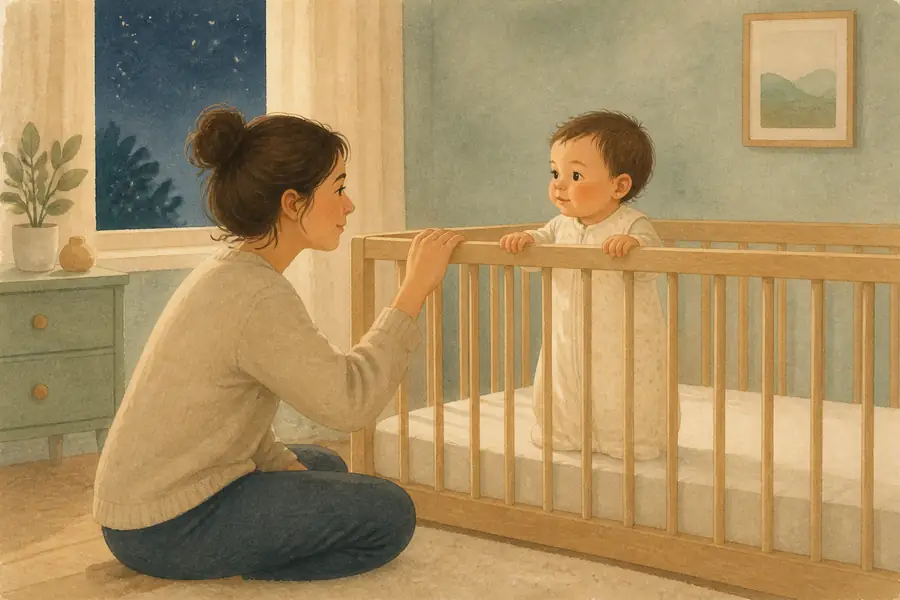
A month ago your one-year-old slept. Now bedtime takes 45 minutes and you are up at 2 a.m. again. The short version:
- It is real, and usually milder than the 4 and 8-month versions. Most families describe two to four rough weeks
- New motor skills are the best-documented cause. Night waking rises around crawling and pulling to stand
- A lot of "12-month regressions" are really the first signs of the 2-to-1 nap change. Different problem, different fix
- Keep the routine you already had. What you start in week one tends to still be there in month six
- Call the pediatrician if it lasts past six weeks or comes with fever, breathing pauses or refused feeds
🌙 Map out the day: enter your baby's age in the sleep schedule calculator for naps and a bedtime that fit their rhythm.
Quick reference: 12-month sleep regression
| Question | Short answer |
|---|---|
| Is it real? | Yes. Night waking rises around new motor milestones (Scher & Cohen, 2015) |
| Typical duration | Two to four weeks is the usual description. Six weeks is our line for calling the doctor, not a measured figure |
| Most common signs | More night wakes, short or skipped naps, longer bedtime, clinginess, standing in the crib |
| Does it predict a bad sleeper? | No. At 12 months disruption was unrelated to night waking before or after (Scher, 2012) |
| Biggest mistake | A new sleep prop that outlasts the regression |
| When to call | Past six weeks, fever, snoring with pauses, refused feeds, lost skills |
For the pattern across the first two years see sleep regression: how long it lasts and what actually helps. The one four months earlier is in 8-month sleep regression: how long does it last.
What is actually happening at 12 months
"Sleep regression" is a parenting term, not a diagnosis. What researchers have measured is narrower and more useful: sleep gets choppier for a while when a big motor skill arrives.
Standing and walking. Anat Scher's group at the University of Haifa followed babies at home with actigraphy every two to three weeks. In 28 infants tracked from 5 to 11 months, the rise in long night wakes lined up in time with the start of crawling (Scher & Cohen, 2015). A second study followed 20 babies from 7 months to their first birthday and found the same thing with pulling to stand, most clearly in the babies who got there early (Atun-Einy & Scher, 2016). That is the crib gymnastics at 3 a.m. Your baby isn't being difficult. They're up on their feet, and they have no idea how to get down again.
The naps start moving. Most toddlers drop to one nap somewhere between 14 and 18 months, and the first signs can show up at 12: a morning nap that gets short, then refused, then accepted again three days later. A baby stuck between one-nap and two-nap days looks "regressed" when really the schedule is in transition. The wake windows by age chart has the age ranges.
Opinions arrive. Twelve-month-olds care who puts them down, which book, and which of three identical-looking muslins goes in the crib. None of that is a sleep problem. It does make bedtime longer.
The finding worth repeating
Here is the part that should take some pressure off. Scher tracked 34 healthy babies with actigraphy at 8, 10, 12 and 14 months. At 12 months, how disrupted a baby's sleep was had no relationship to whether that baby was a frequent night-waker before the first birthday or after it (Scher, 2012). Babies who had slept well got hit too. And a rough month around the birthday said nothing about the 14-month picture.
So a bad few weeks now is not a verdict on your child's sleep. It is 12 months.
Common signs
- more wakes than your own baseline, often with babbling or standing rather than crying
- naps that get short or get refused outright
- bedtime stretching well past its usual length
- new tears or clinginess at bedtime from a baby who used to settle alone
- early waking, see why your baby is waking too early
- sudden objections to one step of the routine (pajamas, teeth, the goodnight kiss)
- standing in the crib in the middle of the night, stuck
- a crankier day, because a few short nights add up fast
One bad night is not a regression. A tired, cranky baby after a rough night usually bounces back within a day or two. A regression persists over several nights and it has a developmental fingerprint: a new skill, new words, a nap that has started to wobble.
What it is NOT
Teething. The NHS lists poor sleep among teething signs, along with a flushed cheek, drooling, gnawing and ear rubbing (NHS, Baby teething symptoms). Teething wakes tend to come with crying and chewing on hands. Regression wakes come with babbling and standing. If you are seeing both, you may well have both.
Illness. Ear infection, a virus, a reflux flare. These start suddenly and bring fever, a blocked nose or refused feeds. A regression usually leaves eating alone.
The 2-to-1 nap change. Short or refused morning nap, normal afternoon nap, fairly stable nights. That is a schedule problem with its own fix, covered in how to switch from 2 naps to 1.
A sleep association that stopped working. If your baby has always been rocked or fed to sleep, twelve months is often when that setup starts to crack. That isn't a regression. It is an old habit your baby has outgrown, and it would have shown up sooner or later anyway.
Wait or act?
| If you see | Then |
|---|---|
| New standing or walking, no fever, eating fine | Hold the routine for 14 days (plan below) |
| Morning nap refused 3+ days, afternoon nap and nights OK | Treat it as a nap transition, not a regression |
| Crying wakes, chewing, drooling | Think teething; comfort and ask the pediatrician about pain relief |
| Fever, ear pulling, refused feeds | Illness first. Call the pediatrician |
| Still no better after six weeks | Book a visit rather than waiting it out |
The 14-day plan
Pick one approach and hold it. Doing one thing well for two weeks beats doing five things for two days each.
Days 1–4: anchor what already worked
- Same wake time (±30 min) every day, weekends included. The AAP asks for the same wake time on weekdays and weekends for a reason: it anchors the whole day
- Bedtime inside a 15-minute window
- Same routine, same order, no longer than 30 minutes
- No new sleep props, not even the ones that "would work just for tonight"
Days 5–10: protect the last hour
- No screens in the last 60 minutes
- Lights down gradually
- Less stimulation, more repetition
- If your baby is standing but not crying, give them a few minutes before you step in. Some lie back down on their own, and it is worth finding out whether yours will
Days 11–14: assess and decide
- Fewer wakes or a shorter bedtime? Keep going
- Unchanged or worse? Read is sleep training safe? what science says and consider a more structured plan
- Looks more like illness than development? Call the pediatrician
What NOT to do
- Don't move bedtime later "to tire them out". Overtired babies wake more, not less. See signs your baby is overtired.
- Don't add an association you don't want for the next six months: your bed, feeding to sleep, holding until deep sleep
- Don't start sleep training mid-regression unless you're committed to the whole plan. A half-finished plan teaches inconsistency
- Don't call one bad night a regression. Two bad nights out of seven is ordinary variation
- Don't switch strategy every two nights. Nothing gets time to work
For the wider list see biggest baby sleep mistakes parents make.
When to call the pediatrician
Talk to your pediatrician if:
- it is still going after six weeks
- there is snoring with pauses or irregular breathing during sleep
- the new pattern comes with fever, ear pulling or refused feeds
- your baby has lost a skill (a word, a milestone)
- night wakes come with screaming for 10+ minutes despite comfort
- growth or weight gain is faltering
- you are running on empty. The AAP's own sleep advice points out that parents getting by on five or six hours pay for it too, and asks families to treat sleep as a priority for everyone in the house (AAP HealthyChildren, Healthy sleep habits)
Pediatricians hear about sleep all the time. The visit is usually short and reassuring. Now and then it turns up an ear infection or snoring that was never a regression at all.
Frequently asked questions
Is the 12-month sleep regression real, or a myth?
The label is informal, but the thing it describes has been measured. Actigraphy studies show night waking going up around crawling and pulling to stand, then settling again. Not every baby has an obvious rough patch at 12 months.
How long does the 12-month sleep regression last?
Most families describe two to four weeks. That is the common rule of thumb, not a figure from a trial. If it is still unresolved after six weeks, something else is more likely going on, and it is worth a visit.
Will my baby be a bad sleeper from now on?
Very unlikely to be decided now. In Scher's 2012 study, sleep disruption at 12 months had no relationship with whether a baby was a frequent night-waker before or after the first birthday. A rough month at this age is not a forecast.
Should I sleep train during the 12-month regression?
If you aren't already mid-plan, most clinicians would wait. Sleep training works best on a calm baseline, not a churning one. Let the regression settle, then decide. The evidence is in is sleep training safe? what science says.
My baby is standing in the crib at 3 a.m. Is that the regression?
Often, yes. Pulling to stand is one of the milestones linked to more night waking. Practice lying down during the day: hold a toy low and let your baby lower themselves to get it. At night, keep your response calm and boring.
Could this be the 2-to-1 nap transition instead?
Quite possibly. Signs that point to the nap change: the morning nap is refused for three days or more, the afternoon nap is normal, and nights are fairly stable. See baby sleep guide 0–2 years for the nap stages.
My partner and I disagree on how to respond. Does it matter?
Yes. Mixed responses drag any regression out. You don't need to agree on philosophy. Agree on the practical default for the next 14 nights, then talk again.
How KidyGrow can help
At 6 a.m. after the third wake, nobody remembers whether Tuesday had a morning nap. And that is the question this whole article turns on: regression, or naps on the move?
KidyGrow remembers the naps for you. On a paid plan, the Tonight plan looks back over the last 14 days, and once naps are logged on at least six of them, it compares the daily nap count in the first half with the second. If it has dropped by half a nap a day or more, the plan's focus switches to sleep. Log only nights and it won't guess.
Most parents only see the naps shifting when the two weeks sit side by side.
_This content is educational and does not replace professional sleep or medical advice. If sleep is significantly affecting your family or your child's health, talk to your pediatrician._
Sources
- Scher A, Cohen D. Sleep as a mirror of developmental transitions in infancy: the case of crawling. Monogr Soc Res Child Dev. 2015;80(1):70-88.
- Atun-Einy O, Scher A. Sleep disruption and motor development: Does pulling-to-stand impacts sleep-wake regulation? Infant Behav Dev. 2016;42:36-44.
- Scher A. Continuity and change in infants' sleep from 8 to 14 months: a longitudinal actigraphy study. Infant Behav Dev. 2012;35(4):870-5.
- NHS, Baby teething symptoms (accessed 2026).
- AAP HealthyChildren, Healthy sleep habits: how many hours does your child need? (accessed 2026).