 Kidy
Kidy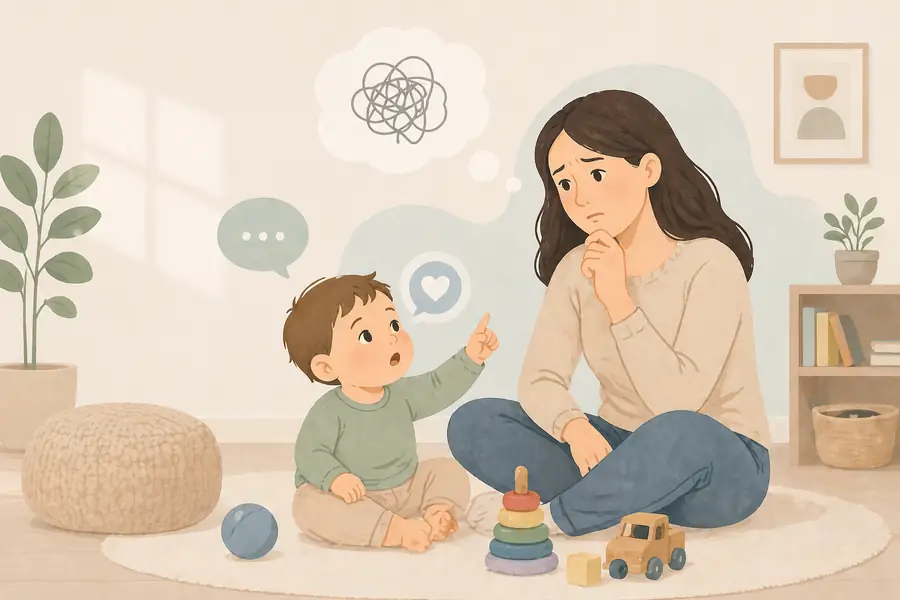
If your 15-month-old isn't saying words yet, the useful question isn't "how many words", it's whether communication is growing through all its channels: pointing, understanding, sounds and shared attention. At 15 months the CDC checklist, which lists what at least 3 in 4 children do, expects:
- one or two words besides "mama" and "dada", like "ba" for ball
- pointing to ask for something or to get help
- following a direction given with both a gesture and words
- looking at a familiar object when you name it
If pointing, understanding and name response are all weak, call your pediatrician now (CDC).
Quick Reference: communication at 15 months
| Skill | What most children do by 15 months | Worth a call |
|---|---|---|
| Spoken words | One or two besides "mama/dada" | No words and no attempts, together with weak gestures |
| Pointing | Points to ask for things or get help | No pointing at all |
| Understanding | Looks at a familiar object when you name it; follows a direction with a gesture | Inconsistent or absent |
| Sounds | Long strings of sounds and syllables with speech-like inflection | Only one or two sounds |
| Shared attention | Shares interest in things with you | Limited or fleeting |
Sources: CDC 15-month checklist, ASHA 13 to 18 months.
Why the number you read online is probably too high
Search "how many words at 15 months" and you'll often see "3 to 10 words". The CDC checklist asks for one or two words besides "mama" and "dada" at 15 months, and three or more by 18 months.
The gap is not an accident. In 2022 the CDC and the AAP rebuilt the checklists so each milestone is one that at least 75% of children reach by that age, instead of the average. A third of the milestones they kept moved to a different age, and two thirds of those moved later. The 15-month visit was added to the checklists in that same revision (Zubler et al., 2022).
So a quiet 15-month-old with good pointing and understanding is not behind. And because the list describes what three in four children already do, a child who misses several items on it is worth a conversation now rather than in six months.
The 4 things to look at instead of word count
1. Pointing. Pointing to ask, pointing to show you something ("look, a dog!") and, a little later, pointing to body parts are some of the strongest communication tools a child has before words. Pointing to ask for something is on the CDC 15-month list, and ASHA lists pointing to request, comment or get information for 13 to 18 months. See baby not babbling at 9 months for the earlier signs in this same channel.
2. Understanding. Does your child look at the dog when you say "where's the doggy?" Bring you a shoe when you ask and hold out your hand? Understanding usually runs ahead of speaking, and strong understanding with few words is the classic late-talker pattern. See toddler not responding to name for what to watch there.
3. Sounds and babbling. ASHA describes long strings of sounds, syllables and real words with speech-like inflection at this age (ASHA). Varied, chatty babbling is a good sign the speech system is on its way. Only one or two sounds is more telling than missing words. See speech delay signs in toddlers for the wider list.
4. Imitation and shared attention. Does your child copy clapping or waving, copy sounds, look from a toy to your face to share it? These are the building blocks words sit on. Strong imitation and shared attention without words is reassuring. If the social signals themselves seem weak, not just the word count, read signs of autism vs speech delay, and for how clinicians sort late talkers from real delay, late talker vs speech delay.
Seven days of noticing, instead of counting words
Take one week and write three lines each evening. That's all.
- Gestures today: which ones you saw
- Understood: which direction worked, with or without a gesture
- Sounds and words: what came up, including made-up words and animal noises
After seven days you have something a pediatrician can actually use. "He doesn't talk" is hard to place. "In seven days: six different gestures, five directions understood, four different syllables, two steady words" is information.
Count generously. A word counts even if it doesn't sound like the dictionary, as long as your child uses it for the same thing each time: "woof" for dog, "nana" for banana, "ba" for bye.
Then watch the next two weeks. If gestures, understanding or sounds are growing, the system is working. If nothing has moved in any channel, that is the moment to call rather than wait. The next checkpoints are the 18-month not-talking guide and how many words should a 2-year-old say.
Common mistakes parents make
- Counting words and ignoring gestures and understanding. The other channels tell you more at this age.
- Turning every moment into "say it". Keep the back-and-forth playful; a child who feels tested often goes quiet.
- Comparing with one particular child instead of the checklist.
- Waiting past 18 months with no progress in any channel. Late talkers are a mixed group, which is why watching beats waiting.
- Talking at your child instead of with them. Short turns, then a pause for their turn, is the format that builds language.
When to seek professional help
Call your pediatrician this week if any of these apply at 15 months:
- no gestures at all (no pointing, waving or showing): this is more telling than zero words
- no response to name across the week, together with little understanding of everyday words
- loss of skills: words, gestures or interaction your child had a month ago and doesn't have now
- little eye contact, social interest or shared attention alongside the language gap
- a family history of speech and language delay or autism, which is worth mentioning at any visit
Germany's federal health institute describes late talkers at age 2 and says a good half catch up on their own between the third year and school age, while the rest benefit from speech therapy (BIÖG). You can't tell at 15 months which group a child is in, which is exactly why a check is low-risk. A hearing test is usually part of it, since hearing is the main input for learning words (NIDCD). For the full arc, see the parent's guide to toddler speech development, and before the appointment, how to prepare for a pediatric visit with your child's data.
Frequently asked questions
Is 0 words at 15 months automatically a problem?
No, but it's a "watch closely" signal. The CDC checklist expects one or two words besides "mama" and "dada" by 15 months, and it describes what three in four children do. Check the other channels: pointing, understanding, name response, varied babbling, shared attention. If those are strong, you likely have a late talker. If they're weak too, call your pediatrician this week.
How many words should a 15-month-old say?
The CDC checklist asks for one or two words besides "mama" and "dada" at 15 months and three or more by 18 months. Higher numbers you see online usually describe an average child, not the point where most children already are.
My 15-month-old is bilingual. Should I expect fewer words?
Often fewer in each language, but a similar total across both. Count both languages together. Bilingualism doesn't explain an absence of gestures or weak understanding.
What should I do at home this week?
Talk through routines ("water on, soap, scrub"), follow your child's attention instead of redirecting it, pause after you speak so there's room for a reply, answer any attempt (a gesture, a sound, a word), and read together every day, even if your child only points. ASHA suggests naming what you see on a walk and adding to the words your child says.
Should we use screens or language apps?
Language grows through back-and-forth with people. A video call with grandparents is still a conversation; a video playing in the background isn't. More in does screen time cause speech delay.
What if two weeks pass and nothing has grown?
Then it's time to call your pediatrician and ask about a developmental check, a hearing test and a referral to a speech-language pathologist. Bring your seven-day notes.
How KidyGrow helps you read communication progress
Gestures, understood directions and new sounds are exactly what you notice in the day and have forgotten by evening. "Since when?" is also the first question a pediatrician asks.
In KidyGrow the milestone checklist has a Communication domain. You mark what your child does, and the milestones you've reviewed are passed to the AI, so its suggestions are personalised to where your child actually is. If something worries you, you log it as a red flag with the date you first saw it and a note.
KidyGrow does not count words or gestures for you. It keeps the dates, so you walk into the appointment with a timeline instead of "sometime in the summer."
Sources
- Centers for Disease Control and Prevention. Important Milestones: Your Baby By Fifteen Months. https://www.cdc.gov/act-early/milestones/15-months.html
- Centers for Disease Control and Prevention. Important Milestones: Your Baby By Eighteen Months. https://www.cdc.gov/act-early/milestones/18-months.html
- American Speech-Language-Hearing Association (ASHA). Communication Milestones: 13 to 18 Months. https://www.asha.org/public/developmental-milestones/communication-milestones-13-to-18-months/
- Zubler JM, Wiggins LD, Macias MM, et al. (2022). Evidence-Informed Milestones for Developmental Surveillance Tools. Pediatrics, 149(3), e2021052138. https://pubmed.ncbi.nlm.nih.gov/35132439/
- Bundesinstitut für Öffentliche Gesundheit (BIÖG). Schwierigkeiten bei der Sprachentwicklung erkennen. https://www.kindergesundheit-info.de/themen/entwicklung/entwicklungsschritte/sprachentwicklung/frueherkennung-sprachstoerung/
- National Institute on Deafness and Other Communication Disorders (NIDCD). Speech and Language Developmental Milestones. https://www.nidcd.nih.gov/health/speech-and-language
_Educational content. Not a substitute for medical advice: call your pediatrician this week if your child shows no gestures, no name response, or has lost skills they had before._