 Kidy
Kidy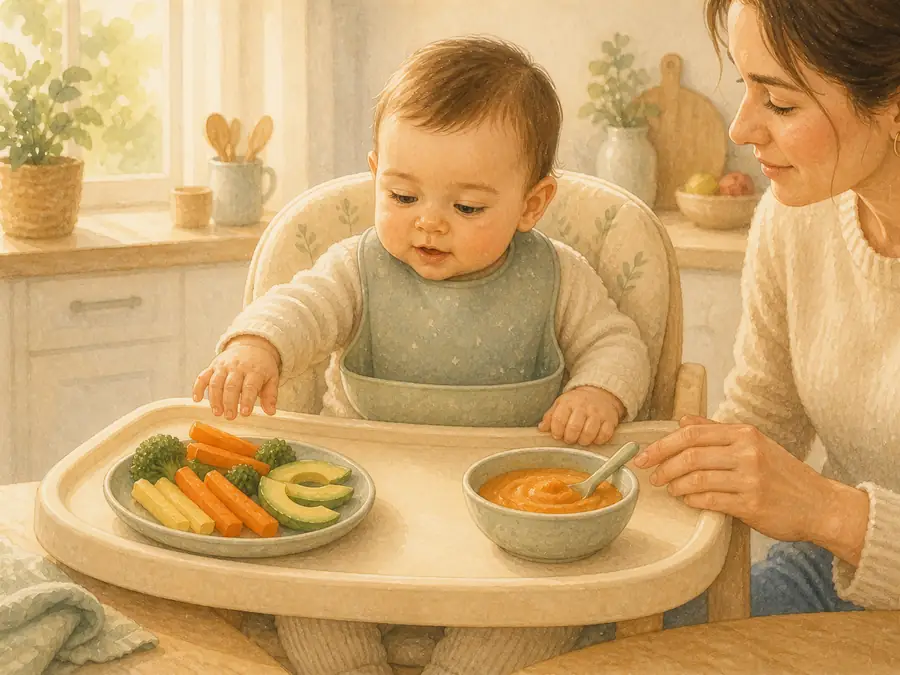
Wondering whether to hand your baby a strip of soft toast or spoon in a bowl of purée? Here is the short version before the detail:
- Start solids around 6 months, not before 4, once your baby can sit with support and has good head control.
- Baby-led weaning (BLW) and spoon-fed purées both reach the same destination: a confident eater by around 12 months.
- Gagging is normal and protective; roughly the first month of solids involves a lot of it. Choking is silent and rare.
- Iron is the priority nutrient from about 6 months, whichever method you pick.
Most of the "which is better" noise online is dogma. The honest answer is that both work, plenty of families blend the two, and the method matters far less than reading your own baby. This guide walks through what each approach is, the readiness signs, the real difference between gagging and choking, and how to decide without joining a tribe.
Quick Reference
| Question | BLW | Purées |
|---|---|---|
| What baby eats | Soft finger foods, family food | Smooth mashes, spoon-fed |
| Who leads | Baby self-feeds | Adult offers spoon |
| Starts | ~6 months, sitting supported | ~6 months, sitting supported |
| Gagging | Common early on, normal | Less common, still possible |
| Iron | Offer iron-rich soft foods | Iron-fortified purées, meat purée |
| Mess | High | Moderate |
What is baby-led weaning?
Baby-led weaning means skipping the spoon-and-purée stage and offering soft, graspable pieces of food that your baby picks up and feeds themselves. Think a roasted carrot stick, a strip of ripe avocado, a wedge of soft-cooked sweet potato. The baby decides how much goes in and at what pace.
The appeal is real. Babies practice hand-eye coordination early, they join family meals from day one, and you are not making separate purée batches. The NHS supports finger foods from the start of weaning and notes babies can move straight to soft family foods (NHS). The main worry parents raise is choking, which we will separate from gagging below.
What are purées?
Purées are the classic route: smooth, blended food delivered by spoon, thickening in texture over weeks until baby moves to lumps, then finger foods. You control the amount, texture progresses gradually, and it can feel calmer for anxious first-timers.
The American Academy of Pediatrics describes this staged approach, starting with single-ingredient smooth foods and advancing texture as baby manages it (AAP). The old worry that purées "delay" chewing is overstated as long as you don't stay on smooth textures too long. By around 9 months, most babies should be handling lumps and finger foods regardless of where they started.
Is one method better or safer?
Here is the reassuring part. Research has not found that one method produces healthier eaters, leaner toddlers, or fewer picky eaters than the other. Both, done sensibly, are safe. A well-run BLW approach that avoids hard, round, and small foods carries a choking risk comparable to spoon-feeding.
What actually matters is more boring than the debate suggests: starting around the right time, offering iron-rich foods, introducing allergens early, and not propping a bottle or leaving a baby alone with food. The World Health Organization recommends solids from around 6 months alongside continued breastfeeding, framing the method as secondary to timing and nutrient density (WHO). If you want the fuller picture on portions and progression, our baby and toddler feeding guide covers the arc from first tastes onward.
Readiness: when is your baby ready?
Age is a guideline, not a starting gun. Look for these signs together, usually landing near 6 months:
- Sits with support and holds their head steady
- Lost the tongue-thrust reflex (no longer pushes food straight back out)
- Brings objects to their mouth and shows interest in your food
- Can make chewing-type mouth movements
Starting before about 4 months is linked to no benefit and some risk; the digestive and oral-motor systems simply aren't ready. If your baby hits 6 months but still can't sit supported, wait a week or two. Readiness beats the calendar.
Gagging vs choking: know the difference
This is the fear that keeps parents on purées, so it deserves clarity. They are not the same thing.
Gagging is loud, red-faced, and often dramatic. It is a protective reflex that pushes food forward, away from the airway. Your baby coughs, sputters, maybe brings something back up, and carries on. It looks alarming and it is completely normal, especially in the first weeks. The gag reflex actually sits further forward on the tongue in babies, which is nature's design for exactly this learning phase.
Choking is silent. The airway is blocked, so there is little or no sound, no effective cough, and the face may turn blue. This is the emergency. It is rare with appropriate foods, and knowing infant first aid matters far more than choosing a feeding method. Avoid whole grapes, nuts, popcorn, chunks of raw apple or carrot, and anything hard, round, or coin-shaped. Never leave a baby unattended while eating, and always seat them upright.
Can I combine both methods?
Yes, and most families quietly do. There is nothing pure about "pure" BLW. You might spoon iron-fortified cereal at breakfast and hand over soft toast fingers at lunch. You might do purées for four weeks while your nerve builds, then shift to self-feeding. A baby refusing the spoon one week may grab finger food happily the next.
Combining also solves the iron question neatly: meat purée or iron-fortified porridge by spoon covers the nutrient while your baby practices self-feeding with softer pieces. If your baby starts turning food down as they get older, our piece on a baby refusing solids at 8 months unpacks the common causes.
How to decide
Use your baby and your own nervous system, in that order.
- Anxious about choking, want control? Start with purées, progress texture briskly, add finger foods by 8 to 9 months.
- Baby grabs everything, you want less prep? Lean BLW, offer soft graspable pieces, stay within arm's reach.
- Not sure? Do both. Spoon some, offer some. Watch which your baby prefers and follow that.
There is no medal for method purity. The goal is a baby who eats a range of textures with some joy by their first birthday.
Common mistakes
- Starting too early. Before 4 months there is no readiness and added risk. Aim for around 6.
- Skipping iron. Milk stores run low by 6 months; iron-rich foods are the real job of early solids.
- Delaying allergens. Introducing peanut and egg early, in age-appropriate soft forms, lowers allergy risk. Don't save them for later.
- Panicking at gagging. Reacting with alarm every time teaches your baby that eating is scary. Stay calm; let the reflex work.
- Only smooth, forever. Staying on runny purées past 9 months can make lumps harder to accept.
When to seek professional help
Talk to your pediatrician or health visitor if your baby: consistently coughs, chokes, or turns blue with food; still can't manage any texture by around 9 to 10 months; loses weight or crosses down growth percentiles; or arches, cries, and refuses most feeding attempts across weeks. Feeding refusal that persists deserves a look; our guide on when a baby is not eating much helps you tell a phase from a flag. A one-off gag is not a reason to call. A pattern of distress is.
Frequently asked questions
Is baby-led weaning safer than purées?
Neither is meaningfully safer when done well. BLW that avoids hard, round, and small foods has a choking risk similar to spoon-feeding. Safe practice, upright seating, and supervision matter more than the method.
Does baby-led weaning cause more choking?
Studies have not shown higher choking rates for BLW when families avoid high-risk foods. Gagging is more visible with BLW, but gagging is not choking. Learn the difference and infant first aid.
Can I do purées and finger foods at the same time?
Absolutely. Blending both is common and practical. Many parents spoon iron-rich purées while offering soft finger foods to practice self-feeding. Your baby may prefer one over the other on any given day.
When should I introduce allergens?
Introduce common allergens like peanut and egg early, around when solids begin, in soft baby-safe forms. Early introduction lowers allergy risk. Offer one new allergen at a time so you can spot reactions.
Which first foods have the most iron?
Iron-rich starters include iron-fortified baby cereal, well-cooked puréed or soft meat, lentils, and beans. Pair with vitamin C foods to boost absorption. Iron is the priority nutrient from about 6 months.
Do I have to choose one method?
No. There is no rule requiring purity. Follow your baby's cues, mix approaches, and adjust as they grow. Both paths reach the same confident-eater destination.
How KidyGrow helps you
The hardest part of early solids is not the method. It is remembering what happened last week when you are running on broken sleep. Did the egg go fine? Was it the sweet potato or the pea that triggered a rash? KidyGrow remembers what an exhausted parent can't.
You log a few first tastes and reactions. Over the first several days the app warms up, and by the second week it may notice something you missed in the blur: that every gaggy meal followed a too-tired late start, or that two "reactions" both traced back to the same food. Instead of a generic "introduce allergens," your Daily Brief starts saying which allergens you have already cleared and which are still open.
Sometimes the app won't find a pattern, because some weeks are just teething and mess. But when there is a thread, it holds it for you. The question shifts from "wait, did we try egg?" to "egg is done, cucumber is new, and we're actually further along than it felt." For pairing solids with the rest of the day, the 0 to 2 year schedule guide sits alongside this in the app.
Sources
- American Academy of Pediatrics (HealthyChildren.org). "Starting Solid Foods." https://www.healthychildren.org/English/ages-stages/baby/feeding-nutrition/Pages/Starting-Solid-Foods.aspx
- NHS. "Baby's first solid foods." https://www.nhs.uk/conditions/baby/weaning-and-feeding/babys-first-solid-foods/
- World Health Organization. "Infant and young child feeding." https://www.who.int/news-room/fact-sheets/detail/infant-and-young-child-feeding
- NHS Start for Life. "What to feed your baby." https://www.nhs.uk/start-for-life/baby/weaning/