 Kidy
Kidy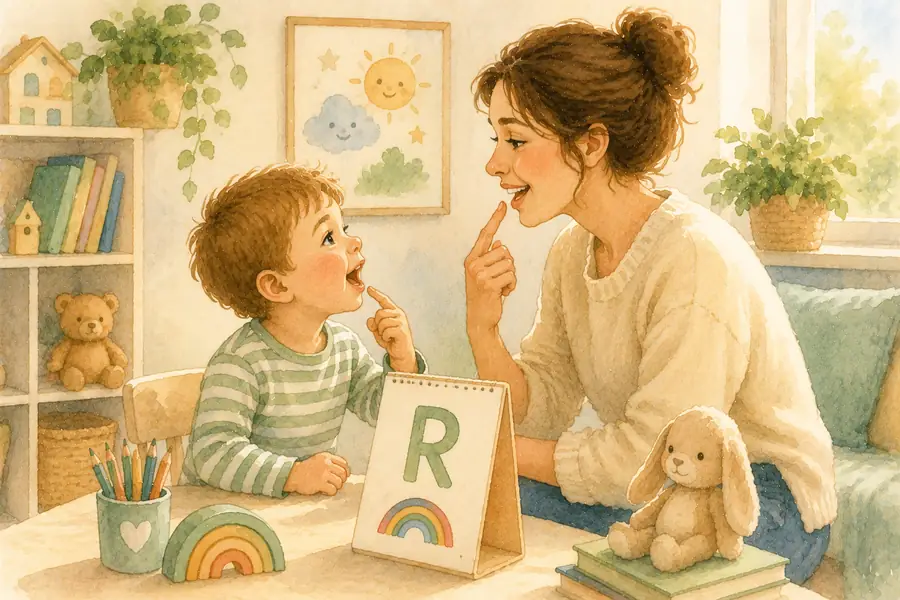
The R sound is one of the last sounds children master. A quick reality check before you panic:
- Most kids are still working on R well into the preschool years
- Clear, consistent R commonly arrives between ages 5 and 7
- R is harder than almost every other sound because the tongue has no visible "target"
- Teaching R is months of small steps, not a five-repeat fix
- It is a different concern from late talking, which is about whole-word language at 1 to 3
If your four-year-old swaps "wabbit" for "rabbit," that is usually right on schedule. This guide covers when the R sound develops, when an articulation gap is worth a speech therapist, and what the therapy road actually looks like. I write this partly as a founder and partly as a mother who recently sat in a waiting room over exactly this sound.
Quick Reference: the R sound at a glance
| Question | Short answer |
|---|---|
| Is "wabbit" at age 4 normal? | Yes. R is a late sound; substitutions are expected. |
| When should R be clear? | Commonly by 5 to 7; many kids by school start. |
| When to see a speech therapist? | If R isn't emerging by ~6, or there is frustration or many sounds affected. |
| Why is R so hard? | The tongue position is hidden and varies by word. |
| How long does therapy take? | Usually months of practice, not a few sessions. |
When does the R sound normally develop?
R sits at the far end of the sound-acquisition timeline. The American Academy of Pediatrics notes that a 2-year-old is typically understood about half the time by strangers, and full intelligibility builds gradually through the preschool years (HealthyChildren.org / AAP). Sounds arrive in a rough order. Easy ones (p, b, m, t, d) come early. The trickier ones (s, l, r, th) trail behind, sometimes by years.
For R specifically, the U.S. National Institute on Deafness and Other Communication Disorders places mastery in the later preschool-to-early-school window, and the CDC's developmental milestone guidance expects a 5-year-old to be largely understandable, though not necessarily flawless on every sound (CDC milestones, 5 years). The American Speech-Language-Hearing Association (ASHA) lists R among the sounds that can still be developing up to around age 7 (ASHA speech sound chart).
So the honest range: a child who isn't producing a clean R at four, or even five, is usually still inside typical development. By six or seven, it should be there.
One distinction worth holding onto: this is about articulation, how a single sound is pronounced, not about language delay, which is about whether words and sentences are coming at all in the early years. They get confused constantly.
Related: If you're untangling the two, late talker vs. speech delay explains the difference.
Why is the R sound so difficult?
Think about how you make a B. Lips together, then apart. A child can watch your mouth and copy it. Now try to explain R. Where is your tongue? Most adults genuinely cannot say.
R is what speech therapists call a "late-developing, motorically complex" sound. The tongue either bunches up in the middle of the mouth or curls back, and the exact shape changes depending on the word: the R in "red" is not produced identically to the R in "car" or "bird." Nothing is visible. There is no lip cue to imitate.
Related: For the broader picture of how sounds and words come online, see our toddler speech development guide.
That hidden complexity is exactly why R is the sound that most often brings a school-age child to a speech therapist, and why it resists the "just say it after me" approach so many of us try first.
R is language-specific (this matters)
If your family is bilingual or you grew up with another language, here is something worth knowing: R is not one universal sound. English R is an approximant, made without the tongue touching anything. The Spanish R can be a single tap or a rolled trill. Many other languages use a strongly rolled or trilled R. A child learning more than one language is learning more than one R, on more than one timeline. Don't assume a delay in one means a delay in the other.
When to see a speech therapist about the R sound
Here is the decision logic, kept simple:
- Age 3 to 4, R is "w" or missing → wait. This is typical. Keep talking, reading, playing.
- Age 5, R still absent but other sounds are fine → mention it at the next pediatric check; many kids self-correct this year.
- Around age 6 / school start, R not emerging → ask for a speech-language evaluation.
- Any age, child is frustrated, avoids words, or is teased → evaluate sooner, regardless of the calendar.
- Many sounds unclear, not just R → that is a broader articulation picture; evaluate.
The NHS advice for parents worried about a child's talking is consistent: if you have a concern, a professional assessment is reasonable and never wasted (NHS, learning to talk). An evaluation is not a commitment to anything. It is information. One honest note from my own experience: waitlists for speech therapy can be long, so many families start with a private speech therapist just to begin sooner. There is no need to panic, but when it is your own child, everything feels urgent, and that is completely normal.
Related: Not sure whether your worry crosses the line? Our piece on when to seek help for a speech concern walks through the same kind of thresholds.
How is the R sound actually taught?
This is the part nobody warns you about. I expected a tip. What I got was a process.
A speech therapist usually breaks R down into pieces a child can actually feel. They might start with R blended into easy sounds, or isolate just one type of R (the "er" in "her" is often a starting point because it is more stable). They use mirrors, hand gestures, even tongue-position cues you'd never invent at home. Then they drill it: in syllables, in single words, in phrases, in sentences, in conversation. Each level only after the last one is solid.
It is methodical. It is repetitive. And it is slow on purpose, because R is a motor skill, like learning an instrument, not a fact to memorize.
Related: Curious how everyday play supports speech overall? See how to encourage your child to talk.
Common mistakes (what NOT to do)
- Don't correct every single R. Constant "say it right" turns talking into a test. Model the word correctly and move on.
- Don't expect a fast fix. The number one thing I had to unlearn: you don't show up, repeat it five times, and walk out with the sound. It is months.
- Don't make the child perform R for relatives. Pressure plus a hard sound equals a kid who stops trying.
- Don't ignore frustration because "he's only five." Age is a guideline; a struggling, upset child is a reason to ask, whatever the number.
- Don't compare twins or siblings out loud. One can have R while the other doesn't, and saying it where they hear you helps no one.
When to seek professional help
Book a speech-language evaluation if R has not emerged by around age six, if your child distorts many sounds and not just R, if speech is hard for unfamiliar people to follow at five, or if your child is visibly frustrated or being teased at any age. You do not need to wait for a "bad enough" moment. Earlier information is just easier to act on.
Frequently asked questions
Is it normal for a 4-year-old to not say the R sound?
Yes. R is a late-developing sound, and substitutions like "w" for "r" are common and expected at four. Most children continue refining R through ages five, six, and into seven. A missing R at four, on its own, is rarely a red flag.
At what age should I worry about the R sound?
Around school start, roughly age six, is the usual checkpoint. If R hasn't emerged by then, or if it's accompanied by frustration, teasing, or other unclear sounds, ask your pediatrician for a speech-language referral. Before five, R alone is usually a wait-and-watch situation.
Can a child learn the R sound on their own?
Often, yes. Many children master R without any therapy, simply through maturation and exposure to speech. That is exactly why the timeline runs to seven. But if it hasn't happened by school age, a speech therapist can teach it directly, and waiting longer rarely helps.
How long does R-sound speech therapy take?
It varies a lot, but plan for months rather than weeks. R is a motor skill built in stages: isolated sound, syllables, words, sentences, then everyday talk. Progress is real but gradual, and consistent home practice between sessions is what moves it along.
Is the R sound the same in every language?
No. English R is made without the tongue touching anything; Spanish uses a tap or a rolled trill; many languages use a strongly rolled R. Children learning more than one language learn more than one R, each on its own schedule, so a gap in one language doesn't automatically mean a gap in another.
How KidyGrow helps
The hardest part of a long articulation road isn't the exercises. It's holding the thread across weeks when nothing seems to change day to day. KidyGrow keeps that thread for you.
You note the small things: which words came easier this week, when frustration spiked, what the therapist asked you to practice. Over time the app surfaces what you can't see in the moment. Early on it might say something generic about late-developing sounds. A few weeks in, after you've added real notes, it gets more specific to your child, flagging that practice landed better on calm afternoons than after daycare, or that a word you'd written off is quietly improving.
Sometimes there is no tidy pattern, and the app will not pretend there is. Some weeks are just tired and slow. But when there is a thread, it remembers it, so the morning question stops being "are we even getting anywhere" and becomes "this is where we actually are."
To the parent whose child can't say R yet: it is almost certainly fine, and even when it needs help, the help works. It just takes longer than anyone tells you up front. My younger daughter, at five, is in the middle of that road right now. We are not rushing it.
— Marija, KidyGrow
Sources
- American Academy of Pediatrics, HealthyChildren.org: Language Development in toddlers and preschoolers. https://www.healthychildren.org/English/ages-stages/toddler/Pages/Language-Development-2-Year-Olds.aspx
- National Institute on Deafness and Other Communication Disorders (NIDCD): Speech and Language Developmental Milestones. https://www.nidcd.nih.gov/health/speech-and-language
- Centers for Disease Control and Prevention (CDC): Developmental Milestones, 5 years. https://www.cdc.gov/act-early/milestones/5-years.html
- NHS Start for Life: Learning to talk. https://www.nhs.uk/start-for-life/baby/learning-to-talk/
- American Speech-Language-Hearing Association (ASHA): Speech sound development chart. https://www.asha.org/public/speech/development/chart/
_This article is educational and does not replace personalized advice from your pediatrician or a licensed speech-language therapist._