 Kidy
Kidy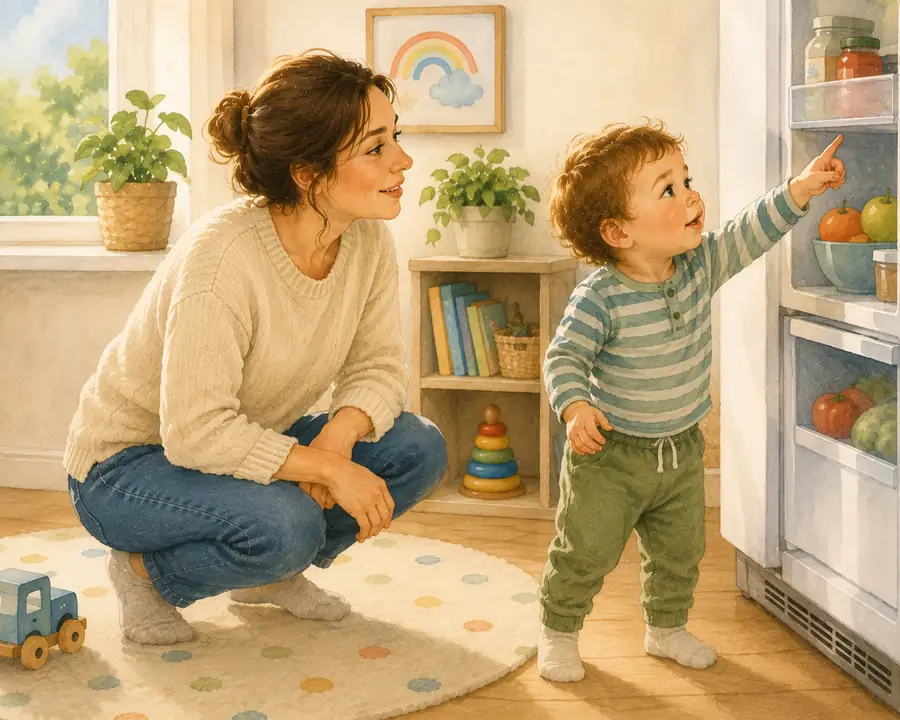
Your toddler leads you to the fridge, points at the top shelf, and grunts. Clear message, no words. If most of the day runs on pointing and hand-pulling, here is what the research actually says:
- Gestures come before words. Pointing usually appears between 9 and 14 months, and it normally shows up before a child's first spoken words, not instead of them (NIDCD).
- Gesture count predicts vocabulary. The number of gestures a 12-month-old uses is one of the best early predictors of how many words they will have a year later.
- Words should overtake gestures with age. A typical 2-year-old says at least 50 words and starts combining two (AAP).
- The real red flags are no gestures at all, no pointing by 18 months, or losing skills the child already had.
So a toddler who gestures a lot is usually communicating well. Gesturing is a milestone, not a problem. The question is whether words are slowly joining the gestures, or whether gestures are carrying the whole load with nothing new arriving behind them.
Quick Reference
| Age | What gesturing looks like | Words you'd expect | Worth a mention if... |
|---|---|---|---|
| 9-12 mo | Waving, reaching up, giving, showing objects | 0-3 words, lots of babble | No gestures at all by 12 months |
| 12-15 mo | Pointing to request, pointing to show you things | 1-6 words | No pointing, no waving by 15 months |
| 16-18 mo | Gestures + word starting to pair ("up" + arms up) | 10-20 words | No pointing to share interest by 18 months |
| 24 mo | Gestures fade as talking takes over | 50+ words, 2-word combos | Still mostly gestures, under ~50 words |
Why do toddlers gesture instead of talking?
Because gesturing works, and it is easier. A point gets the cracker faster than assembling the sounds "c-r-a-ck-er," which is a real motor and memory feat for a small mouth. Children take the efficient route. That is not laziness or a delay by itself. It is a child using the communication tool they already have while the harder tool is still being built.
There is a developmental logic here. Gestures and words sit on the same track. Waving bye-bye, holding a toy up for you to see, pointing at the dog: each of these is the child saying "I have something in mind and I want to share it with you." That shared-attention skill is the foundation that spoken language is built on top of. The NHS describes gestures like pointing and waving as normal, expected steps on the road to talking.
The pattern to watch is not "gestures yes or no." It is the direction of travel. Are gestures picking up words as they go? At 14 months a child might just point at the ball. By 17 months the same point often comes with a grunt or a rough "ba." By 20 months it becomes "ball" with the arm still out. Gesture leading, word catching up. That is exactly what you want to see.
Is gesturing a sign of a speech delay?
On its own, no. Rich gesturing is usually a reassuring sign, because it shows the child understands communication is a two-way exchange and wants to be part of it. Children who point to show you things (not just to demand) are demonstrating the social core of language.
It becomes worth a closer look when gesturing is the only thing that grows. If a child was pointing and waving at 12 months, has the same handful of gestures at 22 months, and still has almost no words, the gap between understanding and talking is the thing to assess, not the gesturing itself. For more on that specific pattern, see toddler understands but doesn't talk and the broader signs of a speech delay in toddlers.
One nuance that trips parents up: there is a difference between pointing to request ("give me that") and pointing to comment ("look at that dog"). The second one, sharing an experience for its own sake, tends to matter more for language and social development. A child who only ever points to get objects, and never just to show you something interesting, is worth mentioning to your doctor.
How can I turn gestures into words?
You do not stop the gestures. You add sound to them. The goal is to be the voice for the message the child is already sending.
- Name the gesture, then wait. Child points at the cup. You say "cup? You want the cup," then pause for two full seconds. That silence is where they try. It feels awkward. Let it sit.
- Pair a word with every gesture you use yourself. Wave and say "bye-bye." Hold your palms up and say "all done." You are modelling the pairing you want back.
- Offer, don't quiz. Not "what's this?" fifteen times a day. Just narrate: "Up. You want up." Pressure shuts kids down.
- Give a beat before you rescue. When they lead you to the fridge, name the thing and hold on one moment before opening it. A little wait invites a sound.
More scripts like these are in how to encourage a toddler to talk. And if you are wondering what "on track" even means for spoken vocabulary, how many words a 2-year-old should say lays out the numbers.
Decision logic: wait or act
Here is the honest cut between "keep going" and "get it checked."
Example
18 months ✔ points ✔ says "up" ✔ says "ball" → reassuring
22 months ✔ only points ✔ no new words → worth an assessment
Keep supporting at home if:
- Your child uses several different gestures and keeps adding new ones.
- They point to show you things, not only to demand.
- Understanding is strong: they follow simple instructions, find named objects, react to their name.
- Words are trickling in, even slowly, even if unclear.
Book an assessment if:
- No gestures at all by 12 months, or no pointing by 18 months.
- Gestures have not grown into any words by around 18 to 24 months.
- Your child has lost words or gestures they used to have. Regression is always worth a same-week call. See why a toddler stopped talking.
- Your gut says something is off. Parents are usually right, and a check costs nothing but time.
Follow the understanding, not just the talking. A child who gestures, points to share, and clearly comprehends is on a different path than one who does neither.
Common mistakes parents make
The instinct to help can quietly backfire. A few patterns to drop:
- Answering the gesture too fast. If the cup appears the instant a finger lifts, there is no reason to attempt the word. You are not being unkind by waiting three seconds.
- Turning talk into a test. Constant "say cup, say cup, say it" raises the stakes and lowers the output. Model, don't demand.
- Comparing to the chatty cousin. The range for normal is wide, and one talkative 20-month-old at the birthday party is not the benchmark. Percentiles are a range, not a finish line.
- Waiting silently for a year. "He'll talk when he's ready" is sometimes true and sometimes a missed window. You can both support at home and mention it at the next check. These are not opposites.
Eat the pause. That is the one habit that changes the most.
When to seek professional help
Talk to your pediatrician, and ask for a referral to a speech-language pathologist, if any of these are true:
- No pointing, waving, or reaching-to-be-picked-up by 12 to 15 months.
- No pointing to share interest (not just to request) by 18 months.
- Gestures with no emerging words by 18 to 24 months.
- Any loss of words, gestures, or social skills at any age.
- Weak understanding: not following simple one-step directions by around 18 months.
A hearing check is often the first step, because even mild, fluctuating hearing loss from repeated ear infections can quietly hold speech back. Early support works, and you never need a "bad enough" reason to ask. Referral pathways and what to expect are covered in when to seek help for a speech delay. If you are also weighing social signs, signs of autism vs. speech delay is a calmer read than most search results.
Gestures are a stage on the way to words, not a detour from them. Where pointing, waving and "uh-uh" sit in the normal sequence, and what usually follows in the next 3 to 6 months, is in the toddler speech development guide.
Frequently asked questions
Is it normal for a 2-year-old to point instead of talking?
Some pointing at 2 is fine, but by this age words should be doing most of the work: around 50 or more words and the start of two-word combos. If a 2-year-old is still communicating almost entirely by gesture, it is worth a conversation with your pediatrician, not a panic, just a check.
My toddler pulls my hand to what they want instead of pointing. Is that a concern?
Hand-leading is common and usually fine on its own, especially if the child also points, makes eye contact, and shares interest in other ways. It gets more worth mentioning if hand-leading is the only strategy and the child rarely points to show you things or make eye contact during the request.
Do gestures delay speech by making talking unnecessary?
No. This is a common worry and the evidence points the other way: gesturing supports language and predicts vocabulary growth. Gestures are practice for communication, not a substitute that holds words back. Keep encouraging them, just add words on top.
At what age should gestures start turning into words?
Words usually begin joining gestures around 12 to 18 months, with clearer pairing (gesture plus a word) by 18 months. By 24 months, spoken words should be overtaking gestures as the main way your child communicates.
Should I stop responding to gestures to force my child to talk?
No, and please do not go silent on them. Withholding response is stressful and can dent the connection that language grows from. Instead, respond warmly and supply the word, then leave a short pause so there is room for them to try.
When do most children's gestures fade?
As spoken vocabulary takes off, usually across the second and into the third year, gestures naturally drop back to the level adults use, for emphasis rather than as the main channel. A steady handover from gesture to word is the healthy pattern.
How KidyGrow helps you
The hard part is not knowing that gestures should turn into words. It is holding six weeks of your own kid in your head while running on no sleep. That is the job KidyGrow quietly does: it remembers what tired parents can't.
Log the gestures and the new sounds as they happen, a few taps, no essays. In the first days you get general guidance. By the second or third week the daily brief gets specific to your child: instead of "toddlers this age point," it might say "three new gestures logged this month, and 'up' and 'ba' both showed up in the last ten days, words are starting to catch the gestures." That is the trend line an exhausted parent almost never spots in real time.
It also holds the thread for the pediatrician. When the 18-month visit arrives, you are not guessing from memory. You have a plain record: which gestures, which words, when the last new one appeared. That turns a vague "I think he's a bit behind" into something a doctor can actually act on, the same idea as preparing for a pediatric visit with your child's data.
Sometimes the app won't find a clean pattern, because some months are just teething and colds and chaos. That is honest, and still useful: seeing a flat stretch is itself information you can bring to a check.
The morning question stops being "was this week better or worse than I remember?" and becomes "here is what actually happened. Now I can decide."
Sources
- National Institute on Deafness and Other Communication Disorders (NIDCD). Speech and Language Developmental Milestones. https://www.nidcd.nih.gov/health/speech-and-language
- American Academy of Pediatrics, HealthyChildren.org. Language Development: 2 Year Olds. https://www.healthychildren.org/English/ages-stages/toddler/Pages/Language-Development-2-Year-Olds.aspx
- American Academy of Pediatrics, HealthyChildren.org. Language Development: 1 Year Olds. https://www.healthychildren.org/English/ages-stages/toddler/Pages/Language-Development-1-Year-Olds.aspx
- NHS. Baby's development: learning to talk. https://www.nhs.uk/baby/babys-development/
- American Speech-Language-Hearing Association (ASHA). How Does Your Child Hear and Talk? https://www.asha.org/public/speech/development/