 Kidy
Kidy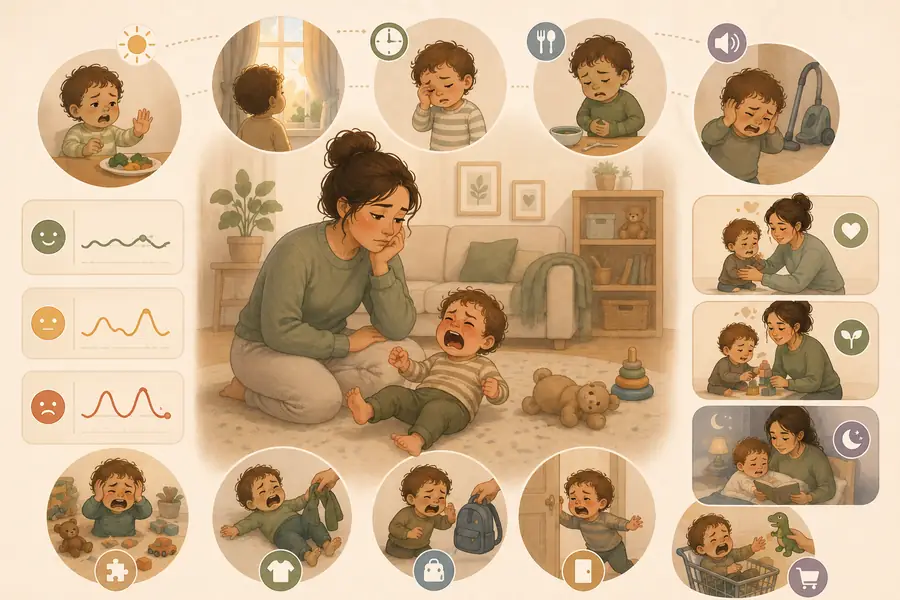
If tantrums spike at the same transition every day (leaving the park, turning off the tablet, getting in the car), it is rarely "random." It is a repeating trigger story you can read in a week. Curiosity beats shame: you are building a map, not a verdict.
🎨 Something to try today: the Developmental activity finder suggests play that fits your child's age and what they are working on.
- About 70% of recurring tantrums track to fatigue, hunger, transitions, or sensory load, not to "personality"
- Toddler emotional regulation is still developing until roughly age 4–5; meltdowns at 2–3 are normal biology, not parenting failure
- Recovery time (minutes to regulate) is usually a stronger pattern signal than intensity
- One bad afternoon is noise. Three at the same transition in a week is data.
Look for patterns across 5–7 days, not one day. For the full method, start at Track your baby's patterns and the behavior sub-pillar How to track toddler behavior patterns.
_Educational only. Not medical advice. Last updated: February 2026._
Quick reference
| Field to log | Why it matters |
|---|---|
| Trigger / context | What happened in the 5 minutes before? (transition, "no," hunger, fatigue, sibling, screen, noise) |
| Intensity 1–3 | Simple scale, perfection is not the goal |
| Recovery (minutes) | How long until regulation returned? More predictive than loudness |
| Time of day | Late-afternoon spikes are usually fatigue + hunger, not "attitude" |
| Sleep the night before | Sleep debt is a multiplier on every threshold |
What "tantrum" actually is, biologically
A tantrum is not bad behavior. It is a developmentally normal emotional flood in a brain that does not yet have the prefrontal capacity to regulate it. The American Academy of Pediatrics is explicit: tantrums are part of normal development through roughly age 4, and the strongest interventions are co-regulation (calm presence) rather than "discipline" of the emotion itself (healthychildren.org, 2024).
This does not mean you have no boundaries. It means the boundary and the regulation are different jobs. You can hold a limit ("we are leaving the park now") and also help the child through the feeling - those are not in conflict.
Tracking triggers for a week before you adjust anything works better than reacting to each episode with a punishment or a reward.
Three common tantrum patterns
Pattern 1: late-afternoon stack
You will see this in 4–5 families out of 10. Hard moments cluster between 16:00 and 18:00, after a long day. The repeating ingredients are accumulated stimulation, falling blood sugar, sleep debt, and one more transition than the day had room for. A tiny snack at 15:45 and a calmer pickup-to-home transition often changes the entire evening, but you have to log a week to believe it.
Pattern 2: transition-specific
Same transition, same intensity, every day. Park-to-car, screen-off, dinner-to-bath. This is not the child being "difficult about transitions in general" - it is one specific transition that has accumulated a pattern. Changing the script for that transition (warning, named choice, slower pace, predictable phrasing) is the lever.
Pattern 3: post-trigger crash
Held it together at daycare, then explodes at home. This is not failure - your child likely held it together by spending all their regulation reserves at school. Recovery time at home is the indicator: it shortens when you reduce stimulation in the first 30 minutes after pickup.
Decision logic: what to try first
| Pattern in your week | Try this | Give it |
|---|---|---|
| Spikes between 16:00–18:00 | Tiny snack + calmer pickup transition | 5–7 days |
| Same transition every day | New script for that transition only (warning + choice) | 5–7 days |
| Explodes after daycare, calm there | Reduce stimulation 30 min post-pickup | 7–10 days |
| Tracks with short night before | Sleep is the real lever, see Why your baby wakes up too early | 7–10 days |
| Sudden change in baseline | Watch for illness, regression, new caregiver, hold supports, do not punish | 7–14 days |
Pick one. Run it. Compare. Stacking three interventions in the same week is how parents stop believing in what worked.
Common mistakes when "fixing" tantrums
Punishing during the flood. A toddler in a meltdown cannot access the part of the brain that learns. Punishment delivered during the storm is not received as instruction - it is received as more stimulation.
Reasoning during the flood. Talking through "why we don't hit" mid-meltdown is the same as the above. Save the conversation for calm. Use short, slow language during the storm.
Reading too much into Tuesday. One hard meltdown in a calm week is noise. Five hard meltdowns at the same time of day in a week is signal worth a small experiment.
Punishing harder on the worst day. That day usually follows a missed nap, a skipped snack, or a poor night. Punishment without context turns up the volume on a regulation problem that needed support.
When to call your pediatrician
Tantrums are part of normal development. Talk to your pediatrician if you see breath-holding episodes, head-banging that causes injury, frequent extreme distress lasting more than 25 minutes, regression in language or social skills, or any concern about safety. The CDC milestone tracker at Learn the Signs, Act Early is a useful first reference.
Frequently asked questions
When do tantrums "stop"?
For most children, frequency drops noticeably between ages 3.5 and 4.5 as language and regulation skills mature. Intensity often drops earlier; frequency lingers a bit longer.
Is "ignoring" the right response?
Ignoring the emotion is rarely right. Not engaging in negotiation is often right. Those are different: the first is "you don't matter," the second is "I am here, and the limit stands."
My child has tantrums at daycare too, what does that mean?
Could mean a few things: nap timing at daycare differs, hunger windows differ, or one specific transition there is the trigger. Ask the teacher: "Do you notice a pattern of when?" Their answer will usually surface a schedule lever you can adjust.
Should we use timeouts?
Mixed evidence, very child-specific. The NHS notes that short, calm "time-in" (staying nearby until regulated) tends to work better than isolation for toddlers under 4 (NHS, 2024).
What about reward charts?
For specific concrete behaviors (using the toilet, brushing teeth), they can help. For emotional regulation (tantrums), they tend to backfire - regulation is not a behavior the child is choosing to withhold.
How KidyGrow helps with this specifically
KidyGrow is not a "tantrum stopper" - that would be dishonest. What the app does is remember what you can't keep track of in the middle of an afternoon meltdown: which transitions repeated this week, which mornings had short sleep behind them, where the recovery times shortened. The Daily Brief reads from that real week, not from a generic age tip.
- Daily Brief highlights the most likely lever this week based on your last 5–7 days. Not "toddlers go through phases", the actual transition or time-of-day pattern your log is showing.
- Tonight plan reflects yesterday's behavior pattern. Rough recovery from a 17:00 meltdown yesterday? Tonight's plan suggests a quieter wind-down.
- Child Insights shows you whether tantrums cluster at specific times, after specific triggers, or on short-sleep days - three different stories with three different fixes.
Honest expectation. The app warms up over 3–5 days of consistent logging. By day five the pattern reads off the screen. You will not get useful behavior-pattern data from one logged meltdown - that is by design.
KidyGrow's free tier covers the baseline → one change → compare loop for behavior the same way it does for sleep.
Related (behavior cluster)
Sources
- American Academy of Pediatrics. Temper Tantrums. healthychildren.org, 2024. https://www.healthychildren.org/English/family-life/family-dynamics/communication-discipline/Pages/Temper-Tantrums.aspx
- NHS (UK). Baby and toddler behaviour guidance. nhs.uk, 2024. https://www.nhs.uk/conditions/baby/
- Centers for Disease Control and Prevention. Developmental Milestones. Learn the Signs. Act Early. CDC, 2024. https://www.cdc.gov/ncbddd/actearly
_Educational only. Not medical advice._