Kidy
Kidy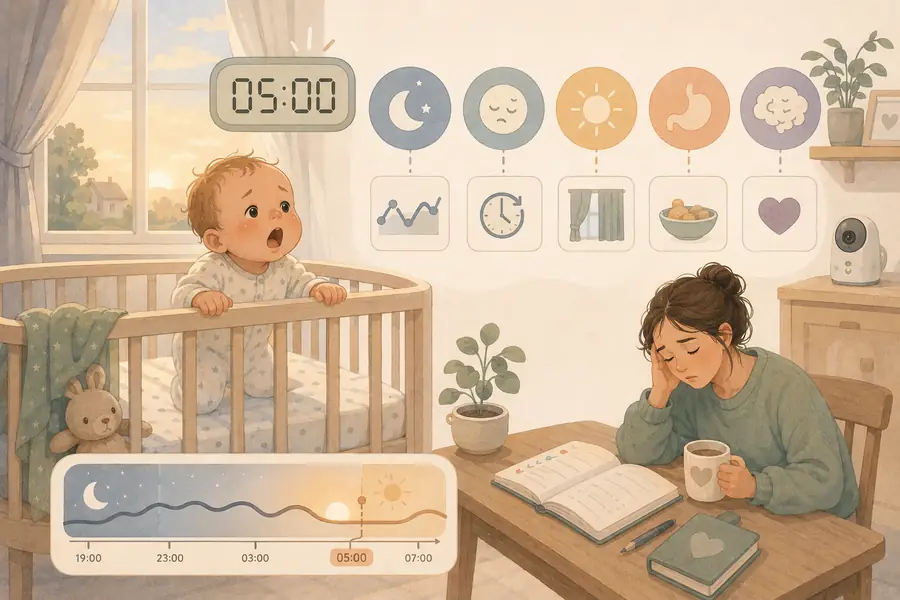
If your baby wakes at 5 a.m. most days, the cause is usually not "wrong" bedtime in isolation:
⏰ Check the timing first: enter your baby's age in the wake windows calculator and see how long they can comfortably stay awake between sleeps.
- About 3 of 4 cases involve a schedule interaction, usually first-nap timing drift or short total night sleep
- Pre-6-month early wakes often respond to feeding-window changes, not behavior changes
- Post-12-month early wakes that started suddenly are most often circadian (light, temperature, recent schedule shift)
- One bad morning is noise. Three in seven days is data.
Some weeks the 5 a.m. start feels personal, like your child has chosen war. It is almost never that. It is a schedule story you can read once you stop trying to fix it from inside the worst hour.
Look for patterns across 5–7 days, not one day. This is an entry article in our pattern-tracking cluster. For the full method, start at Track your baby's patterns and the sleep sub-pillar How to track baby sleep patterns.
_Educational only. Not medical advice. Last updated: February 2026._
Quick reference
| Check | What you are looking for | Why it matters |
|---|---|---|
| Nap timing + end time | First nap drifting later each day | A drifting first nap shifts the whole evening's sleep pressure |
| Total night sleep | Below age-typical hours, 2+ nights/week | Very early wake often follows a short night or a "too late" bedtime for that day |
| Morning habit time | Same wake within ±15 min for 5+ days | Bodies can lock onto an early rise if reinforced (feed, screen, parent attention) |
| Light + temperature | Sunrise hitting the room; room above 22°C | Both shift wake biology |
| Recent change | New tooth, illness, daycare start, vacation | Temporary triggers should fade in 7–10 days |
What "too early" actually means at this age
Early wake is not a number - it is a number relative to your child's pattern. A 5:15 wake every day in a stable 7-month-old who falls back asleep is different from a sudden 4:45 wake after weeks of 6:30 in a 14-month-old.
A few age realities the AAP keeps coming back to (healthychildren.org, 2024):
- Newborn to roughly 3 months: no real circadian rhythm yet. Early wakes are usually feeding cues, not "bad sleep."
- 4–12 months: rhythm forming. Most healthy babies wake somewhere between 6:00 and 7:30. A consistent 5:00–5:30 wake in a baby who is otherwise feeding and growing well is often a schedule conversation, not a medical one.
- 12+ months: schedule and habit reinforcement become the dominant levers. Bedtime, nap end times, and morning routines all matter more than people expect.
If wake time is moving earlier and daytime mood or feeding is degrading - that is when it stops being a schedule question.
The most common pattern: nap-timing drift
This shows up in roughly half the families who track for a week:
- Day 1: first nap at 9:30, calm evening, wake at 6:45.
- Day 2: first nap "felt early" so it gets pushed to 9:50. Wake at 6:30.
- Day 3: first nap at 10:00. Wake at 6:00.
- Day 5: first nap at 10:20. Wake at 5:40, and now bedtime is hard because of overtiredness, which shortens the night further.
You will swear nothing changed. The log will show the first nap walked 50 minutes later over five days. The fix is usually as boring as anchoring the first nap to a fixed time for 5–7 days and watching what wake time does.
The "habit clock" pattern
A baby who is fed, picked up, or otherwise rewarded for waking at 5:00 a.m. for two weeks will often start waking at 5:00 a.m. even when the underlying tiredness has resolved. This is not manipulation, it is ordinary infant learning.
The fix here is different. It is about gradually shifting what happens at 5:00 a.m., a quieter response, delaying the morning feed 5–10 minutes per day, rather than changing the schedule.
The log helps you tell which pattern you have: does early wake track with later naps (drift), or has wake time been locked at the same minute for weeks despite schedule changes (habit)?
Decision logic: what to try first
| What your week looks like | First thing to try | Give it |
|---|---|---|
| First nap walking later, bedtime stable | Anchor first nap to a fixed time | 5–7 days |
| Bedtime crept later, naps stable | Pull bedtime back 15 min for 3–4 nights, then 15 more | 5–7 days |
| Wake locked at same minute for 2+ weeks | Quieter, slower response at 5 a.m. (no lights, no full feed) | 7–10 days |
| Started after a tooth, illness, or trip | Hold the schedule, do not stack changes | 7–10 days |
| Started after new daycare or vacation | Hold schedule the first week, then review | 7–14 days |
If you change two of these at once, you will not learn anything from the next week. Pick one. Run it. Compare.
If early wake is just one piece of a bigger sleep puzzle, our full guide to baby and toddler sleep covers naps, bedtime routines, and night wakings stage by stage.
Common mistakes when "fixing" early wake
Moving bedtime later. The most common reflex, and it backfires more often than it works. Overtired babies wake earlier, not later.
Capping the first nap aggressively on day one. A drastic cap causes a meltdown and an even earlier wake the next morning. Walk naps down 10 minutes per day.
Reading too much into Tuesday. One 4:50 wake in an otherwise stable week is noise. Three 5:00 wakes in seven days is signal.
Making the decision at 5 a.m. Choices under sleep debt are not choices - they are reflexes. Pick your strategy when you are rested (or at least caffeinated).
When to call your pediatrician
Schedule conversations stay schedule conversations unless the early wake comes with snoring or breathing pauses, persistent crying or feeding refusal on wake, drops in weight or wet diapers, recurrent vomiting, or fever in babies under 3 months. The CDC keeps a simple red-flag checklist at Learn the Signs, Act Early.
Frequently asked questions
Is 5:30 a.m. just "the new normal" for some babies?
For a small subset, yes, usually short sleepers or naturally early-rise children. But normal-for-your-child should be stable over weeks, not creeping earlier. A moving target is almost always a schedule story.
Should I wake my baby earlier to "reset" the day?
Usually not the first thing to try. The risk is compounding a short night with an earlier start, which makes overtiredness worse. Consider this only after schedule changes have run their 5–7 day window without effect.
How long does daylight saving time take to resolve?
For most healthy infants, 7–10 days with no scheduling changes. If you are still seeing the shift after two weeks, you have a non-DST pattern you can now diagnose against the log.
My partner thinks bedtime is wrong; I think it is naps. How do we settle it?
The log settles it. Pick the two competing hypotheses, test bedtime for 7 days (nothing else changes), then naps for the 7 days after. The week you stop arguing is the week you start fixing it.
Does a blackout shade actually help?
In some homes, yes, measurable difference. Especially if the room currently lights up at 5:15 and you live somewhere with a 5:30 sunrise in summer. The NHS notes that environmental cues (light, temperature) are real drivers in infant wake biology (NHS, 2024).
How KidyGrow helps with this specifically
KidyGrow does not promise to "stop early wakes" - no app honestly can. What it does is remember what sleep-deprived parents can't: which mornings cluster, which evenings preceded them, when the first nap actually drifted. It reads from your real week, not from an average-baby template.
- Daily Brief each morning surfaces the most likely lever for your child based on the last 5–7 days. Not "8-month-olds need...", the actual interaction your log is showing (e.g., "first nap drifted 35 minutes over 4 days").
- Tonight plan reflects yesterday's pattern. If your log shows overtired evenings before early wakes, tonight's plan suggests an earlier wind-down rather than a generic bedtime number.
- Child Insights lets you see whether early-wake mornings cluster after late naps, short nights, or specific external events - the pattern reads off the screen instead of out of memory.
Honest expectation. The app warms up over 3–5 days of consistent logging. Day one you see age-based defaults. By day five it is reflecting your baby's actual rhythm. You will not get useful "what is driving the 5 a.m. wake" data from a single morning of input.
KidyGrow's free tier covers the baseline → one change → compare loop. You do not need to pay anything to read this pattern.
Related (sleep cluster)
- Baby only naps 30 minutes
- Bedtime battles
- Nothing seems to work with baby sleep
- How to track baby sleep patterns
Sources
- American Academy of Pediatrics. Getting Your Baby to Sleep. healthychildren.org, 2024. https://www.healthychildren.org/English/ages-stages/baby/sleep
- NHS (UK). Baby and toddler sleep guidance. nhs.uk, 2024. https://www.nhs.uk/conditions/baby/
- Centers for Disease Control and Prevention. Developmental Milestones. Learn the Signs. Act Early. CDC, 2024. https://www.cdc.gov/ncbddd/actearly
_Educational only. Not medical advice._