 Kidy
KidyBaby Tooth Eruption Timeline
Enter your child's age in months and you'll see how many baby teeth are typical by now, which have likely come in, and which are next up.
verified Last updated: May 2026 · AAP eruption guidelines

How the eruption ranges work
Primary teeth come in a predictable order, but every baby keeps their own schedule. The American Academy of Pediatric Dentistry (AAPD) and the European Academy of Paediatric Dentistry (EAPD) publish the same consensus ranges: lower central incisors usually come first, second molars last.
All 20 primary teeth have typically come in by the end of age 3. The "min–max" range for each tooth type shows when it can appear, from the earliest to the latest typical month. A child inside that range is normal; only a significant departure (e.g., first tooth after 18 months) is a reason for a dental check.
Order:
- Lower central incisors (6–10 mo)
- Upper central incisors (8–12 mo)
- Upper lateral incisors (9–13 mo)
- Lower lateral incisors (10–16 mo)
- Upper first molars (13–19 mo)
- Lower first molars (14–18 mo)
- Upper canines (16–22 mo)
- Lower canines (17–23 mo)
- Lower second molars (23–31 mo)
- Upper second molars (25–33 mo)
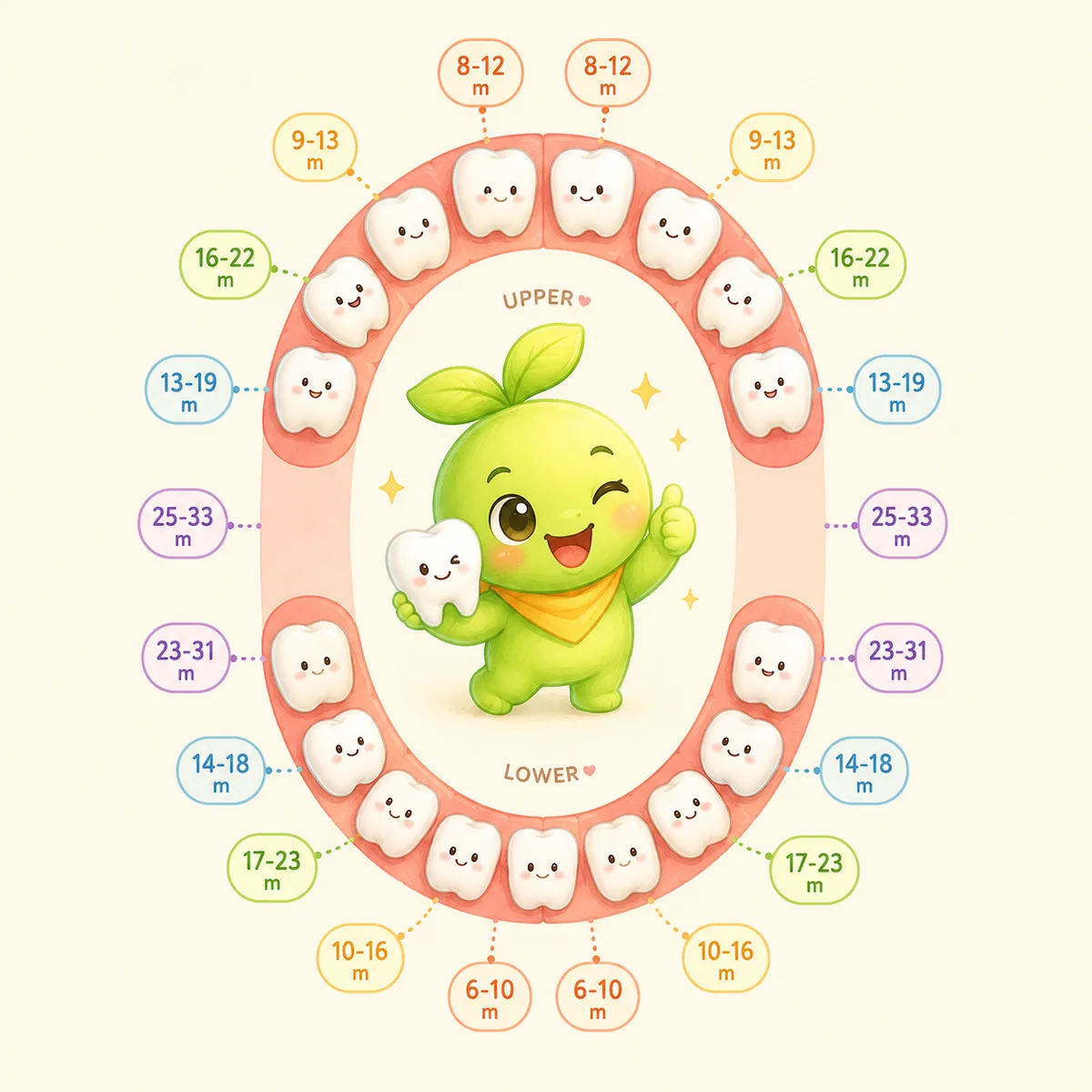
Visual timeline (0–36 mo)
Horizontal axis: months. Each bar shows the typical range when that pair of teeth appears.
groupsWhat parents most often notice
Medical signs are one thing. Here's how teething actually shows up for parents day to day:
- Everything goes in the mouth, toys, the remote, mom's nose
- More night wakings and nap refusal
- Chewing the pacifier instead of sucking it
- Red cheek on the side a tooth is breaking through
- Drooling like a faucet, bib change every hour
- Refusing the bottle or breast (sucking hurts)
- Evening fussiness and constant clinginess
- Sudden meltdowns for no obvious reason
If it feels like sleep went sideways right when a tooth is breaking through, you're probably right. The two naturally overlap.
Medical signs of teething
A few days before a tooth breaks through, babies show familiar signs:
- Increased drooling, often the main signal, starts 1–2 weeks before the tooth
- Chewing on anything in reach (toys, fingers, parents' jewelry)
- Red, swollen gums over the tooth site
- Red cheek on the side where the tooth is coming in
- Mild low-grade fever (up to 38°C / 100.4°F, not true fever)
- Fussiness and crying without obvious cause
- Sleep changes, night wakings, resistance to naps
- Reduced appetite or refusing meals
What teething is NOT: high fever (over 38.5°C / 101.3°F), diarrhea, weight loss, or a rash. Those are infection signs and need a pediatric exam. A viral infection often coincides with teething, which creates the impression of a "teething fever". There's more on this in the fever section.
Can teething cause a fever?
Short answer: a slight rise, yes; a real fever, no. Teething can lift the temperature by about half a degree, but anything over 38.5°C (101.3°F) is almost certainly an infection, not a tooth.
Studies that tracked babies through teething (Wake et al. 2000; Macknin 2000) show the typical rise is mild (≤ 38°C / 100.4°F) and short (1–2 days around the tooth breaking through). Anything bigger has another cause.
| Temperature | Likely | What to do |
|---|---|---|
| Up to 37.5°C / 99.5°F | Normal, not even a low-grade fever | No action needed |
| 37.5–38°C / 99.5–100.4°F | Possibly teething if paired with other signs (drooling, chewing) | Cool the room, rest, watch other symptoms |
| 38–38.5°C / 100.4–101.3°F | Borderline, overlap with teething, but also possibly a mild infection | Watch; if it lasts more than 24 h or the child looks unwell → pediatrician |
| Above 38.5°C / 101.3°F | Likely infection, not teething | Pediatrician, especially with other signs (diarrhea, cough, lethargy) |
The AAP and European pediatric associations are clear: "teething fever" as a popular term can be dangerous because it distracts from the real cause. If the fever is rising or your child looks visibly unwell, don't blame teething. Check for infection.
How to help your baby through teething
- Chilled teethers, silicone or hard rubber from the fridge. Not frozen (can injure gums).
- Chilled water in a bottle or a chilled, twisted washcloth to chew on
- Gum massage with a clean finger, light pressure helps
- More nursing or bottle, extra cuddles and soothing, if it's overlapping with worse sleep, check the wake windows for your child's age to avoid the overtiredness that makes everything harder
- Wipe drool with a soft cloth to prevent chin rash
- Medication (infant acetaminophen by dose) only on pediatrician advice
Avoid: amber necklaces (choking and strangulation risk), benzocaine gels (FDA warning for babies under 2), homeopathic teething tablets (FDA warned in 2017 over inconsistent belladonna doses).
When to talk to the pediatrician or dentist
- First tooth has not come in by 18 months
- Fever over 38.5°C (101.3°F), strong diarrhea, or dehydration (likely infection, not teething)
- Tooth is coming in crooked or the color is unusual
- Baby has severe pain that doesn't respond to cold and normal measures
The first preventive dental visit is recommended by the first birthday or 6 months after the first tooth comes in. The goal is familiarizing the child and care advice, brushing from the first tooth, fluoride, healthy nutrition.
Methodology
The calculator uses the AAPD consensus ranges for primary tooth eruption, the standard in pediatric and dental practice. The same ranges are used in EAPD guidelines (European Academy of Paediatric Dentistry).
Last reviewed: May 2026. The ranges have been a stable medical consensus for decades, the date marks when our implementation was last aligned with published guidelines.
About the tool: KidyGrow was built by a parent and software engineer who wanted a simpler way to follow a child's development between well-child visits. The goal isn't to replace the pediatrician or dentist, but to give a reference you can cross-check with your provider.
help_outlineFAQ
In what order do baby teeth come in?
Most often: lower central incisors (6–10 mo), upper central incisors (8–12 mo), upper lateral (9–13 mo), lower lateral (10–16 mo), first molars (13–19 mo), canines (16–23 mo), second molars (23–33 mo). All 20 primary teeth usually appear by age 3.
When should my baby get their first tooth?
Most often between 6 and 10 months, but the range is wide, some babies get a tooth at 3 months, others after their first birthday.
If no tooth has come in by 18 months, it's worth a conversation with the pediatrician or dentist.
What are the signs of teething?
Increased drooling, chewing on toys and fingers, red cheeks, mild low-grade fever (up to 38°C), restless sleep, fussiness without obvious cause, reduced appetite.
High fever (over 38.5°C) or diarrhea aren't from teething, those are infection signs and need the pediatrician.
What if my child is late getting teeth?
Late teething is often hereditary, if parents teethed late, the child often does too. Pediatricians don't typically worry before 18 months.
If no teeth by then, or the count is far off the typical age, the dentist can check development with an X-ray.
How do I help my baby through teething?
Chilled teethers (silicone or rubber from the fridge, not frozen), a chilled wet washcloth, gum massage with a clean finger, more nursing or comfort time. Medication only on pediatrician advice.
Avoid amber necklaces and benzocaine gels, not safe.
When should a baby see the dentist for the first time?
The first visit is recommended by the first birthday or within 6 months of the first tooth coming in. The goal isn't treatment but familiarizing the child and getting care advice.
Routine visits then continue every 6 months.
Sources
- American Academy of Pediatric Dentistry (AAPD), Eruption Charts of Primary Teeth.
- American Academy of Pediatrics, Teething: 4 to 7 Months.
- European Academy of Paediatric Dentistry (EAPD), early dental health recommendations.
- FDA Safety Communication (2017), homeopathic teething products.
Informational only, not a substitute for pediatric or dental care.