 Kidy
Kidy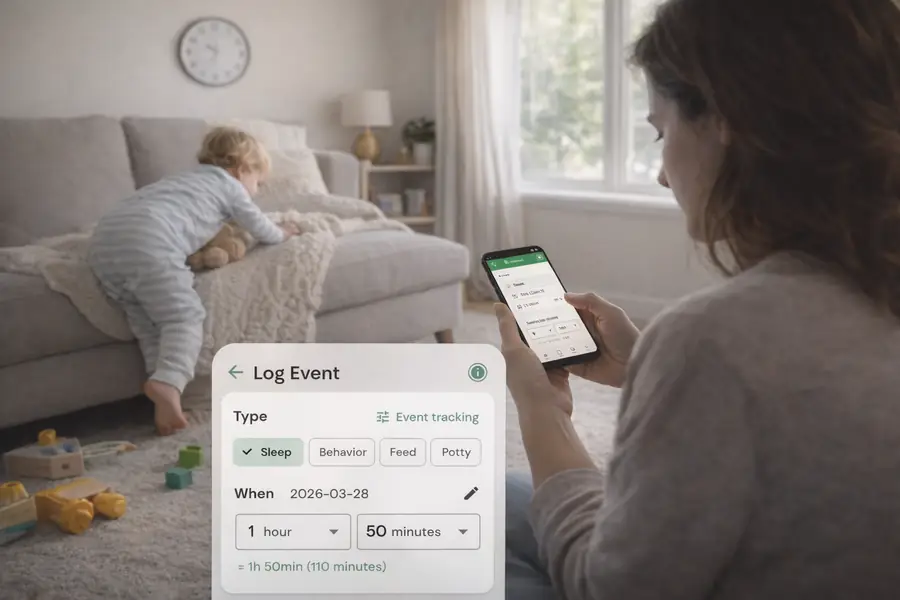
If your toddler fights one of the two naps and bedtime falls apart, the question isn't whether to drop a nap. It's whether they're ready, and how slowly to move.
- Look for 2+ weeks of resistance, not 2 days, before calling it readiness
- Log naps, bedtime, and evening behavior for 10–14 days through the transition
- Move the morning nap later by 15 minutes a week. Don't drop it cold.
- Expect 2–6 weeks of messy middle, with bridge naps on the hard days
- Cap the new single nap around 2.5 h and end it by 15:00 to protect bedtime
⏰ Check the timing first: enter your baby's age in the wake windows calculator and see how long they can comfortably stay awake between sleeps.
Transitions go badly mostly for one reason: moving too fast, and mistaking a transition trough for a regression. KidyGrow shows the trend across days in the Daily Brief, so you can tell whether the evenings are settling or getting worse.
Quick Reference: typical 2-to-1 nap transition by age
| Age | Most likely transition | Sign to watch for | Sustainable single nap |
|---|---|---|---|
| 12–13 months | Too early for most | Fighting one nap occasionally | Not yet |
| 13–15 months | Possible but uncommon | Consistent 2-week refusal of one nap | 12:00–14:00 |
| 15–18 months | Most common window | One nap regularly skipped, late bedtime | 12:00–14:30 |
| 18–24 months | Sometimes still 2 | Dropping the morning nap cold turkey | 12:30–14:30 |
| 24+ months | All on 1 | Single nap looks set | 12:30–14:30 |
Source: AAP healthy sleep ranges. KidyGrow uses your child's actual logs to see whether their pattern fits the average window or sits outside it. Averages are the starting line, not the answer.
Why nap transitions feel impossible
You cut the morning nap. Bedtime turns into a meltdown. You bring it back. Three days later they refuse it again. You read twelve guides, half of which say follow their cues and half of which say hold the new schedule.
The problem is that you're acting on two or three days of data when a nap transition only becomes readable over two weeks. One bad afternoon means nothing. A 14-day pattern means the transition is real. If nap timing and total sleep needs still feel murky beyond this one change, our full guide to baby and toddler sleep covers what shifts at each age from newborn onward.
The American Academy of Pediatrics is explicit that infants 4–12 months need 12–16 hours of total sleep including naps, and toddlers 1–2 years need 11–14 hours (AAP, 2016). During a transition, total sleep usually dips for a while. That is expected. The job is to keep the two-week average inside the band, not to defend any single nap.
Nap transitions are downstream of the previous 10 to 14 days, not of yesterday, and KidyGrow is built around that. The Daily Brief reads bedtime drift, evening behavior, morning wake, and the shape of the whole stretch, then answers the only question that matters this week: push forward, or hold.
The 4 hidden traps of the 2-to-1 transition
1. You moved the schedule too fast. Going from a 9:30 morning nap to no morning nap overnight is too big a jump for most toddlers. A 15-minute shift per week (9:30, then 9:45, then 10:00) lets the body adapt. KidyGrow flags when bedtime trouble lines up with the shift days specifically.
2. You mistook the trough for a regression. Weeks two and three are usually the worst part: a short single nap, a hard bedtime, an early wake. Parents often roll back to two naps exactly when the body is a few days from settling. See signs your baby is overtired for the cortisol pattern that impersonates a regression.
3. The single nap is too short, or ends too late. Under 90 minutes won't carry the day. Ending past 15:00 for under-2s eats the evening sleep pressure. Both patterns get flagged once they repeat. See why bedtime spirals for the same logic on the evening side.
4. You refused the bridge naps. Some days need a 20-minute bridge nap in the stroller or the car to reach bedtime without a meltdown. That isn't going backwards. That is surviving the middle. NHS guidance puts consistency of routine above rigidity of schedule (NHS, 2024).
Step-by-step: 2-to-1 transition in 3 to 6 weeks
Week 1: log, don't change. Tap-log naps, bedtime, morning wake, and evening behavior (calm, fussy, meltdown). No schedule change yet. KidyGrow needs about seven days to learn what a normal two-nap week looks like for your child, and that baseline is what everything after gets compared against.
Week 2: read the Daily Brief, then move the morning nap 15 minutes. If it flags real readiness (a consistent fight at one nap, plus a late bedtime, plus an early wake), shift the morning nap 15 minutes later and hold that for seven days. Do not drop it. Log evening behavior every night, because it is the cleanest signal you have.
Week 3–4: keep shifting, or hold. If evening behavior is stabilizing, shift another 15 minutes. If it's deteriorating, hold this week. Most toddlers walk the morning nap from around 9:30 to around 11:30 over four to six weeks before it merges into a single midday nap. Use a bridge nap on the days the arithmetic doesn't work.
Week 5–6: merge into one midday nap. Once the morning nap sits near 11:30 and consistently runs 30 minutes or less, drop it and lay down at about 12:00 instead. Cap it at 2.5 hours, end by 15:00, and move bedtime 30 minutes earlier to absorb the lost daytime sleep.
Week three is the week most people quit. The single nap comes in at 50 minutes, dinner is a disaster, and it genuinely looks like proof you got it wrong. Give it four more days before you decide.
Throughout: open the wake-too-early guide if an early wake shows up mid-transition, because it's a common temporary effect of the change.
Common mistakes parents make
- Declaring readiness after two days of nap refusal, which is usually a regression rather than the transition
- Dropping the morning nap cold instead of shifting 15 minutes a week, which more or less guarantees overtired meltdowns
- Refusing every bridge nap on principle. Survival beats purity during the messy middle.
- Letting the single nap run past 15:00. See the bedtime chaos guide for why that wrecks the evening.
- Leaving bedtime where it was. Moving it 30 minutes earlier through weeks three to six protects total sleep.
When to seek professional help
KidyGrow handles patterns and routines, not medical evaluation. Talk to your pediatrician if any of these apply:
- Total daily sleep is consistently below the AAP minimum for the age, meaning under 11 hours at age 1–2, for more than two weeks
- Loud snoring, mouth breathing, or visible pauses while sleeping (possible sleep apnea)
- Persistent distress at every nap attempt that doesn't ease with a calmer routine
- Sudden new wake patterns, frequent night wakes, or a behavioral regression. See baby suddenly waking more at night.
- The pattern hasn't moved at all after four to six weeks of consistent transition work
The AASM practice parameter found that consistent behavioral routines improve infant sleep without harming attachment (Mindell et al., 2006, Sleep), which is exactly the kind of routine this transition asks you to hold, one 15-minute shift at a time.
Frequently asked questions
How do I know if my toddler is actually ready for one nap?
Two weeks or more of consistently fighting one of the two naps, a late bedtime even on days both naps happened, and often an early wake. Two or three days of nap drama is almost always a leap or a regression instead.
My 13-month-old fights nap 2. Are they ready to drop?
Probably not. Thirteen months is on the early edge, and the more likely explanation is that the morning nap is too long or too late and is eating the second one. Cap the morning nap at 60 minutes, end it by 9:30, and watch for a week before reading it as a transition signal.
Why is bedtime worse during the transition?
Because total daily sleep dips through weeks two to four, and overtiredness shows up at bedtime as cortisol-driven resistance. It usually resolves by week five or six if you keep shifting and hold the earlier bedtime. Still worsening at week six means you are moving too fast.
Should I cap the new single nap?
Yes. 2.5 hours, ending by 15:00 for under-2s. Longer or later drains the evening sleep pressure, which creates a hard bedtime, which creates an early wake, which makes tomorrow's nap harder. It's a loop.
What if 4–6 weeks pass and we're still in chaos?
Then it's probably not the schedule. A developmental leap, a change of environment, or a medical factor are all worth ruling out, and the Daily Brief will tell you when the pattern has stopped responding to 14 days of consistency. See nothing helps toddler sleep for the broader checklist.
How KidyGrow helps with the 2-to-1 nap transition
Day one, the app is generic: "most toddlers move to one nap between 15 and 18 months." Day fourteen, once you have logged two weeks, it sounds different: "morning nap fought 5 of 7 days this week, bedtime averaged 30 minutes later than baseline, morning wake unchanged. That reads as real readiness. Shift the morning nap to 9:45 for the next 7 days and re-check."
That shift is the whole product. The question during a transition is never "what does the average toddler do", it's "is this week better or worse than last week", and that is exactly the question a tired parent cannot answer from memory. The app remembers instead, so when you ask whether to push or hold, it already knows five of seven mornings had a nap fight and that bedtime drifted half an hour.
It also knows when to tell you to wait. Trends run across 7 to 14 days, so one rough Tuesday doesn't trigger a panic rollback to two naps, and a genuine two-week worsening trend gets read as a signal to slow down rather than as bad luck. The mechanics are in behind the scenes: how KidyGrow's AI learns.
Sometimes it has nothing. A transition that collides with molars, a house move, and a new daycare room produces no clean pattern at all, and the Brief will say so instead of inventing one.
The Daily Brief and Tonight plan are part of the paid tier. Free accounts can log and see basic patterns, which is enough to catch the obvious link between a single nap ending late and a wrecked bedtime.
The useful thing isn't a schedule. It's being able to answer, on the worst Wednesday of week three, whether this is working.
Sources
- American Academy of Pediatrics, "Healthy Sleep Habits: How Many Hours Does Your Child Need?" (2016, updated 2022). https://www.healthychildren.org/English/healthy-living/sleep/Pages/Healthy-Sleep-Habits-How-Many-Hours-Does-Your-Child-Need.aspx
- NHS, "Helping your baby to sleep" (Start for Life, 2024). https://www.nhs.uk/conditions/baby/caring-for-a-newborn/helping-your-baby-to-sleep/
- Mindell JA et al., "Behavioral treatment of bedtime problems and night wakings in infants and young children", Sleep (2006). https://pubmed.ncbi.nlm.nih.gov/17068979/
_Educational content. Not a substitute for medical advice. Talk to your pediatrician if you have concerns about your child's sleep._