 Kidy
Kidy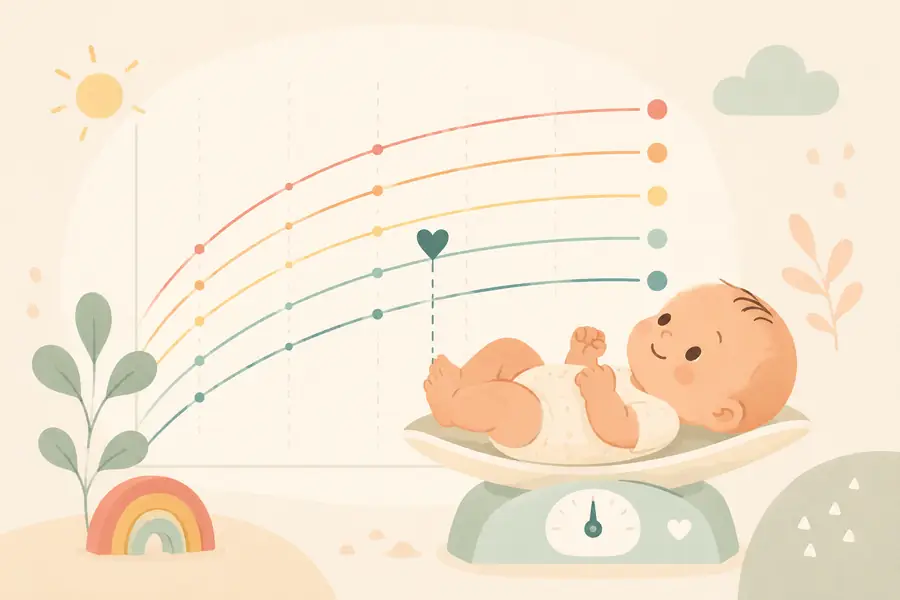
Your pediatrician points at a curve and says "she's in the 25th percentile", and your parent-brain immediately translates it into a grade. It isn't. Before the long version, the short list:
- The 50th percentile is the median, not a passing grade. By definition, half of healthy babies sit below it
- The 3rd to 97th percentile is the normal range. A baby tracking the 10th can be as healthy as one tracking the 90th
- Moving across lines is common early on: in one large study, 39% of healthy babies crossed two major weight lines between birth and 6 months
- What matters is the direction over several visits, together with feeding, wet nappies and how alert your baby is
- The WHO charts describe how healthy breastfed babies grow in good conditions, which is why they are the standard for the first two years
What finally moved me from reading percentiles as grades to reading them as positions was the twins. Same parents, same belly, same dinner table, and from the start they tracked different curves. The number wasn't a score. It was a snapshot of who was who, and the lines they each followed were the real story.
Quick Reference: what each percentile range means
| Percentile range | Where your baby sits | What it usually means |
|---|---|---|
| Below 3rd | Bottom 3% | Worth a pediatric review. The trend matters more than this one point |
| 3rd to 25th | Smaller side of normal | Healthy if growing along their own line; often family size |
| 25th to 75th | Middle half | The most common range; says little about future size |
| 75th to 97th | Larger side of normal | Healthy if growing along their own line; often family size |
| Above 97th | Top 3% | Worth a pediatric review, usually together with feeding context |
Reading rule: the number is a snapshot. The line your baby follows across visits is the signal.
What does a baby's weight percentile actually mean?
A weight percentile compares your baby with healthy babies of the same age and sex. "25th percentile" means that out of 100 such babies, your baby weighs more than about 25 and less than about 75. That is the whole definition. It is a position in a group of healthy children, not a verdict.
For the first two years the reference is the WHO Child Growth Standards (2006). They were built from babies in Brazil, Ghana, India, Norway, Oman and the USA who were breastfed and raised in good health and feeding conditions (WHO, Child Growth Standards). So the chart describes how healthy babies can grow, not simply how babies in one country happen to grow. The 3rd and 97th are not danger lines. They are the statistical edges where a doctor takes a second look.
Is the 25th percentile bad?
No. A low percentile on its own does not mean a baby is unhealthy. A baby at the 25th is, by definition, sitting inside the healthy reference group. The chart has no "bad" middle zone.
What pediatricians actually look at:
- Direction: is your baby following roughly the same line from visit to visit?
- Pace: is the gain right for the age? Gain is fastest in the first months and slows after that
- Proportion: do weight and length sit on roughly similar lines? The NHS notes it is normal for them to differ a little, but they are usually fairly close (NHS, baby height and weight)
The surprising part: crossing lines is common
The rule most parents hear is "crossing two lines is a warning sign". In the doctor's office it is indeed one of the usual definitions of slow weight gain. But look at what happens in healthy babies.
A CDC team followed nearly 11,000 children with more than 44,000 measurements. Between birth and 6 months, 39% crossed two major weight-for-age lines. Between 6 and 24 months that fell to 6 to 15%, and after two years to 1 to 5% (Mei et al., Pediatrics 2004). The authors conclude that doctors should keep how common these shifts are in mind before they worry parents or refer a child.
A review for family doctors says the same from the clinical side. Crossing two major lines, or a weight below the 5th percentile, are the usual office definitions, but any single one of these has a low predictive value for real undernutrition. In one study, 27% of infants met at least one definition during their first year. The review lists normal reasons a line drops: children of small parents growing into their genetic size, big newborns settling towards the middle, and premature babies whose numbers look normal once corrected for age (Cole & Lanham, American Family Physician 2011).
If a doctor has ever said "failure to thrive", you may hear it less from now on. In March 2026 the AAP and the North American pediatric gastroenterology society (NASPGHAN) replaced it with faltering weight, and swapped percentiles for z-scores (Kersten et al., Pediatrics 2026). Faltering weight now means any one of three things: weight-for-length (or BMI) below the 5th percentile; in a child under two, weight gain slower than the 2.3rd percentile for age; or a fall in weight, weight-for-length or BMI of at least one z-score. The same guideline says tests are only for children with specific warning signs or weight that keeps faltering. The first step is a good history, an exam and a look at feeding.
So a big drop in the first months is a reason to look closer, not proof that something is wrong. The NHS puts it simply: weight may go up or down by one line, crossing two is less common, and if it happens you talk to your health visitor.
What makes a drop worth acting on
A drop becomes a real signal when it comes with something else:
- it keeps going over three or more checks instead of settling
- it happens after 6 months, when big shifts are much rarer
- feeding has become hard, wet nappies are fewer, or your baby is unusually sleepy
- weight falls while length keeps rising, so the two lines split apart
What usually does not need action:
- a baby who has followed the 10th since birth and is alert, feeding well, and has plenty of wet nappies
- a move of one line between two checks
- the weight loss in the first days after birth. The NHS says this is normal, babies are weighed in the first two weeks to check they are regaining it, and most are back at or above birth weight by 3 weeks
Things that move the number (and are normal)
- The first weeks. Newborns lose weight, regain it and then settle onto their own line.
- Family size. Small parents often have small, healthy children. This is exactly the "normal variant" doctors check for before anything else.
- Prematurity. Premature babies are plotted by corrected age, which the AAP recommends using for the first two years (AAP, Corrected age for preemies). Plotted by calendar age, a healthy preemie looks far too low.
- Starting solids. Some babies plateau briefly while solids replace part of their milk.
- Illness. A few days of fever or diarrhoea can dent the next weighing without changing the long line.
How milk and solids change from birth to three, stage by stage, is in the baby and toddler feeding guide.
Decision logic: wait or act
| What you see | What to do |
|---|---|
| One-line move, baby alert and feeding well | Wait for the next check and note it |
| Steady line at any percentile, good feeding signs | No action needed |
| Two-line drop in the first 6 months, baby well | Mention it at the next check; ask to see the trend |
| Continuing drop over 3+ checks, or any big drop after 6 months | Book a visit to discuss |
| Low number plus poor feeding, few wet nappies or a very sleepy baby | Call within a day or two |
| Newborn not back to birth weight by about 3 weeks | Call your midwife, health visitor or pediatrician |
Common mistakes parents make reading the chart
- Treating it as a school grade. "She's only in the 25th" is not a low mark. It is a healthy position.
- Comparing with a friend's baby. Two babies can be the same age and sit ten lines apart, both healthy.
- Reacting to one visit. One point is not a curve. Wait for three.
- Changing feeds because of the number. Wet nappies, alertness and hunger cues tell you about today; the chart describes a population. When eating itself is the worry, see when "baby not eating much" needs attention.
- Using calendar age for a premature baby. Check that corrected age is being used.
When to seek professional help
Talk to your pediatrician or health visitor if you see:
- weight falling across lines over several checks, or a large drop after 6 months
- a newborn who is not back to birth weight by about 3 weeks
- a low percentile together with feeding problems, few wet nappies or low alertness
- weight and length lines moving apart
- no weight gain over several weeks in a young baby
Trust your gut alongside the chart. What to bring to make the visit count is in how to prepare for a pediatric visit using your child's data, and portion benchmarks for the toddler years are in how much a toddler should eat.
Frequently asked questions
Is a baby in the 10th percentile small?
Smaller than most babies of the same age and sex, yes; about 90 in 100 are heavier. Small does not mean unhealthy. If your baby follows their own line, feeds well and is meeting milestones, the 10th is inside the normal range.
My baby dropped from the 75th to the 25th in the first months. Is that bad?
Not necessarily. In the Mei study, almost 4 in 10 healthy babies crossed two major weight lines before 6 months. It is still worth raising at the next check, so the doctor can look at length, feeding and the following measurements together.
Should I give formula if my breastfed baby is on a low percentile?
Not because of the number alone. That decision rests on feeding signs, wet nappies, stools and alertness. Talk to your pediatrician or a lactation consultant before changing the plan.
Why do weight and length sit on different lines?
It is normal for them to differ a little. The NHS says they are usually fairly similar. A gap that keeps widening is what gets checked.
How accurate are home baby scales?
Less accurate than clinic scales, and small differences between weighings are common. If you weigh at home, use the same scale, the same time of day and the same clothing, and do not read a trend from one reading.
How KidyGrow helps
In KidyGrow you enter weight, length and head circumference, and each measurement gets a WHO percentile. If you recorded a birth before 37 weeks, the app uses corrected age automatically. Below the 3rd or above the 97th percentile, it suggests talking to your pediatrician.
What it does not do is judge a line crossing for you. The app remembers every measurement, so the chart is personalized to your baby's own line over time, and reading that line together with feeding and nappies stays with you and your doctor. For a one-off check, use the growth percentile calculator.
Sources
- World Health Organization. WHO Child Growth Standards (2006). https://www.who.int/tools/child-growth-standards
- Mei Z, Grummer-Strawn LM, Thompson D, Dietz WH. Shifts in percentiles of growth during early childhood: analysis of longitudinal data from the California Child Health and Development Study. Pediatrics. 2004;113(6):e617-27. https://pubmed.ncbi.nlm.nih.gov/15173545/
- Cole SZ, Lanham JS. Failure to thrive: an update. American Family Physician. 2011;83(7):829-834. https://www.aafp.org/pubs/afp/issues/2011/0401/p829.html
- NHS. Your baby's height and weight. https://www.nhs.uk/baby/babys-development/height-weight-and-reviews/baby-height-and-weight/
- American Academy of Pediatrics. Corrected Age For Preemies. HealthyChildren.org. https://www.healthychildren.org/English/ages-stages/baby/preemie/Pages/Corrected-Age-For-Preemies.aspx
- Kersten HB, Goday PS, et al. Clinical Practice Guideline for Diagnosis and Management of Faltering Weight. Pediatrics. 2026. https://pubmed.ncbi.nlm.nih.gov/41833317/