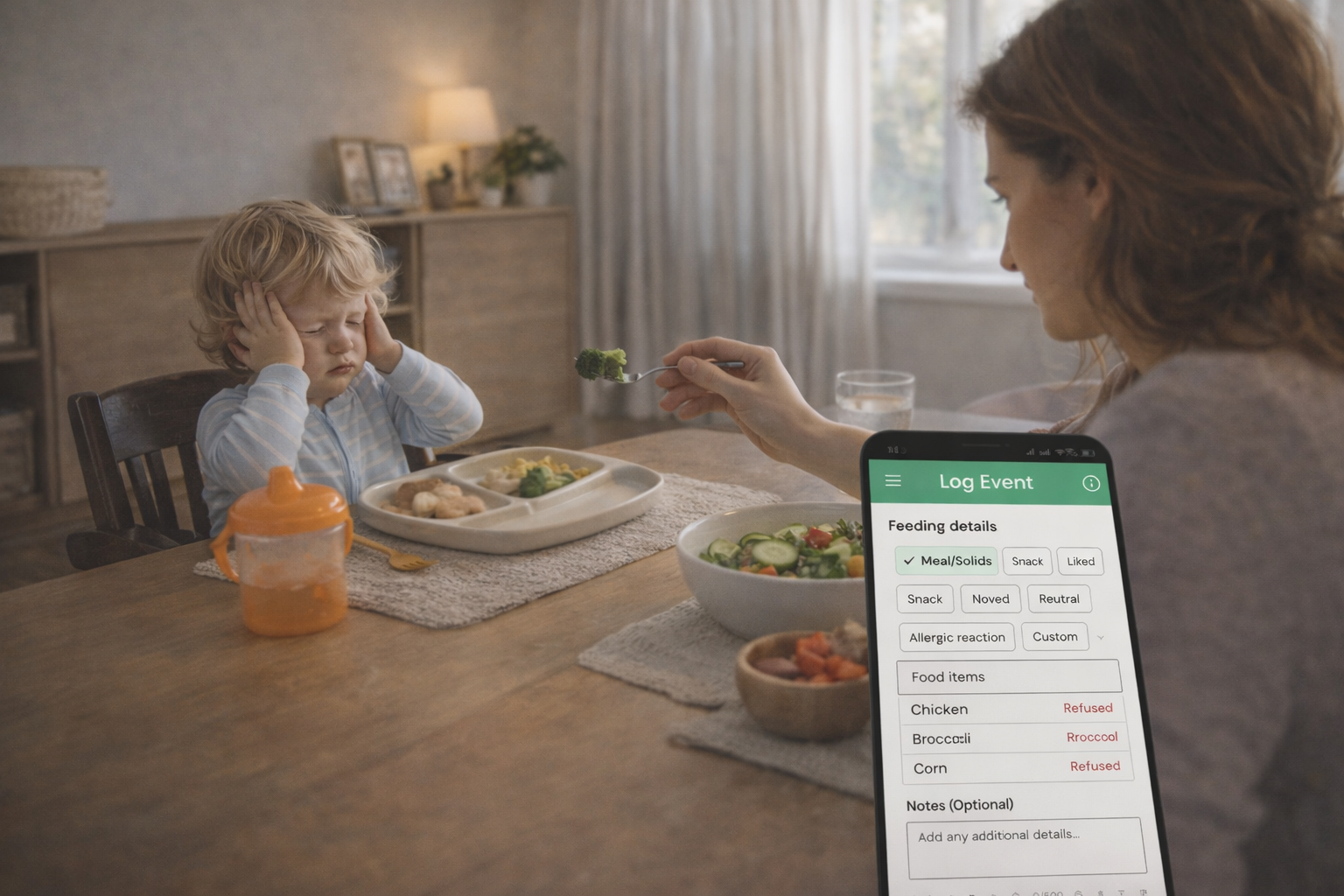
If dinner is a daily battle and "no pressure" advice isn't working, the food is probably not the problem. KidyGrow logs meals alongside sleep, naps, and behavior, then shows whether refusal clusters after short naps, late daycare pickup, or a hunger window you missed — so you fix the actual upstream cause instead of the food on the plate.
- Log meals (what + accepted/refused + mood) for 7–10 days alongside naps and bedtime
- Read the Daily Brief — it shows which factor most correlates with dinner battles
- Test ONE upstream change for 5–7 days and watch the trend, not single meals
- Hold the division of responsibility: you decide WHAT and WHEN, child decides HOW MUCH
- Use the rest of the day too — overtired or dysregulated kids don't eat well
The biggest reason mealtime battles resist fixing is you change the food when the issue is the 90 minutes before the meal. KidyGrow surfaces the upstream signal in the Daily Brief, so you stop debating broccoli and start fixing the timing.
Quick Reference: typical daily intake and meal expectations by age
| Age | Daily intake (toddler-sized) | Meals + snacks | Common battle pattern |
|---|---|---|---|
| 12–18 months | ~1000 kcal across day | 3 meals + 2 snacks | Refuses spoon-fed; wants self-feeding |
| 18–24 months | 1000–1200 kcal | 3 meals + 2 snacks | Hunger spikes 4:30, dinner war at 6:00 |
| 2–3 years | 1000–1400 kcal | 3 meals + 2 snacks | Drops to 1 favorite food, "no" stage |
| 3–4 years | 1200–1600 kcal | 3 meals + 1–2 snacks | Negotiates portions, separates foods |
| 4+ years | 1400–1800 kcal | 3 meals + 1 snack | Social/peer comparison creeps in |
Source: AAP daily intake guidance. KidyGrow uses your child's actual logs to spot whether their pattern fits or sits outside this band — averages are the starting line, not the answer.
Why mealtime battles are hard to solve alone
You try a no-pressure approach. Your toddler still throws the broccoli. You add structure. They negotiate every bite. You try hiding vegetables. They detect every gram. You read 47 conflicting pieces of advice. The issue: you're testing strategies on the meal itself instead of testing changes to what happens before the meal.
The American Academy of Pediatrics is explicit that toddler appetite is normally variable from day to day and meal to meal — and that pressure to eat actively makes refusal worse, not better (AAP, 2018). The job isn't to eliminate refusal — it's to lower how often the upstream drivers (overtiredness, transition stress, missed snack window) hit at the same time as the meal.
KidyGrow is built around this insight: dinner battles are downstream signals of the previous few hours. So the Daily Brief reads more than the meal — it reads the last nap, the last snack, the recent transition, and the day's behavior to surface the upstream trigger most worth removing.
The 4 hidden drivers of mealtime refusal
1. Overtiredness from a missed or short nap. A toddler who got 45 minutes of nap instead of 90 will refuse dinner more — overtiredness shuts down appetite and makes any frustration explode. KidyGrow flags this when the pattern repeats. See the toddler tantrum guide for the same upstream-trigger logic on behavior.
2. The 4:30 hunger crash you didn't see coming. Lunch at 11:30 + no snack until dinner at 18:00 = 6.5-hour gap, which is too long for most under-3s. By 17:30 they're past hunger into dysregulation, and dinner becomes a fight. Adding a small protein-and-carb snack at 15:30 often eliminates 70% of dinner battles by itself.
3. Transition stress. Daycare pickup, ending screen time, switching from play to table — transitions are top trigger and they land RIGHT before dinner. The fix isn't to skip them but to add a 5-minute calm landing at home before food appears (low-stim activity, dim light, no questions about food).
4. A normal growth plateau. Between 12 and 24 months, growth slows substantially and appetite drops with it. The NHS confirms this is expected and self-resolving — eating less during slow-growth months is biology, not behavior (NHS, 2024). KidyGrow's growth chart context lets you see whether your child is in a plateau and adjusts expectations accordingly.
Step-by-step: pattern detection in 3 weeks
Day 1–7: just log. Open the app and tap-log each meal (what was offered + how it went: ate well / picked / refused) alongside naps, snacks, and bedtime. No advice yet — KidyGrow needs at least 7 days for feeding patterns specifically (longer than sleep, because appetite is noisier and influenced by many upstream factors). Free-text note context if it stood out ("dad gave snack at 16:00", "missed afternoon nap").
Day 8: read your first Daily Brief. It surfaces the dominant signal — for example "last 7 days, 5 of 7 dinner refusals happened on days the last nap ended before 13:30, AND the last snack was before 15:30." Two upstream variables, both fixable. That's where you intervene, not at the food itself.
Day 9–15: test ONE upstream change. If the Brief flags the snack gap, add a small protein+carb snack at 15:30 every day for a week. If it flags short-nap days specifically, prioritize protecting the nap on weekdays. If it flags transition stress, build a 5-minute calm-landing routine after daycare. Run it for 5–7 days. Log every meal so you can actually measure the shift.
Week 3: hold the change or pivot. If refusal frequency dropped meaningfully, repeat for another week to lock it in. The brain needs ~5–7 days of the same predictable rhythm to register safety around food. If frequency didn't shift, the Brief points to the next most-correlated upstream signal.
Throughout: open how much should a toddler actually eat for the realistic intake numbers — most parents overestimate.
Common mistakes parents make
- Pressuring or bribing ("two more bites") — research shows pressure increases refusal both that meal and over the long term
- Removing the nap to "make them hungrier for dinner" — almost always backfires; overtired = less appetite, not more
- Offering 5 alternatives if the first is refused — teaches the child to wait for the preferred food
- Changing 3 strategies in one week — the brain needs 5–7 days of the same predictable food rhythm to register safety
- Ignoring the rest of the day — see how to build a routine that works for why daily predictability lowers food anxiety
When to seek professional help
KidyGrow handles patterns and prevention, not clinical assessment. Talk to your pediatrician or a feeding specialist if any of these apply:
- Weight loss or stalled growth across 2+ growth check-ins
- The child eats fewer than 20 distinct foods, or drops foods steadily
- Choking, gagging, or pain with swallowing — possible oral-motor or reflux issue
- Extreme distress at the table that doesn't ease with calmer routine
- Anxiety or rigidity around food that pre-dates toddlerhood, or sensory aversions across multiple textures
A Cochrane review found that consistent behavioral routines around feeding and sleep improve child regulation without harming attachment (Mindell et al., 2006, Sleep) — the kind of routine the KidyGrow pattern-detection helps you build, one variable at a time.
Frequently asked questions
How long until KidyGrow's mealtime pattern is reliable?
7–10 days of consistent logging is the minimum for feeding patterns specifically (longer than sleep, because appetite has more upstream drivers and more day-to-day variability). Confidence grows for ~3 weeks before plateauing.
My child eats well at daycare but refuses at home. What's that?
Almost always structure + social context. Daycare has predictable timing, peer modeling, no negotiation, and the child has nowhere else to go for food. Home meals are looser, and the child has learned that holding out gets attention or alternatives. KidyGrow flags when refusals are home-specific — and the fix is usually tighter timing + division of responsibility (you decide what+when, they decide how much), not a different recipe.
Should I let my toddler skip a meal if they refuse?
For toddlers over 1 year, yes — within reason. Offer the meal, no pressure, no alternatives. If they don't eat, the next eating opportunity is the next planned meal or snack (not in 30 minutes). This is the "division of responsibility" that the Ellyn Satter Institute and most pediatric guidelines recommend. Skipping one meal is normal and not dangerous.
What about kids who only eat 5 foods?
Limited variety alone (5–10 acceptable foods) without weight loss or distress is often within normal toddler range, especially during 18–30 months. KidyGrow tracks how variety changes month-over-month — if it's stable or growing slightly, that's typically fine; if it's shrinking steadily, that's the cue to talk to a pediatrician or feeding therapist.
What if nothing changes after a month of pattern work?
Then the issue is likely outside the routine — possible sensory processing, oral-motor issue, reflux, or food-anxiety pattern that needs specialist input. KidyGrow's Daily Brief flags when the pattern doesn't respond to schedule changes, which is your cue to talk to a pediatrician or feeding therapist. See the toddler behavior management guide for the broader screening checklist.
How KidyGrow helps you reduce mealtime battles
KidyGrow learns your child specifically. After 7–10 days of warm-up, the Daily Brief stops sounding like a script and starts sounding like a parent who actually remembers your kid's week — "5 of 7 dinner refusals in the last 7 days happened on days the last nap ended before 13:30, AND the last snack was before 15:30. Try a small protein+carb snack at 15:30 every day for a week and re-check."
Three things make this different from a generic feeding guide:
- Memory. When you ask "Why is dinner a fight again?", the AI already knows your child's name, age, that yesterday's nap was 45 minutes, that lunch was at 11:30, and that you noted "no snack today." You don't re-explain.
- Pattern over single meals. The Daily Brief shows trends across 7–14 days, so one rough Tuesday doesn't trigger five strategy pivots by Friday — and a 7-day trend gets the credit it deserves.
- One variable at a time. The Brief surfaces the most correlated upstream trigger to remove, not five — so you can actually tell what worked. See behind the scenes: how KidyGrow's AI learns for how the correlation logic actually works.
The Daily Brief and Today Plan are part of the paid tier. Free accounts can log and see basic patterns, which is enough to spot the obvious (no afternoon snack = dinner refusal) without the personalized prevention plan.
Sources
- American Academy of Pediatrics, "Picky Eaters" (2018, updated 2022). https://www.healthychildren.org/English/healthy-living/nutrition/Pages/Picky-Eaters.aspx
- NHS, "Fussy eaters" (Start for Life, 2024). https://www.nhs.uk/conditions/baby/weaning-and-feeding/fussy-eaters/
- Mindell JA et al., "Behavioral treatment of bedtime problems and night wakings in infants and young children", Sleep (2006). https://pubmed.ncbi.nlm.nih.gov/17068979/
_Educational content. Not a substitute for medical advice — talk to your pediatrician if you have concerns about your child's eating or growth._