 Kidy
KidyBaby Food Introduction Planner
Pick your baby's age and tap the allergens you have already introduced. You will get a clear next step: which allergen to try next, the textures that suit this age, iron-rich foods to prioritise, and what to leave until later. One calm plan instead of a dozen open tabs.

How to serve common first foods
The scariest part of starting solids is rarely what to offer, it's how to cut it so it's safe. Tap a food to see how to prepare it at each stage. If you've entered an age above, the matching stage is highlighted.
Pick a food to see age-by-age serving and the choking-safe cut.
Simple 3-ingredient first-food recipes
Real meals built from the plan above: each one pairs an iron-rich or allergen food with something soft, and tells you the choking-safe way to serve it. Grouped by stage, so you can jump to your baby's age.
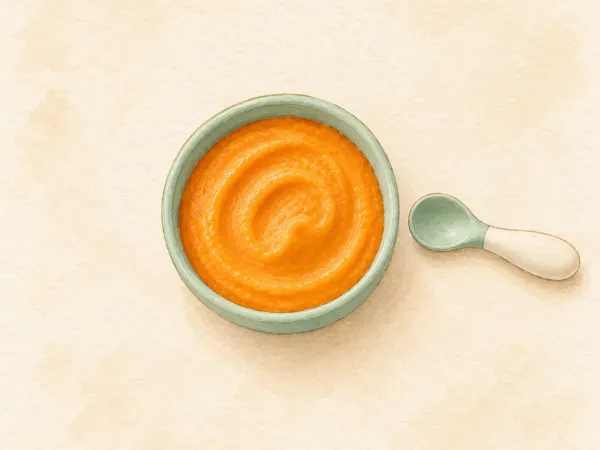
Lentil & sweet potato purée
6–8 moIngredients
- 2 tbsp red lentils, rinsed
- ½ small sweet potato, peeled and cubed
- Water or unsalted stock
- A small squeeze of orange (optional, for vitamin C)
Method
- Simmer the lentils and sweet potato in water until very soft, about 15 minutes.
- Blend to a smooth purée, adding water to loosen.
- Cool, then stir in a small squeeze of orange. Serve lukewarm.
ac_unitFridge 2 days · freeze in portions up to 1 month
shieldPurée off a spoon; for baby-led weaning, load onto a self-feeding spoon
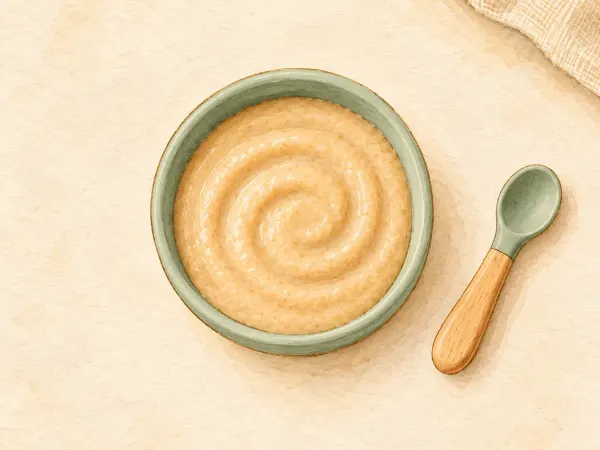
Banana & peanut oat porridge
6–8 moIngredients
- 2 tbsp iron-fortified baby oat cereal
- Breastmilk, formula, or water to mix
- ½ ripe banana, mashed
- 1 tsp smooth peanut butter
Method
- Mix the oat cereal with warm liquid to a smooth porridge.
- Stir in the mashed banana.
- Stir in the peanut butter until fully dissolved, with no globs. Serve lukewarm, earlier in the day.
ac_unitBest fresh · fridge up to 24 hours
shieldIntroduce on a day you can watch for two hours; never serve peanut butter in thick globs
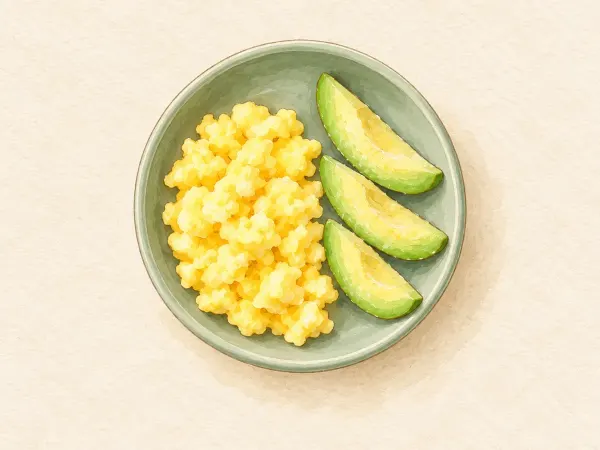
Soft scrambled egg with avocado fingers
8–9 moIngredients
- 1 egg
- 1 tsp full-fat milk or water
- A tiny knob of unsalted butter or a little olive oil
- ¼ ripe avocado
Method
- Whisk the egg with the milk.
- Cook gently over low heat, stirring, until fully set and soft.
- Slice the avocado into finger-length wedges and roll in fine cereal for grip. Serve warm.
ac_unitEat fresh · don't reheat scrambled egg more than once
shieldEgg must be fully cooked; the cereal coating helps little hands hold the slippery avocado
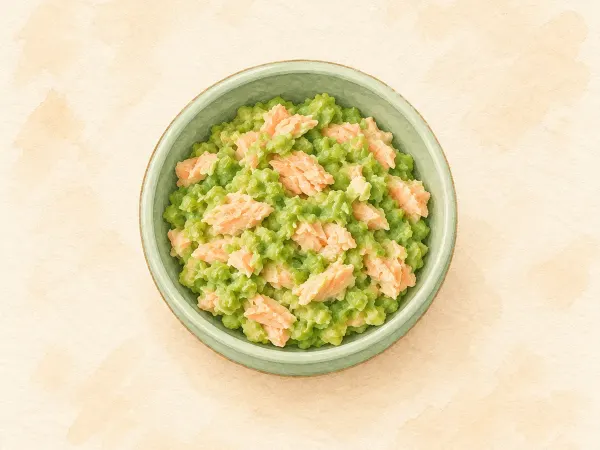
Flaked salmon with mashed peas
8–9 moIngredients
- 1 small salmon fillet, skin and bones removed
- ¼ cup frozen peas
- A splash of water or olive oil
Method
- Steam or poach the salmon until it flakes, about 8 minutes.
- Cook the peas until soft and mash.
- Flake the salmon, carefully checking for bones, mix with the peas, and loosen with a little water. Serve warm.
ac_unitFridge 1 day · freeze cooked portions up to 1 month
shieldDouble-check for tiny bones; mash to your baby's texture stage
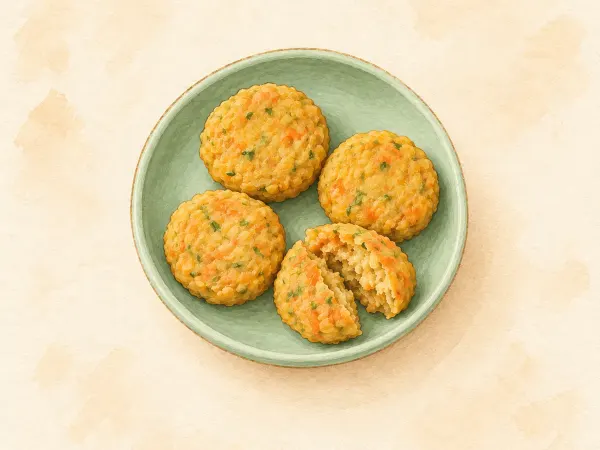
Mini lentil & veg patties
10–12 moIngredients
- ½ cup cooked red lentils
- ¼ cup grated soft-cooked carrot or courgette
- 2 tbsp fine breadcrumb or oats
- 1 tsp olive oil
Method
- Mash the lentils and mix with the grated veg and breadcrumb to a shapeable mix.
- Form small, soft patties.
- Pan-fry gently in olive oil until set, or bake for 15 minutes. Cool before serving as finger food.
ac_unitFridge 2 days · freeze up to 1 month
shieldKeep patties soft enough to squish; break into pea-sized pieces once the pincer grasp develops
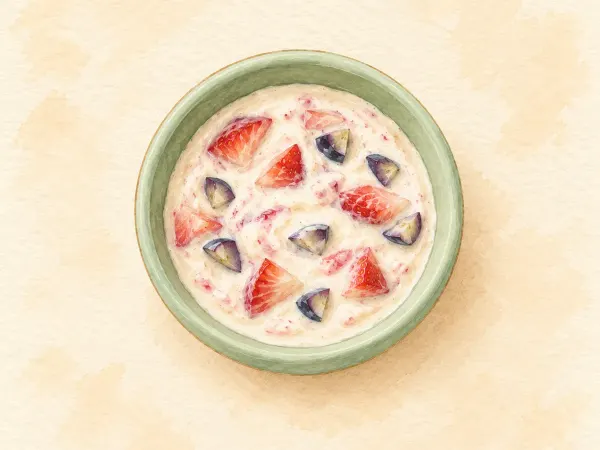
Yogurt with berries & tahini
10–12 moIngredients
- 3 tbsp full-fat plain yogurt
- A few soft berries, halved or quartered
- 1 tsp tahini
Method
- Spoon the yogurt into a bowl.
- Halve or quarter the berries, never whole.
- Stir or drizzle in the tahini until smooth. Serve chilled.
ac_unitBest eaten fresh
shieldBerries are a round choking hazard, always halve or quarter; tahini introduces sesame
Gagging vs choking, and the cuts that prevent it
Almost every baby gags while learning to eat. Gagging is not choking, and knowing the difference keeps you calm enough to respond well to the rare time it matters.
volume_upGagging, loud and normal
It's the reflex doing its job.
Coughing, retching, a red face, watering eyes, the tongue pushing food forward. Your baby is moving air and clearing food on their own.
What to do: stay calm, sit them upright, let them work it out. Don't put your fingers in, you can push food further back.
volume_offChoking, quiet and urgent
Silence is the warning sign.
Little or no sound, a weak or absent cough, a panicked or floppy look, lips turning blue. The airway is blocked.
What to do: act now, back blows and chest thrusts for infants, and call emergency services. Take an infant first-aid course before starting solids.
Gagging is loud and protective. Choking is quiet and an emergency.
Choking-safe cuts, the rules that cover most foods
- content_cutRound foods (grapes, cherry tomatoes, large blueberries, mozzarella balls, sausage): quarter lengthways, never serve whole rounds.
- whatshotHard raw foods (apple, carrot): cook until soft enough to squish, or grate finely. No raw hard chunks until around 4 years.
- do_not_disturb_onWhole nuts and large seeds: not until 4–5 years. Use smooth nut butter thinned with water or stirred into purée instead.
- straightenSize by stage: before the pincer grasp (~9 months), offer finger-length pieces with a bit to hold. Once they pick up small things, pea-sized soft pieces.
- opacitySticky and slippery: thin out thick globs of nut butter; roll slippery foods like banana or avocado in fine cereal for grip.
How to use this
The planner does two things. It tracks the common allergens so you can see which ones are still worth introducing, since offering them early and often, from around 6 months, is linked to a lower risk of food allergy. And it suggests age-appropriate foods and textures so the rest of the plate keeps moving forward too.
Introduce one new allergen at a time, at home, earlier in the day, and keep it in the diet once it is in. Everything here is a starting point, your baby's appetite, your family's foods, and your pediatrician's advice all shape the real plan.
The early-allergen approach, in plain terms
For years parents were told to delay peanut, egg, and other allergens. The evidence now points the other way. Introducing the common allergens from around 6 months, alongside normal first foods, and keeping them in the diet regularly, lowers the chance of developing a food allergy. Delaying does not help and may increase the risk.
The practical rule is simple: one new allergen at a time, a small amount first, offered when you can watch your baby for a couple of hours. No reaction means you build it up and keep it on the menu. A few days later, add the next one. Babies with eczema or a family history of allergy should be introduced under a doctor's guidance, because they are higher risk.
Alongside allergens, the headline nutrient at this age is iron. Babies' own stores run low around 6 months, so iron-rich foods like puréed meat, iron-fortified cereal, lentils, and beans deserve a regular place on the plate, paired with fruit and vegetables to help absorption.
groupsWhat introducing foods really feels like
The science is reassuring. The day-to-day is messier, and that is normal:
- The first peanut feels scary, doing it in the morning helps you breathe
- Refuses it three times, then happily eats it on the fourth
- A red cheek that turns out to be the tomato, not an allergy
- Gagging is not choking, it is the reflex doing its job
- Loved it last week, spits it out this week, offer it again later
- Keeping a little list of what is in helps more than memory does
Go at your baby's pace, but do not stall on allergens out of fear, regular exposure is the protective part. If you want the day's shape too, pair this with the feeding schedule by age.
help_outlineFAQ
When should I introduce allergens to my baby?
From around 6 months, alongside other first foods, and without delay. Early, regular exposure is linked to a lower risk of food allergy.
Offer one new allergen at a time, a small amount, earlier in the day so you can watch for a reaction.
How do I introduce a new allergen safely?
A small amount of a single allergen at home, in the morning or at lunch, not at daycare and not at bedtime. Watch for about two hours.
If there is no reaction, build the amount up and keep it in the diet a couple of times a week. Wait a few days before the next new allergen so any reaction is easy to trace.
What does an allergic reaction look like?
Mild: a few hives, redness around the mouth, some vomiting. Severe (anaphylaxis): swelling of lips or face, widespread hives, breathing difficulty, persistent cough or wheeze, pale or floppy behaviour.
Severe reactions are a medical emergency, call emergency services immediately. With eczema or a family history of allergy, talk to your doctor before starting.
What foods should babies avoid in the first year?
Honey until 12 months, added salt and sugar, whole nuts and other hard round choking hazards, unpasteurised cheese and milk, and high-mercury fish like shark, swordfish, and marlin.
Cow's milk is fine in cooking but not as a main drink until 12 months.
Why does iron matter so much at 6 months?
Babies' iron stores start running low around 6 months, just as solids begin.
That is why iron-rich foods, puréed meat, iron-fortified cereal, lentils, beans, are a priority, offered with fruit and vegetables to help absorption.
Does this replace advice from my pediatrician?
No. It is general guidance, not personalised medical advice.
If your baby has eczema, an existing food allergy, a strong family history of allergy, or any health condition, talk to your pediatrician or an allergy specialist before introducing allergens.
Sources
- NHS Start for Life, Weaning and food allergies
- American Academy of Pediatrics, Starting solid foods
- World Health Organization, Complementary feeding
This content is informational and does not replace medical or nutritional care. Talk to your child's doctor before introducing allergens if there is eczema, existing allergy, or family history.