 Kidy
Kidy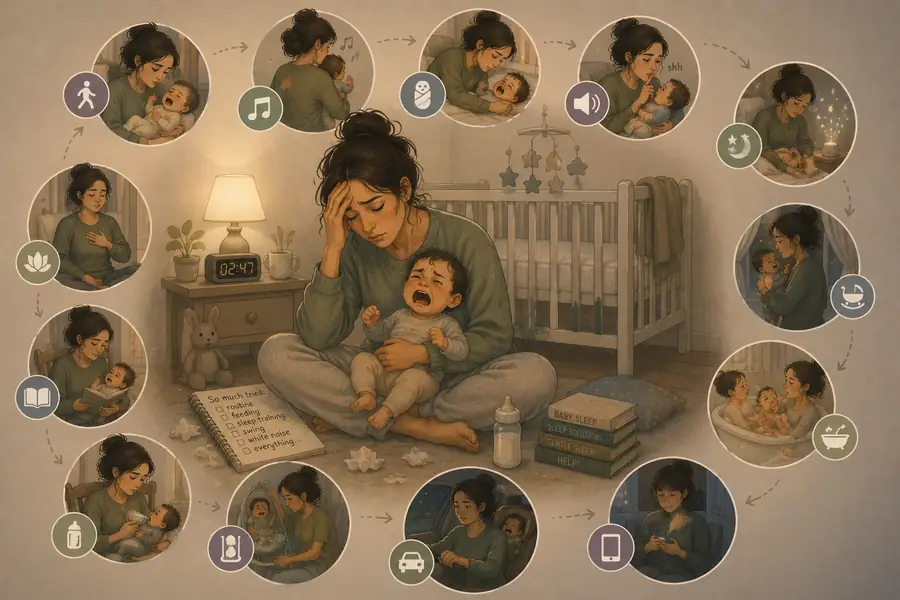
If "nothing works" with your baby's sleep, you are usually drowning in too many changes at once, not missing one magic technique:
⏰ Check the timing first: enter your baby's age in the wake windows calculator and see how long they can comfortably stay awake between sleeps.
- About 5 of every 7 families who say "nothing works" are stacking 3+ schedule changes in the same week
- A typical sleep change needs 5–7 days of consistency before its effect is readable
- Stacking three changes after one bad night makes everything less readable, not more
- The fix is boring on purpose: baseline, one variable, review.
Look for patterns across 5–7 days, not one day. For the full method, start at Track your baby's patterns and the sleep sub-pillar How to track baby sleep patterns.
_Educational only. Not medical advice. Last updated: February 2026._
Quick reference
| Check | Look for | Why it matters |
|---|---|---|
| Changes in the last 14 days | How many did you stack? | If > 2, you are reading noise, not signal |
| Last week of sleep logs | What is the actual baseline? | Without baseline, every change looks like a regression |
| Recent life events | Daycare, move, illness, vacation | All take 2–3 weeks to stabilize |
| Caregiver alignment | Are scripts the same between parents? | Two scripts = two experiments running at once |
| Sleep history (4+ weeks) | Is the current "bad" week actually worse, or just the only one you remember? | Recall bias under sleep debt is real |
What "nothing works" usually means
Three things, in roughly this order of frequency:
- Stack. You tried earlier bedtime + capped naps + sleep training + a new sound machine in the same week. If anything improved you cannot tell what. If it got worse, you cannot tell which one to undo.
- Premature judgment. You gave each new approach 1–2 nights before deciding it failed. Most sleep changes take 5–7 nights of consistency before the effect is readable above the noise.
- Real schedule mismatch in disguise. The age has changed; the schedule has not. Or there is a medical contributor (reflux, snoring, ear infection) that no amount of behavioral intervention will fix.
The American Academy of Pediatrics emphasizes that consistency over 7+ days matters more than which specific approach you choose (healthychildren.org, 2024).
The "boring escape" plan
This is unsexy, and it is what actually works. It takes 2–3 weeks but you can start tonight. If you want the wider context of naps, bedtime, and night waking across the whole first two years, our full guide to baby and toddler sleep lays out the foundations this plan builds on.
Week 1: stop everything
Pick one schedule (one bedtime, one nap structure, one feeding pattern) and do not change anything else for 5–7 nights. No new techniques. No "let me try one more thing." Just log what happens.
This is hard. You will be tempted to "tweak just one thing." Resist. The baseline is the thing you cannot see right now, and without it nothing else is interpretable.
Week 2: read the baseline + pick one lever
After 5–7 days of unchanged routine, you can actually see what your week looks like. Now pick the one most likely lever:
- Wake time within ±20 min most days? → bedtime/nap timing is probably the lever.
- Wake times scattered widely? → schedule consistency is the lever, not technique.
- Hard moments cluster at one transition? → that transition is the lever.
- Sleep is short and short-naps + early-wake + bedtime battles all happen? → see if a single schedule adjustment moves all of them.
Week 3: change one thing, hold everything else
Pick the lever. Make the change. Run it 5–7 nights without stacking anything else. Then compare to your baseline.
This is unglamorous, and it is the actual escape from "nothing works."
Decision logic by symptom
| Your dominant symptom | Read this entry next |
|---|---|
| Wake before 6am most days | Why your baby wakes up too early |
| Every nap is 30 minutes | Baby only naps 30 minutes |
| Bedtime is a fight | Bedtime battles |
| Want the method itself | How to track baby sleep patterns |
Common mistakes when "nothing works"
Adding more techniques. "Maybe if we also do X" is what got you here. Subtract, do not add.
Quitting the experiment on night 2. Most changes take 5–7 nights. Quitting on night 2 means you are not actually testing anything.
Changing both parents' scripts at once. That is two experiments running simultaneously. You will not learn anything from either.
Comparing to "what worked for my sister's baby." Different baby, different week. Compare your baby to your baby's own week.
When to call your pediatrician
"Nothing works" deserves a clinical check-in if it is paired with weight loss or plateau, breathing difficulties or apnea, persistent extreme distress, mucus or sweating without illness, or any developmental regression. The CDC red-flag checklist at Learn the Signs, Act Early is a useful first reference.
Frequently asked questions
How do I know if my baby is actually getting worse or I'm just exhausted?
You cannot tell from inside the worst week. The fix is 5–7 days of unchanged logging. At the end, the trend reads itself, even with imperfect logs.
Should I get more help / book a sleep consultant?
If you have run the boring escape plan honestly for 3 weeks and the trend is genuinely flat or worsening, a sleep consultant or pediatric sleep medicine referral becomes reasonable. But run the baseline first; a consultant will ask for it anyway.
Is sleep training cruel?
Mixed evidence, very individual. The NHS notes that gentle behavioral approaches have not been shown to cause harm in studied populations, but the right approach for any specific family depends on temperament, age, and the parent's own well-being (NHS, 2024).
My partner thinks we should try yet another technique. How do we settle this?
The log settles it. Agree to commit to one approach for 7 nights. Then read the week. Most "let's try one more thing" debates dissolve when you can both see the actual data.
When will it just be over?
For most healthy infants, regulated nighttime sleep arrives between 6 and 12 months. For some, later. The variance is wide, normal, and not a parenting failure. In many cases, wait-and-track ends up in the same place as active intervention, meaning sometimes the boring escape plan ends with "actually, this resolved on its own."
How KidyGrow helps with this specifically
KidyGrow is built for exactly this situation - the week where you cannot tell signal from noise. The app remembers what sleep-deprived parents can't, which means it shows you the actual baseline you keep forgetting because every night feels like the worst one yet.
- Daily Brief stops you from stacking. Each morning highlights the one most likely lever based on your last 5–7 days, not five things to try simultaneously.
- Tonight plan reflects yesterday's pattern, so you change one thing tonight, not three.
- Child Insights shows you the actual baseline you cannot see right now. Whether the current "bad" week is actually worse than three weeks ago, or just the only one you remember clearly.
Honest expectation. The app warms up over 3–5 days of consistent logging. That is exactly what the boring escape plan needs anyway. By the end of week one you have a baseline; by the end of week two you have a readable experiment.
KidyGrow's free tier covers the baseline → one change → compare loop. You do not need to pay anything to escape the "nothing works" trap.
Related (sleep cluster)
- Why your baby wakes up too early
- Baby only naps 30 minutes
- Bedtime battles
- How to track baby sleep patterns
Sources
- American Academy of Pediatrics. Getting Your Baby to Sleep. healthychildren.org, 2024. https://www.healthychildren.org/English/ages-stages/baby/sleep
- NHS (UK). Baby and toddler sleep guidance. nhs.uk, 2024. https://www.nhs.uk/conditions/baby/
- Centers for Disease Control and Prevention. Developmental Milestones. Learn the Signs. Act Early. CDC, 2024. https://www.cdc.gov/ncbddd/actearly
_Educational only. Not medical advice._