 Kidy
Kidy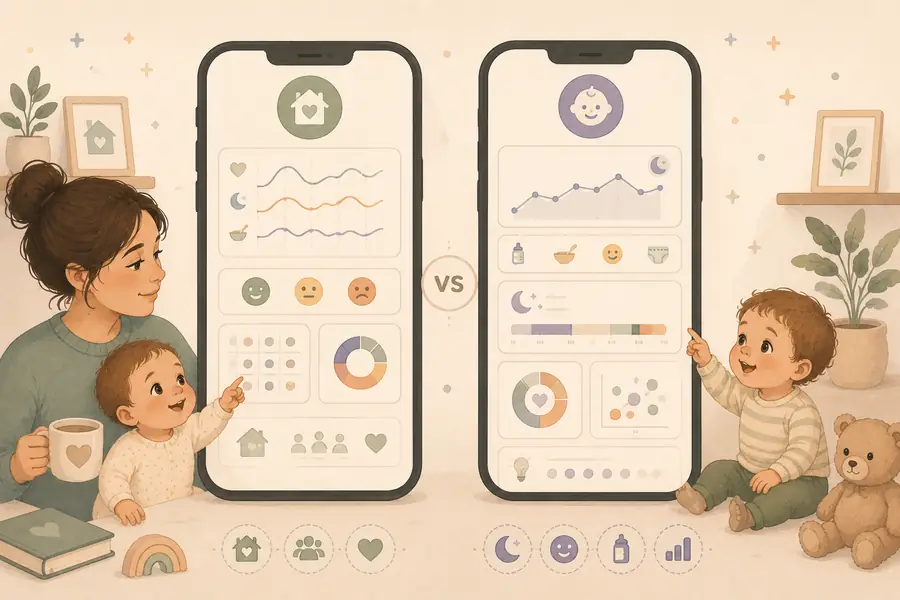
KidyGrow has two surfaces that look similar at first glance and do completely different jobs. Family Pulse shows you what is happening now across your family; Child Insights explains why over time for one child. Mixing them up is the #1 reason new users say "everything feels the same." Quick orientation:
- Family Pulse is action-oriented: today's plan, today's signals, what needs your attention next.
- Child Insights is explanation-oriented: trends across days and weeks for one child, with the "why" behind the suggestions.
- The two surfaces share no duplicate content by design. If you see the same sentence twice, that's a bug, not a feature.
- Most parents use Family Pulse daily and Child Insights weekly - that split alone reduces app fatigue dramatically.
This guide breaks down what each screen is for, when to open which, and how to think about the split when you are adding caregivers or premium features. The system hub is track your baby's patterns.
Quick Reference: Family Pulse vs Child Insights
| Question | Family Pulse | Child Insights |
|---|---|---|
| Time horizon | Today + tonight | Yesterday → today → this week → this month |
| Primary job | What to do next | What's been true over time |
| Tone | Action, short | Explanation, longer |
| Number of children | All your children, glanceable | One child at a time, deep |
| Use frequency | Daily | Weekly (or when something feels off) |
What Family Pulse is (and is not)
Family Pulse is the front door. It answers "given everything we know about your family right now, what's worth your attention next?" It is meant to be glanced at, under 30 seconds, and acted on. It surfaces today's plan and tonight's plan; it flags anything urgent; it does not explain in depth.
It is not a place for analysis. It is not where you scroll to remember what happened last Tuesday. It is not where two paragraphs of "why" should live. If a sentence is longer than a tweet, it does not belong here.
This matters because attention is the scarce resource for tired parents, not information. A screen that tries to do everything ends up as background noise.
What Child Insights is (and is not)
Child Insights is the library for one specific child. It answers "what has been true about my child over the past week or month, and why?" It shows trends, continuity (yesterday → today connections), explanations of suggestions, and learning lines as patterns emerge.
It is built to be opened deliberately, not glanced at. The visit might be 5 minutes. You go there when:
- You want to understand why the app suggested something.
- You are preparing for a pediatrician visit and want a clean picture of the past month.
- A new pattern is showing up (early waking, new tantrum window) and you want to see if it's real or noise.
- You are about to make a non-trivial change (drop a nap, start solids, change daycare routines) and want a baseline.
It is not a daily destination. If you are opening Insights 5 times a day, the design has failed you.
Why the two surfaces don't say the same thing
If two screens repeat the same sentence, the brain flags both as noise. KidyGrow separates roles on purpose, with a rule: any insight that belongs as a prompt to act today lives in Family Pulse only. Any insight that belongs as context to understand lives in Child Insights only.
When Premium/Pro AI-guided context is active for a family, rule-based "patterns from logs" notes are intentionally de-emphasized so the same observation does not appear twice in different words. The goal is clarity, not breadth. See the broader pattern-tracking method at track your baby's patterns, sleep, behavior, and feeding.
When to open which (a 30-second test)
Ask: do I need to do something or do I need to understand something?
- Do something (now or tonight) → Family Pulse.
- Understand something (over days/weeks) → Child Insights.
You will be surprised how often the right screen is "I am scrolling for understanding at 9pm and Family Pulse is not it — open Insights instead."
Common mistakes parents make
- Treating Pulse as a journal. It is not. It forgets fast on purpose. Insights persists the story.
- Refreshing Pulse 8 times a day "in case something changed." The recompute cadence does not reward this. Once after morning, once before bedtime is the right rhythm.
- Opening Insights expecting it to feel like Pulse. It is deliberately longer and quieter. If you want short, you wanted Pulse.
- Comparing Insights between two children on the same screen. Insights is one-child-at-a-time on purpose; bouncing between children is what daily Pulse is for.
- Treating either screen as medical-grade. Both surfaces support decisions; neither replaces a pediatrician for breathing issues, fever, weight changes, or developmental concerns (AAP, 2024).
When to talk to a clinician (not the app)
For breathing difficulty, persistent vomiting, fever in young infants, weight loss, severe behavioral regression, or any symptom that worries you, contact your pediatrician (NHS, 2024). Bring 1–2 weeks of logged signals if you have them, they make the appointment more productive than your memory ever could.
Frequently asked questions
Why aren't all the insights in one place?
Because attention is finite. A single screen with both today's action and weeks of explanation collapses into noise. The split exists so each screen can do one job well, and so daily use is fast.
If I am a shared caregiver, do we both see the same Pulse?
Yes for the shared signals; access models can vary by role. Family Pulse is built for shared-care reality: a partner or grandparent opens it and sees the same "what's now" without you having to brief them.
Where do AI-guided suggestions show up?
The "what" lives in Family Pulse (today's action). The "why this and not something else" lives in Child Insights. That split is intentional. Pulse should not feel like a wall of explanations.
What happens when I have more than one child?
Family Pulse aggregates across children with quick switches; Child Insights stays one-child deep. Most parents find the daily Pulse view is the better fit for households with siblings; weekly Insights gets done one child at a time on Sunday.
Does Insights replace a sleep coach?
No, it complements one. Coaches bring outside expertise; Insights brings local evidence about your specific child. Best results often combine the two.
Why do some screens look thinner during a slow week?
Because honest reporting beats fake stats. If your week is uneventful, Insights should look uneventful. Filling a screen with noise to look "more useful" trains parents to ignore the screen.
How KidyGrow helps
The app remembers what sleep-deprived parents can't. KidyGrow holds the thread across both children at once, who needs attention today, which patterns have been stable for weeks, which suggestions you have already tried, and routes that to the right surface.
A concrete example: you log a week of sleep and one mood note per day. By day eight, Family Pulse on the home screen reads: "try ending nap 30 min earlier today", short, actionable, ready before coffee. Child Insights, opened on Sunday, explains why in two paragraphs and shows the late-catnap-vs-evening-mood data behind it. Same insight, two different jobs.
Sometimes a child's week is just chaos - illness, travel, daycare flu round - and Insights will say it could not find a stable pattern. That is the app being honest rather than inventing one. Day 1's Pulse is mostly age-based; by day 4–5 it is tuned to your child. Insights only becomes meaningful after a baseline week.
For the full method, see track your baby's patterns and the topic sub-pillars: sleep, behavior, feeding.
Sources
- American Academy of Pediatrics (AAP). Healthy Living parenting framework, https://www.healthychildren.org/English/healthy-living/Pages/default.aspx
- American Academy of Pediatrics. Sleep guidance for caregivers, https://www.healthychildren.org/English/healthy-living/sleep/Pages/default.aspx
- NHS. Helping your baby (and toddler) to sleep, https://www.nhs.uk/conditions/baby/caring-for-a-newborn/helping-your-baby-to-sleep/
- Mindell JA, Williamson AA, 2018 Benefits of a bedtime routine in young children, Sleep Medicine Reviews, https://pubmed.ncbi.nlm.nih.gov/29195725/
- American Academy of Sleep Medicine, 2006. Behavioral treatment of bedtime problems and night wakings, https://pubmed.ncbi.nlm.nih.gov/17068979/
_Educational content only. Not medical advice. Last updated: February 2026._