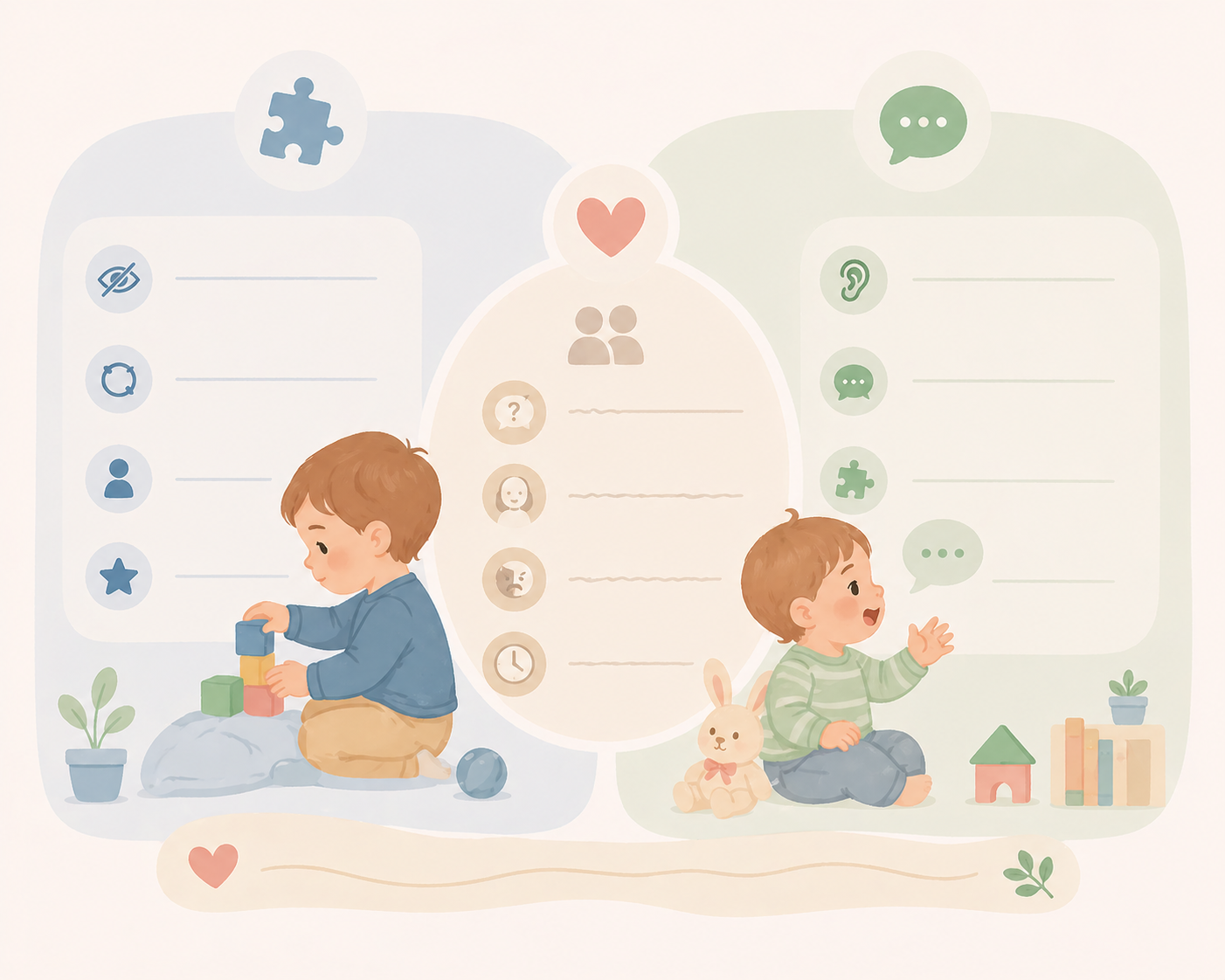
If you're trying to tell whether your child has signs of autism or just a speech delay, the most useful difference isn't the words — it's how your child uses social communication beyond words.
Quick orientation:
- Speech delay alone: child seeks connection (eye contact, points to share, brings toys, watches your face), but words lag.
- Autism: differences in social communication and restricted/repetitive behaviors — language may also be delayed, but the social pattern is the bigger signal.
- Big overlap: 1 in 4 toddlers later diagnosed with autism are first flagged as a "speech delay" — so a single quiet 2-year-old is not enough information.
This guide walks the differences side by side, lists the social red flags that should trigger a developmental screen now (not in 6 months), and explains why an autism evaluation is a useful step — not a verdict (CDC, 2024).
Quick Reference: Autism vs Speech Delay
| Question | Answer |
|---|---|
| Biggest difference? | Speech delay = language is behind, social drive is present. Autism = differences in social communication + repetitive patterns. |
| Can a child have both? | Yes — about 30–50% of autistic children also meet criteria for a language disorder, depending on the study. |
| Most useful single check? | Joint attention: does your child point to show you something interesting (not just request)? |
| When to ask for evaluation? | Any combo of: no words at 16 mo, no two-word phrases at 24 mo, lost skills, weak social engagement. |
| Does early evaluation hurt? | No. It's low-risk and gives faster access to therapy if needed. |
What this looks like in practice
Two different real-world patterns:
Pattern A — speech delay, social drive intact. Your 2-year-old has 8 words but uses dozens of gestures. Points to airplanes to show you. Brings books and crawls into your lap. Mimics what you do, watches your face for reactions, takes turns in tickle games. Frustrated when not understood. → Often a late talker; the language system is behind, the social system is online.
Pattern B — autism signs, with or without language delay. Your 2-year-old says 30 words but uses them mostly to label, not to share. Rarely points to show. Brings your hand to objects rather than looking at your face. Lines up cars or fixates on spinning. Reacts strongly to small changes in routine. → This pattern needs a developmental evaluation, regardless of word count (AAP, 2024).
The key takeaway: count gestures and social bids more carefully than you count words.
The social red flags that change the answer
These are the signs that pull a "probably late talker" into "ask for an autism screen now" territory:
- No joint attention by 12–14 months — doesn't follow your point, doesn't point to show
- Limited or fleeting eye contact during familiar play (not a one-time thing — a pattern)
- Doesn't respond to name by 12 months in a quiet setting (after hearing is ruled out — see toddler not responding to name)
- Loss of words or social skills at any age — this is never "wait and see"
- Restricted, repetitive play — same toy in same way, lining up, hand-flapping with intensity
- Strong reaction to sensory input — covering ears at normal sounds, seeking deep pressure, refusing textures
- No pretend play by 18–24 months (feeding a doll, pretending a block is a phone)
One sign in isolation rarely means autism. Two or more, persistent for weeks, is the threshold to ask for a developmental screen.
How is this different from "just a speech delay"?
A child with an isolated speech delay typically:
- understands more than they say (receptive > expressive)
- compensates with gestures, facial expression and pulling you to things
- engages socially — eye contact, smiling at you, sharing attention
- shows pretend play, imitates, takes turns
- most catch up by school age, though a minority retain some language differences into the preschool years (Rescorla, 2010)
If most of those are intact, you're more likely looking at a late talker. The exact line between "late talker" and a true expressive language disorder is in late talker vs speech delay: how to tell the difference.
Decision logic: should I ask for an evaluation now?
Walk this top to bottom:
- If your child has lost words, eye contact, or interaction skills they previously had → ask today. Regression is never wait-and-see.
- If by 12 months there's no babbling, no pointing, no waving, and weak response to name → ask now.
- If by 18 months there are no clear words AND limited gesturing → ask now.
- If by 24 months there are no two-word phrases AND poor joint attention or pretend play → ask now.
- If your child has 30+ words but uses them to label not share, plus repetitive play patterns → still ask. Word count is reassuring; social pattern matters more.
- If your child has 10–30 words at 24 months, points to share, plays pretend, and is clearly progressing → likely a late talker; revisit at the next pediatric visit.
- If you're unsure or it depends on the day → log a 4-week pattern (gestures, joint attention, response to name, pretend play) and bring it to your pediatrician.
If the bedtime/sleep picture is also chaotic, signs your baby is overtired is worth ruling out first — fatigue makes the social-engagement gap look bigger than it is on a single hard day.
Why "we'll come back at 3 if it's not better" is risky advice
The "watch and wait" approach has been gradually replaced in pediatric guidance because:
- Early intervention is most effective in the 18–36 month window.
- Even if it turns out to be only a speech delay, a few months of speech therapy doesn't hurt.
- An autism diagnosis isn't a label that sticks if wrong — it's an assessment outcome that opens doors to support.
- Waiting 6–12 months only matters if nothing changes; if your child catches up, the evaluation closes uneventfully.
The CDC's "Learn the Signs. Act Early." program exists precisely because earlier action improves outcomes (CDC actearly, 2024).
Common parent mistakes
- Counting only words. A child with 50 words and no joint attention is not "just fine."
- Comparing to siblings. Each child's profile is its own story; "but his brother spoke at 18 months" doesn't tell you anything about this child.
- Assuming bilingual = delay. Bilingual children are not delayed; if there's a delay, it shows up across both languages.
- Confusing introversion with autism signs. Quiet kids who watch and then engage are different from kids who don't engage when invited.
- Confusing screen-driven language gaps with autism. Heavy screen use can flatten communication attempts — see does screen time cause speech delay.
When to seek professional help
Talk to a pediatrician and request a developmental screen if any of the following apply:
- No babbling or pointing by 12 months
- No single words by 16 months
- No two-word phrases by 24 months
- Loss of speech, social, or play skills at any age
- Persistent absence of eye contact, joint attention, or pretend play
- Strong reaction to small changes in routine, paired with restricted interests
You don't have to be sure it's autism to ask for the evaluation. The evaluation is what answers the question.
Frequently asked questions
Can a child have both autism and a speech delay?
Yes. Estimates range from about 30–50% across studies, depending on how language disorder is defined. The two diagnoses aren't mutually exclusive — a child can be autistic and a late talker, autistic with average language, or have a speech delay without being autistic.
My child responds to their name sometimes but not always — is that autism?
Inconsistent name response can be a sign worth tracking, but on its own it's not a verdict. Hearing should always be ruled out first. If name response is unreliable AND joint attention or pretend play also feel weak, ask for a developmental screen.
What's the single most useful thing I can observe at home?
Joint attention. Does your child point to show you something (a plane, a dog, a flashing light) — not to request? Do they look between the object and your face to share the moment? Joint attention is the strongest single predictor in the 12–18 month window.
Will my child be "labeled" if I get an autism evaluation?
No. An evaluation is just an assessment — it can come back as "not autistic," "autistic," or "language disorder, no autism." A confirmed diagnosis opens access to therapies; it doesn't close any doors.
How is autism evaluation actually done at age 2?
Usually a multi-step process: pediatric developmental screen (M-CHAT-R) at 18 and 24 months, hearing test, then a full evaluation by a developmental pediatrician, child psychologist, or multidisciplinary team. The specific test varies but typically includes ADOS-2 plus parent interview.
Does heavy screen time cause autism?
No. Screens don't cause autism. They can mask communication gaps and reduce back-and-forth interaction time, which makes a real delay show up later than it otherwise would. See does screen time cause speech delay for the nuance.
How KidyGrow helps you
For "is this autism or speech delay?", a single hard day tells you nothing — a 4-week log tells you a lot. KidyGrow gives you three concrete tools:
- Daily mini-log (60 sec) — tag word attempts, joint-attention moments, response to name, pretend play, and any repetitive patterns. Builds a 4-week pattern automatically.
- Social-vs-language overlay — you see whether the issue is "behind on words" or "behind on social bids" — the exact distinction that matters in the autism vs speech-delay question.
- Pediatrician-ready report — exports the 4-week log as a PDF you hand to the doctor, so the screen visit becomes data-driven instead of "I think something's off."
For the broader behavior context (tantrums, frustration, regulation), see the toddler behavior management guide.
About this guide: KidyGrow is a parent-built developmental tracker. This guide is based on AAP, CDC and peer-reviewed pediatric guidance. It is educational and is not a diagnostic tool. If you're worried, ask your pediatrician — that's always the right next step. Last updated April 2026.
Sources
- American Academy of Pediatrics. (2024). Early Signs of Autism Spectrum Disorders. HealthyChildren.org. https://www.healthychildren.org/English/health-issues/conditions/Autism/Pages/Early-Signs-of-Autism-Spectrum-Disorders.aspx
- Centers for Disease Control and Prevention. (2024). Signs and Symptoms of Autism Spectrum Disorder. CDC. https://www.cdc.gov/autism/signs-symptoms/index.html
- Centers for Disease Control and Prevention. (2024). Learn the Signs. Act Early. CDC. https://www.cdc.gov/ncbddd/actearly/index.html
- Rescorla, L. (2010). Language Outcomes of Late Talking Toddlers at Preschool and Beyond. Topics in Language Disorders, 30(1), 20–33. https://pubmed.ncbi.nlm.nih.gov/20040771/