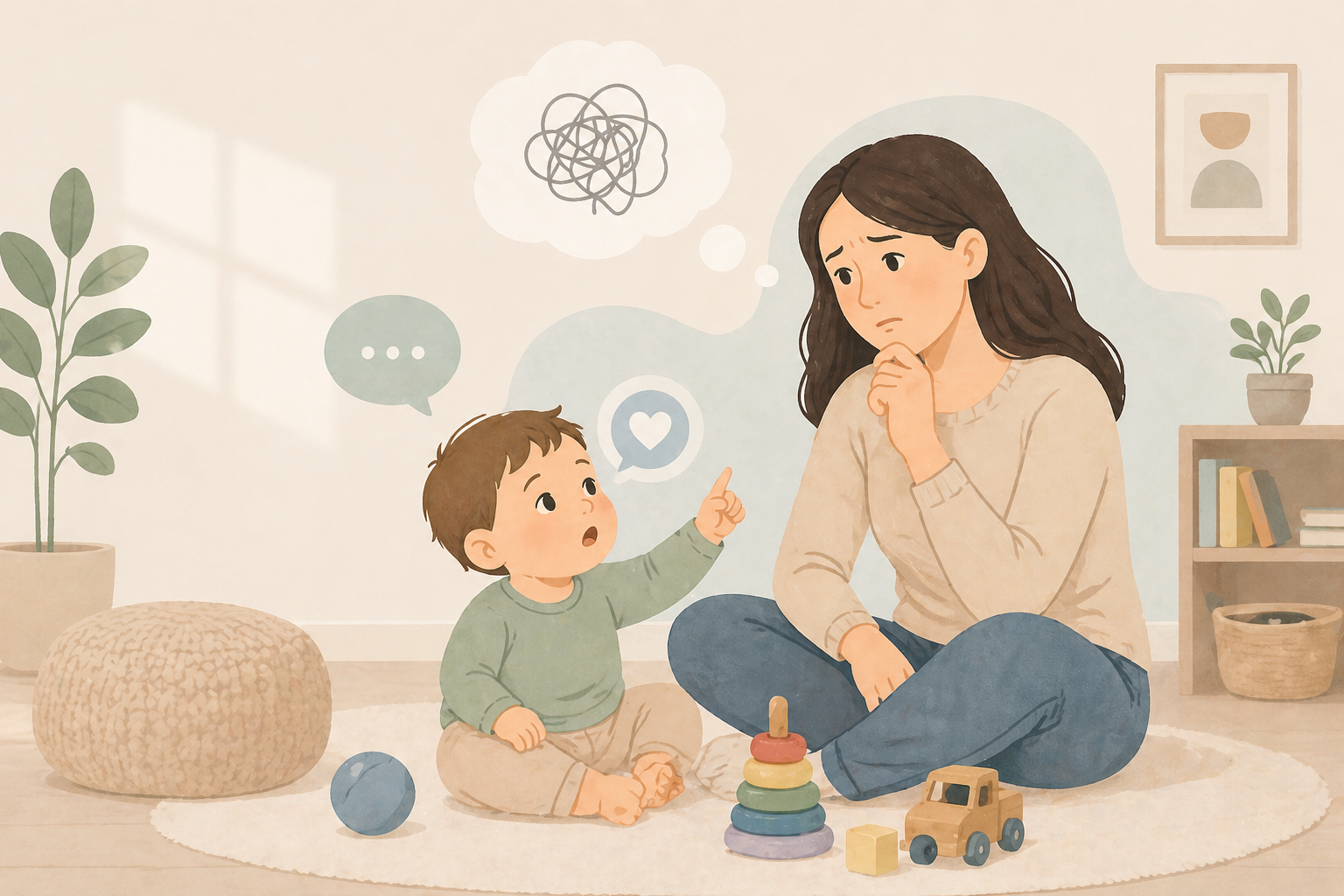
If your 15-month-old isn't saying words yet, the question isn't actually "do they have words" — it's whether communication is growing across all the channels (gestures, understanding, eye contact, sounds). Many late talkers catch up on their own; some need early support. KidyGrow logs the full communication picture across days so you can see whether progress is happening — without panicking and without ignoring real signals.
- Word count is one signal; gestures, understanding, and back-and-forth matter as much
- Most 15-month-olds say 3–10 words, but variation is wide and normal
- Watch the trend across 4 weeks, not the snapshot today
- Gestures (point, wave, show) at 12+ months are the strongest non-word signal
- If pointing, understanding, AND name response are all weak → call your pediatrician now
The biggest reason "no words at 15 months" causes the most parental worry: everyone counts words, but the warning sign isn't word count alone — it's the absence of gesture and understanding alongside it. KidyGrow surfaces the broader pattern so you can read the actual signal.
Quick Reference: communication milestones at 15 months
| Skill | Typical at 15 months | When to be concerned |
|---|---|---|
| Spoken words | 3–10 (huge variation) | 0 words AND no signs of trying |
| Gestures (point, wave, show) | Multiple, used daily | None of these by 15 months |
| Understanding (responds to name, simple commands) | Consistent | Inconsistent or absent |
| Babbling and varied sounds | Rich, conversational tone | Limited to one or two sounds |
| Eye contact + joint attention | Used to share interest | Limited or fleeting |
| Imitation | Copies sounds, gestures, simple actions | No imitation at all |
Source: AAP, CDC, and ASHA developmental milestone guidance. KidyGrow uses your child's actual logs to see whether their pattern fits inside (or outside) this band — averages are the starting line, not the answer.
Why "no words at 15 months" causes the most parental worry
You watch other 15-month-olds at the playground saying "ball" and "mama" while yours stays silent. You google "15 month not talking," get 47 conflicting answers — half say "wait, totally normal," half say "act now, don't wait." The issue: word count is the most VISIBLE part of communication but only a small slice of what actually predicts language outcomes. You're worrying about the wrong number, and the actual signal (or non-signal) is hiding in plain sight.
The American Academy of Pediatrics is explicit that at 15 months the typical range is 3–10 words but variation is enormous, and the more important signs are gesture use, understanding, and back-and-forth interaction (AAP, 2023). The American Speech-Language-Hearing Association adds that gesture milestones (especially pointing) are stronger predictors of later language than word count at this age (ASHA, 2023).
KidyGrow is built around this insight: communication at 15 months is a multi-channel signal. So the Daily Brief reads more than today's word attempt — it reads gesture frequency, name response, understanding of routine words, and the trend across days to surface whether the system is growing or static.
The 4 things to look at instead of word count
1. Pointing. A child who points at things they want, points to share interest ("look at the dog!"), and points to body parts when asked is using one of the strongest pre-verbal communication tools. CDC milestone guidance flags absence of pointing by 15 months as a concern even if other things look fine (AAP, 2023). See baby not babbling at 9 months for the earlier signal in this same channel.
2. Understanding. Does your child consistently respond to their name? Bring you a shoe when you say "shoe"? Look at the dog when you say "where's doggy?" Comprehension typically runs ahead of production by months — strong understanding alongside few words is the classic late-talker pattern that usually catches up. See toddler not responding to name for the diagnostic signal here.
3. Sounds and babbling. Rich, varied babbling with intonation that sounds "conversational" (even without real words) is a strong sign the speech motor system is developing on time. Limited or repetitive sounds is more concerning than missing words. See speech delay signs in toddlers for the broader red-flag list.
4. Imitation and joint attention. Does your child copy what you do (clapping, waving), copy sounds, share attention with you about an object? These are the cognitive-social building blocks that words sit on top of. Strong imitation + joint attention without words is reassuring; weak imitation + weak words is a clearer signal to act. See the late-talker vs speech-delay difference for how clinicians distinguish these two.
Step-by-step: 7-day communication pattern check
Day 1–7: just log. Open the app and tap-log every communication attempt — words attempted, gestures used, name response, what they understood today. Free-text note specifics ("pointed at the dog and said 'da'", "brought me her shoe when I asked"). No interpretation yet — KidyGrow needs at least a week to baseline what your child's actual communication frequency looks like.
Day 8: read your first Daily Brief. It surfaces the dominant signal — for example "7 days logged: 4 distinct word attempts, 8 gesture instances/day average, name response 5 of 7 days, strong understanding of 'shoe', 'cup', 'come'." That's a typical late-talker profile — communication is growing, words just lag. Versus "7 days logged: 0 word attempts, 1 gesture in 7 days, name response 2 of 7 days, no clear understanding logged" — that's a multi-channel pattern that needs pediatric input THIS WEEK.
Day 9–21: watch the 2-week trend. Two weeks is the minimum to tell growth from stagnation in this age band. If the Brief shows gestures or word attempts increasing week-over-week, the system is working — keep doing the simple language-supporting things below. If 2 weeks show no growth across any channel, that's the cue to act, not wait.
Throughout: open the late-talker vs speech-delay guide for what clinicians look at, and the 18-month not-talking guide for the next age-window context.
Common mistakes parents make
- Counting words obsessively while ignoring gestures and understanding — the gesture data is doing the actual predictive work
- Pressuring with "say it" prompts — research consistently shows this reduces word attempts in late talkers
- Comparing to one specific other child rather than the typical 3–10 word range
- Waiting "just a few more months" past 18 months with no progress — earlier intervention has the best evidence base
- Talking AT the child rather than WITH them — back-and-forth ("serve and return") is the format that grows language; long monologues do not
When to seek professional help
KidyGrow handles patterns and routines, not clinical assessment. Call your pediatrician this week if any of these apply at 15 months:
- Zero gestures (no pointing, no waving, no showing) — this is more concerning than zero words
- No response to name consistently across the week, AND limited understanding of routine words
- Loss of skills — words, gestures, or interaction your child had a month ago and doesn't have now
- Limited eye contact, social interest, or joint attention alongside the language gap
- Family history of speech/language delay or autism — early screening has stronger benefit if there's a family pattern
Early intervention services in most countries are free or subsidized for under-3s, and the evidence is clear that earlier support produces better outcomes (NIDCD, 2024). "Wait and see" past 18 months with no progress is the option with worse evidence.
Frequently asked questions
Is 0 words at 15 months automatically a problem?
No — but it's a "watch carefully" signal. The check is whether the other communication channels are healthy: pointing, understanding, name response, varied babbling, joint attention. If those are strong, you likely have a late talker who'll catch up. If those are also weak or absent, the right move is to call your pediatrician this week.
My 15-month-old is bilingual. Should I expect fewer words?
Bilingual children typically know roughly the same TOTAL number of words across both languages as monolingual peers — but spread across two systems, so each language individually shows fewer words. The 3–10 word range still applies if you count both languages combined. Bilingualism alone doesn't explain absence of gestures or weak understanding.
What should I do at home this week?
Five evidence-based moves: (1) talk during routines ("Now we wash hands, water on, soap, scrub..."), (2) follow your child's attention rather than redirecting, (3) pause and wait after you speak so they have room to respond, (4) acknowledge ANY communication attempt — gesture, sound, word, (5) read together every day, even if they only point. Avoid "say it" prompts and constant questions.
Should I do screen time / language apps?
For under-2s, AAP guidance is to minimize screen-only language input — speech development is built through back-and-forth interaction with people, not passive video. Video-call with grandparents counts as interaction; passive YouTube does not. See the toddler behavior management guide for the broader screen-time evidence.
What if 4 weeks pass and there's still no growth?
Then the issue is likely beyond normal variation — call your pediatrician for a developmental check, and ask specifically about a referral to early intervention or a speech-language pathologist. Most countries offer this assessment free under age 3. KidyGrow's Daily Brief flags when 4-week trends show no growth across any communication channel — that's the cue to escalate, not wait.
How KidyGrow helps you read communication progress
KidyGrow learns your child specifically. After 7 days of warm-up, the Daily Brief stops sounding like a script and starts sounding like a parent who actually remembers your kid's week — "7 days logged: 4 distinct word attempts (up from 2 last week), 8 gestures/day average, name response 5 of 7 days, strong understanding of 6 routine words. Late-talker pattern with positive trend — keep doing what you're doing and re-check in 2 weeks."
Three things make this different from a generic "is my toddler talking" article:
- Memory. When you ask "are we making progress?", the AI already knows your child's name, age, that 7 days ago they had 2 word attempts and 5 gestures and now have 4 and 8, that name response improved from 3/7 to 5/7, and that you've added the 5 supportive habits. You don't re-explain.
- Pattern over single days. The Daily Brief shows trends across 1–4 weeks, so one quiet day doesn't trigger a panic call — and a 4-week pattern of no growth gets the credit it deserves (signal to escalate).
- Multi-channel view. The Brief surfaces gestures, understanding, name response, AND words together — not just word count, which is the metric that hides the actual predictive signals. See behind the scenes: how KidyGrow's AI learns for how the correlation logic actually works.
The Daily Brief and Today Plan are part of the paid tier. Free accounts can log and see basic patterns, which is enough to spot the obvious (no gestures + no name response = call now) without the personalized 4-week trend analysis.
Sources
- American Academy of Pediatrics, "Language Development in 1 Year Olds" (HealthyChildren.org, 2023). https://www.healthychildren.org/English/ages-stages/toddler/Pages/Language-Development-1-Year-Olds.aspx
- American Speech-Language-Hearing Association, "Communication Milestones — Birth to 1 Year" (2023). https://www.asha.org/public/developmental-milestones/communication-milestones-birth-to-1-year/
- National Institute on Deafness and Other Communication Disorders (NIDCD), "Speech and Language Developmental Milestones" (2024). https://www.nidcd.nih.gov/health/speech-and-language
_Educational content. Not a substitute for medical advice — call your pediatrician this week if your child shows no gestures, no name response, or has lost skills they had before._