 Kidy
Kidy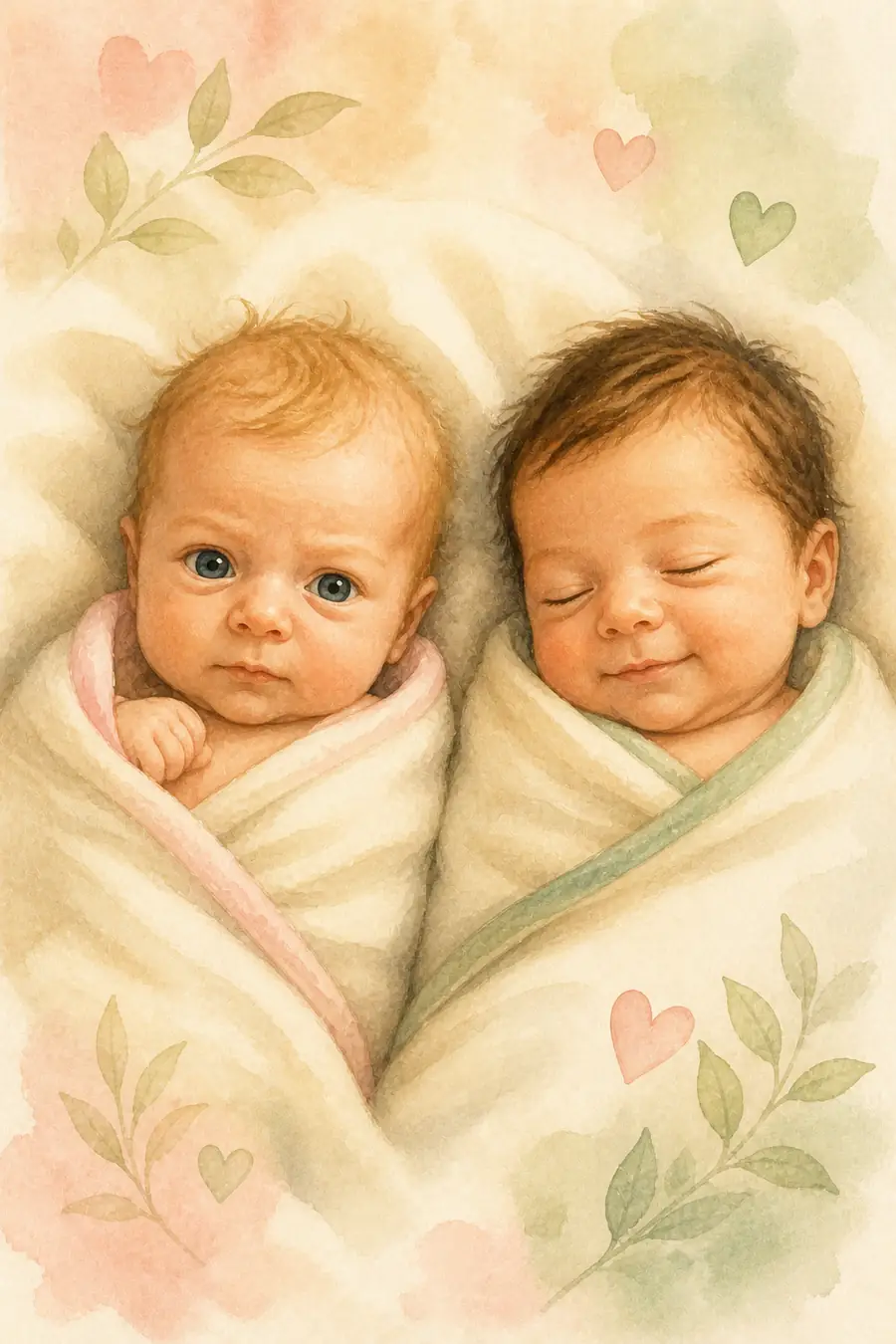
I assumed twin parenting was "first kid, just doubled". I was wrong from day 1 — sometimes from the womb. What surprised me most:
📋 See where your child is: check the Milestone checklist by age for the skills most children reach around this age.
- Feed one, think you've cracked the code, try the other → start from zero
- One was "anything goes — milk, water, the kitchen sink, fine"; the other refused everything except the breast
- One was angry-by-design from the first week; the other was cool-by-design
- They looked nothing alike — blonde vs dark — and personalities matched the contrast
- "Treating them the same" stopped working before they could roll over
Before my twins were born, I was sure I had this part figured out. "You change as a parent with the first kid. With twins, the parenting is basically the same — just doubled." That assumption fell apart in week 1. They kicked in shifts even in utero, like they were already taking turns.
This isn't unique to me. It's what the research has been saying for forty years.
Quick reference: twin temperaments
| What I expected | What actually happened |
|---|---|
| Same routine, same response | Two completely different feeding rhythms |
| One sleep schedule | Different wake windows from week 2 |
| Identical soothing tools | She wanted close contact; he wanted space |
| "I'll mass-produce parenting" | Read each one separately, every single time |
| Easier than the firstborn | Harder in volume, easier in mindset |
The myth I started with
When I had my firstborn daughter, I changed completely as a person. Sleepless, slower, gentler, more anxious. So when I learned twins were coming a year and eight months later, I told myself the obvious: "OK, the parent transformation already happened. Twins is just two of the same."
It is not.
The science: temperament is measurable from day 1
For decades pediatric researchers have known that newborns arrive with distinct, observable temperament patterns. The classic AAP framing describes nine temperament dimensions — activity level, rhythmicity, intensity, mood, adaptability, approach/withdrawal, attention span, distractibility, sensory threshold — and roughly three broad groupings: easy, slow-to-warm, challenging (AAP, Understanding Your Child's Temperament).
Twin research adds an interesting twist. The Wisconsin Twin Project, a longitudinal study running since 1989, found that even monozygotic (identical) twins show measurable temperament differences in infancy on dimensions like negative emotionality, approach behavior, and persistence (PMC, Wisconsin Twin Project Overview). Genes set a range; prenatal environment, subtle neurological differences, and early experience interact to shape where each twin lands within it.
Translation: even your "identical" twins are not identical. And dizygotic (fraternal) twins — like mine, a boy-girl pair — are genetically as different as any two siblings. They just share a birthday.
The bottle night I'll never forget
My twins were three weeks old. I knew I didn't have enough breastmilk for both that night, and I'd already decided: she gets the breast first, he gets the bottle of expressed milk plus formula on top. Logical, fair, simple.
She refused. Not with a quiet "no thanks". With a full-body, hour-long campaign of refusing the bottle, sealing her lips, swallowing a single sip and vomiting it back at me on principle. After 60 minutes of this, I gave up and put her on the breast. She drank for 90 seconds and fell asleep, victorious.
That was the night I understood: she would rather punish herself than cooperate with a plan she didn't agree with. From that day on, she always got the breast first and he got whatever was left + the bottle. He took it without a complaint. Always has.
He is the cool one. The charmer. "Mama, I'm comfortable, do whatever, I'll get there in the end." She is fire. "It's my way or nothing, and I will outlast you."
This isn't bias. It's their actual operating system, and I saw it in week 2. Both AAP and twin research align on this — your baby's temperament shows up in the earliest weeks (AAP, Your Baby's Temperament).
Four areas where "twins are the same" breaks down
If you're expecting twins or already in it, the four places this myth dies hardest:
1. Feeding
One twin is rhythmic and predictable; the other is "I'll eat when I'm ready, and not a minute before". Trying to keep them on identical feeding schedules from day one usually means at least one of them is being fed against their actual biology. For a wider feeding playbook (still applies to twins, just doubled), see the baby and toddler feeding guide.
2. Sleep
Wake windows are individual, not shared. By week 2, mine had measurably different sleep tolerance — one could go 90 minutes between naps, the other tipped at 60. Forcing a synchronized nap schedule too early creates a permanently overtired baby and a permanently undertired one. The framework in the baby sleep guide for 0–2 years applies twin-by-twin, not pair-by-pair. The same goes for milestones, where one twin often sits, crawls, or talks ahead of the other, which is usually normal and covered in twins developing at different paces.
3. Soothing
Some babies want skin-to-skin. Some want motion. Some want to be put down in a quiet, dark room alone (this surprised me the most). What soothes one can actively over-stimulate the other.
4. Attention reading
One twin will tell you exactly what they need with a clear cry-pattern. The other will signal in a way that takes you weeks to decode — and which doesn't translate to anything you learned with your first child or your first twin. Misreading a temperament shows up later as feeding battles, bedtime tantrums, and "why does this kid never listen?" — all of which trace back to a parent treating two distinct people as a unit. The same logic applies all the way through toddlerhood — see the toddler behavior guide.
Why "treat them the same" backfires (even with the best intentions)
Treating twins as a unit is well-intentioned. It feels fair. It feels efficient. It's also one of the fastest ways to generate two unhappy children.
What "the same" actually means in practice:
- Easy twin gets ignored because they don't escalate
- Challenging twin gets labeled "the difficult one" — at age two months
- Both kids miss a chance to be seen as themselves
The fix isn't complicated, but it's relentless: observe each one separately, every day, for a few weeks. Tiny notes — when did each fall asleep, what calmed them, what set them off. After 14 days you'll have two distinct profiles, and the parenting decisions almost make themselves. The mental load drops, even though the workload doesn't. (For your own survival in this period, see realistic new-mom self-care.)
That same instinct, treating each child as their own person instead of applying one blanket rule, is the whole idea behind gentle parenting.
How KidyGrow handles twins (two profiles, not one doubled)
Most baby apps were built for one child. When you have twins, that's the moment a generic tracker becomes actively painful — you're recording two distinct sets of feeds, naps, and triggers in a tool that wants to average them.
KidyGrow keeps two separate child profiles and learns each one independently. The Daily Brief shows two separate plans side by side — what's most likely driving twin A's overnight wakings and what's most likely behind twin B's afternoon meltdown — and adapts the suggestions for each child as the days go. It remembers what worked for her sensory profile and what worked for his — and stops recommending what didn't. (First 3–5 days are a warm-up while it learns each baby's pattern.)
For the bigger picture on how KidyGrow learns each child, see Behind KidyGrow.
→ Get a personalised plan for each of your twins
Frequently asked questions
Are identical (monozygotic) twins really different in temperament?
Yes. Decades of twin research, including the long-running Wisconsin Twin Project, show measurable temperament differences between monozygotic cotwins from infancy onward. Genetics set a range; prenatal environment and early experience push each twin to a slightly different point on that range. The differences are usually smaller than between fraternal twins, but they're real and observable.
Should I keep twins on identical schedules?
For very young babies, no — try aligning feeds when convenient (it helps your survival), but match each baby's wake-window biology, not a shared clock. By 4–6 months, schedules tend to converge naturally for many twins. Forcing earlier alignment usually means one twin is overtired and one is undertired daily.
Is one twin always going to be the "easier" one?
The "easier vs harder" labels stick mainly because parents reinforce them. The "challenging" twin often grows into a deeply self-aware, persistent child if their intensity is read as a strength, not a defect. The "easy" twin may need extra effort to be seen — easy doesn't mean low-need.
How do I avoid playing favorites?
You probably already do play favorites in any given moment — the calmer twin gets attention because they're easier to enjoy, the louder one gets attention because they demand it. The fix is not "treat them identically" — it's rotating who gets the patient, full-attention version of you across the day. Notes help.
When does temperament stabilize?
Core temperament patterns are visible from infancy and tend to stabilize by toddlerhood. The expression of the temperament changes (a "fierce" baby may become a focused, persistent kid), but the underlying intensity, rhythmicity, and adaptability tend to persist. Don't expect your "stubborn" newborn to become a different person at 3 — but do expect them to channel the trait differently as they develop language and self-regulation.
Sources
- American Academy of Pediatrics — Your Baby's Temperament (HealthyChildren.org): https://www.healthychildren.org/English/ages-stages/baby/Pages/Babys-Temperament.aspx
- American Academy of Pediatrics — Understanding Your Child's Temperament: Why It's Important (HealthyChildren.org): https://www.healthychildren.org/English/ages-stages/gradeschool/Pages/How-to-Understand-Your-Childs-Temperament.aspx
- Goldsmith HH et al. — Wisconsin Twin Project Overview: Temperament and Affective Neuroscience. Twin Research and Human Genetics, 2019. https://pmc.ncbi.nlm.nih.gov/articles/PMC7056557/
_Educational content. Not medical advice._