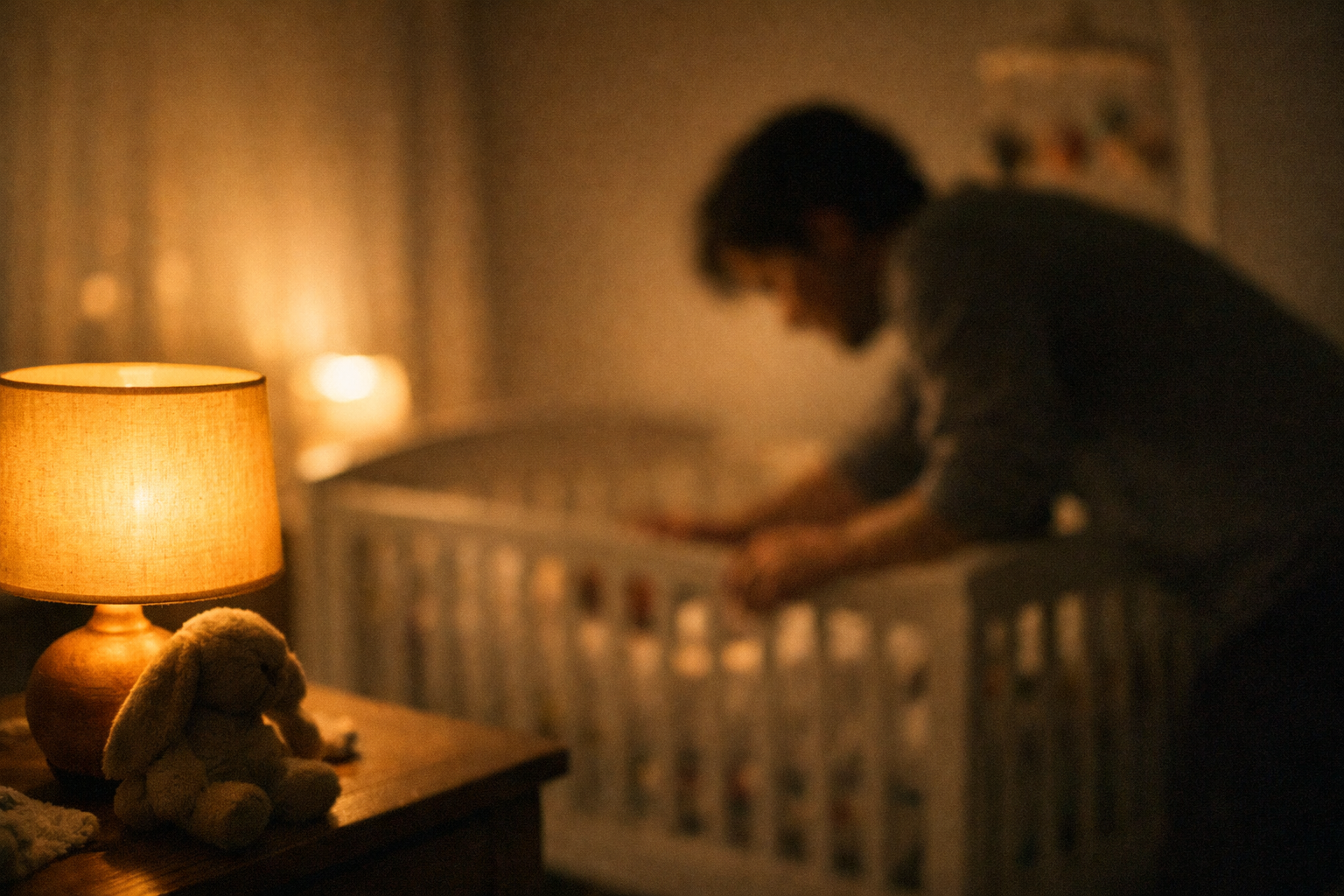
If your baby wakes up crying every night, you are exhausted and stuck guessing — hunger, regression, pain, or "just a phase"?
Quick takeaways:
- Crying at night is rarely random — it almost always has a driver
- Overtiredness is the most common cause and the easiest to fix tonight
- One change at a time, held for 3 nights, beats daily tweaks
- Red flags (fever, breathing trouble, dehydration) need a pediatrician, not a routine fix
- Most patterns become visible after 3–5 nights of simple tracking
Tonight's highest-ROI test if you suspect overtiredness: move bedtime 30–60 minutes earlier for 2–3 nights.
Quick Reference: 7 causes and what to try first
| Cause | Quick signal | First move tonight |
|---|---|---|
| Overtiredness | Short naps, late bedtime, wakes upset | Bedtime 30–60 min earlier × 3 nights |
| Hunger | Calms fast with feeding, then long stretch | Feed; protect daytime intake tomorrow |
| Discomfort | Teething, fever, congestion, hot/cold room | Treat symptoms; check room ~18–20°C |
| Sleep associations | Wakes at predictable cycle ends, needs the same prop | Pick ONE association to gently reduce |
| Sleep regression | New skill burst (rolling, standing, words) | Hold routine; don't add new habits |
| Separation anxiety | 8–18 months, peaks around 12 mo | Brief reassurance, calm, predictable |
| Schedule mismatch | Wake windows wrong for age | Recalibrate using wake windows by age |
The American Academy of Pediatrics emphasizes that some night waking is normal at every age — what changes is the response parents need (AAP, 2024).
Red flags: when to call your pediatrician
Skip the troubleshooting and call your doctor if you see:
- Breathing difficulty, wheezing, or rapid breathing
- Dehydration signs (very few wet diapers, dry mouth, unusual lethargy)
- Persistent vomiting
- Fever in a baby under 3 months — or any fever that worries you
- Severe pain signs, ear pulling with fever, rash that doesn't blanch
- Sudden change in cry quality (high-pitched, weak, or unusual)
These need medical assessment, not a sleep fix. Everything below assumes you have ruled them out.
The 7 most common causes
1. Overtiredness (most common)
Counterintuitively, an over-tired baby sleeps worse, not deeper. When wake windows stretch too long or naps run too short, cortisol and adrenaline rise to keep the baby going — and those same hormones disrupt sleep at night. The clue: bedtime keeps drifting later, naps are getting shorter, and the baby wakes upset rather than rested. The fix is usually earlier bedtime (yes, even though it feels backwards). See signs your baby is overtired for the full signal list.
2. Hunger
Babies under 6 months often genuinely need a night feed; older babies sometimes wake hungry during growth spurts or after a low-intake daytime. The clue is the response: hunger settles fast with feeding, and the baby then sleeps a longer stretch. If feeding leads to a 5-minute awake-then-back-to-sleep, hunger probably isn't the driver — it's a sleep association.
3. Discomfort (teething, illness, room temperature)
Pain pulls babies out of every sleep cycle. Teething typically peaks around drooling, gum-chewing on hands, and one-night-bad-then-better patterns. Illness brings fever, congestion, or appetite changes. Room temperature is underrated — a hot room is a top hidden cause of split nights.
4. Sleep associations
If your baby falls asleep with a specific prop (bottle, rocking, holding) and then wakes between cycles needing that same prop to fall back asleep, the prop is the wake-up. The fix is not necessarily removing it overnight — it's choosing one to gently reduce, holding the rest.
5. Sleep regression / new development
Around 4, 8–10, 12, and 18 months, babies hit developmental jumps (rolling, sitting, standing, walking, language). The brain is busy rehearsing the new skill, often at 3 AM. Regressions are real but temporary — usually 1–3 weeks. The trap is "fixing" a regression by introducing a new habit (a bottle, co-sleeping) that outlasts the regression itself. Hold your normal routine; ride the wave.
6. Separation anxiety
Peaks around 8–18 months. Baby wakes, doesn't see you, panics, cries. Brief reassurance — a calm voice, a hand on the chest, low light — is more effective than picking up and starting a long settling sequence.
7. Schedule mismatch
Wake windows that worked at 5 months don't work at 7 months. If nothing else explains the waking, your baby may have outgrown the schedule. Recheck against baby schedule by age (0–2) and wake windows by age.
Decision tree: how to tell which one in 60 seconds
Use this in the moment:
- Calms fast with feeding + then long stretch? → Hunger. Feed. Tomorrow, protect daytime intake.
- Day had short naps or long wake windows? → Overtiredness. Bedtime 30–60 min earlier for 2–3 nights.
- Pain signs (teething, fever, congestion)? → Discomfort. Treat symptoms; check room temp.
- Wakes at predictable cycle points needing the same "help"? → Sleep association. Pick ONE to reduce.
- New skill week (rolling, standing, words)? → Regression. Hold routine; expect 1–3 weeks.
- 8–18 months and the baby panics until you appear? → Separation anxiety. Brief reassurance, low light.
- None of the above and the schedule feels off? → Schedule mismatch. Recalibrate wake windows.
What helps tonight (and what makes it worse)
Helps:
- Earlier bedtime if in doubt — overtiredness is the most common driver
- Dark room, white noise if you already use it (don't introduce mid-regression)
- One change at a time, held 3 nights before evaluating
- Brief, calm, low-stimulation responses (low light, quiet voice)
Makes it worse:
- Changing bedtime, naps, AND routine in the same week
- Introducing a new "must-have" association (rocking to sleep, new bottle) during a regression
- Picking up and starting a 30-minute settle sequence for a 30-second separation cry
- Pushing bedtime later when the baby seems wired — that is overtiredness, not undertiredness
A 2015 study by Mindell and colleagues (n=405 mother–infant pairs) showed that consistent bedtime routines held over 2 weeks significantly improved both sleep onset and night wakings — confirming that the consistency matters more than the specific routine (Mindell et al., 2015).
When to seek professional help
Most night waking patterns settle within 2–3 weeks of consistent response. Talk to your pediatrician if:
- Night wakings are increasing (not decreasing) past 6 months
- A previously good sleeper has suddenly regressed for 4+ weeks
- You see persistent breathing pauses, snoring, or mouth-breathing during sleep
- Your baby seems in pain on waking, not just upset
- You are exhausted enough that your own wellbeing is suffering — that is a real reason to ask
The NHS notes that sleep "problems" in the first 18 months are usually mismatched routines, not medical issues — but flag anything new, intense, or accompanied by other symptoms (NHS, 2024).
Frequently asked questions
Is it normal for a baby to wake up crying at night?
Some night waking is normal at every age — even into toddlerhood. Waking crying (rather than waking quietly and resettling) usually has a driver: most often overtiredness, hunger, or discomfort. A consistent pattern usually becomes visible within 3–5 nights of simple tracking.
Why does my baby wake up screaming at night?
Screaming (rather than just fussing) usually points to either pain/discomfort, severe overtiredness, or a high-arousal nightmare/night terror in older babies. If it is new and intense, treat it as discomfort first and consult your pediatrician. For babies who only sleep when held, the screaming may be at the cycle-end transition.
My baby was sleeping well and suddenly started waking up crying. Why?
Three common causes: a sleep regression tied to development, illness/teething, or a schedule that has outgrown the baby. Check the date against the 4/8/12/18-month windows; check for fever or teething; check whether wake windows match current age.
How long does night waking from a regression last?
Most regressions last 1–3 weeks. The trap is introducing a new "fix" (rocking, bringing baby to your bed) that outlasts the regression itself. Hold your normal routine, expect a wobbly week or two, and avoid creating a new association you'll have to undo later.
What's the single best thing I can try tonight?
If you genuinely don't know the cause, earlier bedtime is the best first test. Overtiredness is the most common driver and the easiest to fix. Move bedtime 30–60 minutes earlier for 2–3 nights, then evaluate.
How KidyGrow helps
Most night-waking advice is generic. The harder problem is figuring out which of the seven drivers is showing up for your baby this week — and what one thing to change.
KidyGrow learns your baby. As you log naps, feeds, and wake-ups over 3–5 days (the warm-up window), the app starts surfacing patterns specific to your baby — not the average baby. The Daily Brief on your home screen turns those patterns into one or two concrete next steps: "bedtime drifted 35 minutes later this week, try 19:30 tonight" or "the 4 hard nights followed naps that ended after 16:00."
Adaptive plans, not generic tips. The longer you use KidyGrow, the better it remembers what works for your baby specifically. The plan you see on a hard week is shaped by what you have already tried — so the next thing it suggests is genuinely a next step. For walking through a chaotic stretch, see using KidyGrow when bedtime feels chaotic.
This is the difference between tracking and understanding. Tracking shows you what happened. Understanding shows you what to change.
Sources
- American Academy of Pediatrics. Healthy Sleep Habits: How Many Hours Does Your Child Need? HealthyChildren.org, 2024. https://www.healthychildren.org/English/healthy-living/sleep/Pages/Healthy-Sleep-Habits-How-Many-Hours-Does-Your-Child-Need.aspx
- NHS. Helping your baby to sleep. Start for Life, 2024. https://www.nhs.uk/baby/caring-for-a-newborn/helping-your-baby-to-sleep/
- Mindell JA, Li AM, Sadeh A, Kwon R, Goh DYT. Bedtime routines for young children: a dose-dependent association with sleep outcomes. Sleep, 2015. https://pubmed.ncbi.nlm.nih.gov/27005423/
_Educational content; not medical advice. Talk to your pediatrician about specific concerns._